Stablecoin Fireside
Paxos: What adding a stablecoin demands from your finance controls
Paxos CRO Peter Jonas on why issuing a stablecoin is the solved problem, and why the reconciliation, controls and sign-off that start after are what decide whether the program holds.
Adding a stablecoin to a product roadmap now looks more achievable than it did a few years ago. Issuance infrastructure is mature, large platforms have launched branded assets and regulated companies have clearer reasons to move beyond an innovation exercise. The hard questions begin after a leadership team agrees that stablecoins belong in the stack. At that point, the decision shifts from technical feasibility to commercial advantage and operational ownership.
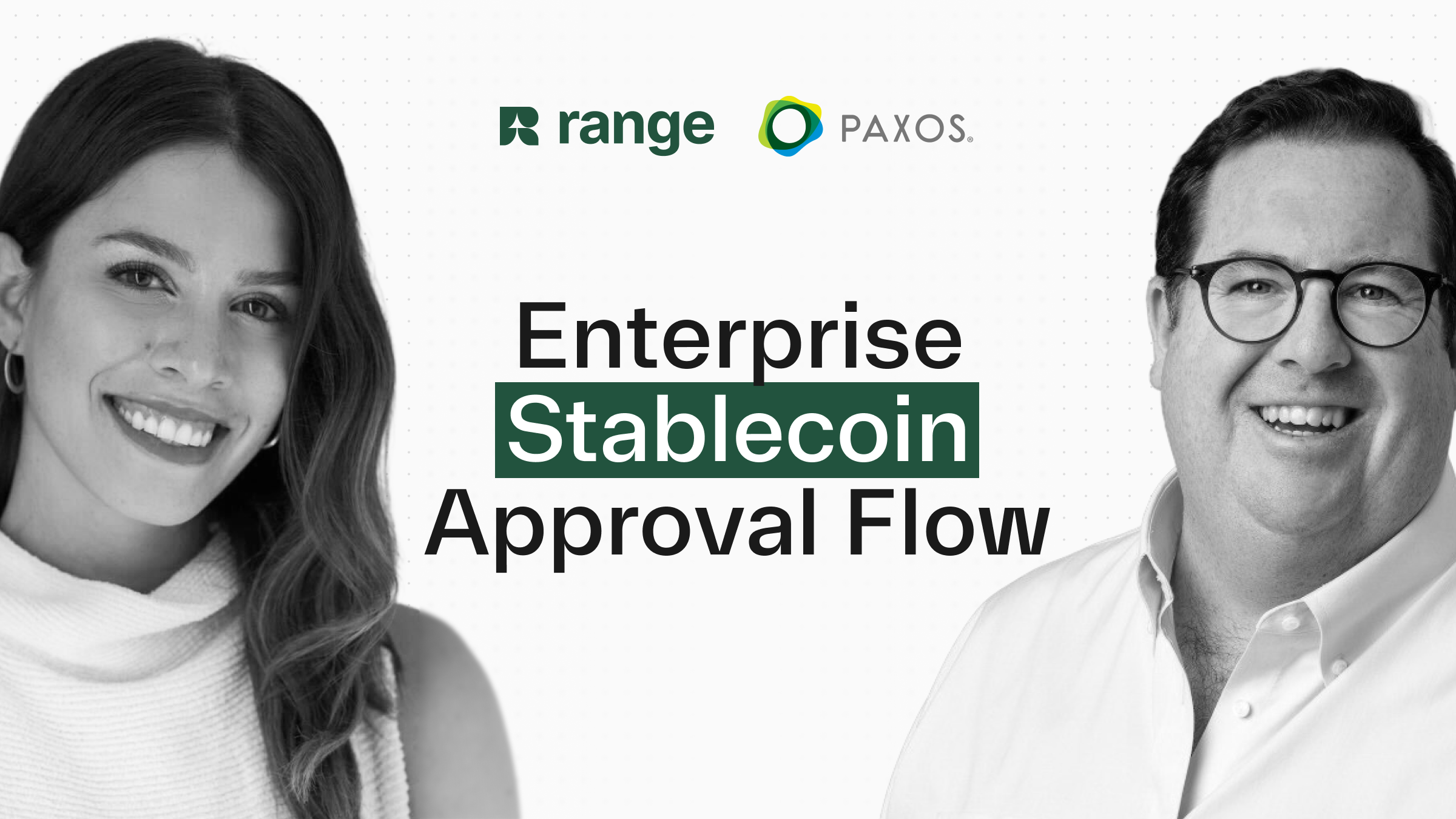
Peter Jonas, Chief Revenue Officer at Paxos, joined Paula Pettit, VP of Strategy and Growth at Range, to explain how those questions surface in commercial conversations. Paxos has issued stablecoins since 2018 and provides infrastructure beneath products including PYUSD and USDG. Peter's tests begin with the problem, the need for custom control or specifications and the company's distribution advantage. Product design determines what happens next.
Range's view adds an operating sequence around those product choices. A company should define its requirements, translate them into financial and transaction controls, orchestrate the risk and compliance providers it already uses, then maintain monitoring, reconciliation and reporting as activity grows. Stablecoin infrastructure can make movement programmable and available 24/7. It does not remove the need for an accountable operating model around the money.
Distribution decides whether a custom stablecoin makes sense
Companies often begin with the asset rather than the problem. They ask how to launch a branded stablecoin before deciding what the asset must do, which controls need to be specific to their business and whether an existing stablecoin could support the first version of the product. That order can turn an experiment into a costly issuance program before demand is proven.
Peter Jonas framed the technical question plainly: "The technical layer is not the hard part." Issuance still requires regulatory standing, reliable reserves, mint and redeem operations and production-grade infrastructure. Paxos provides that underlying infrastructure for its partners. Distribution depends on the company's position in the market and cannot be supplied by infrastructure alone.
Peter Jonas's test for prospective issuers was equally direct: "do you have a distribution advantage?" A large installed network, a strong payments brand or a product with natural transaction demand can create that advantage. A company without one still needs a credible answer for why businesses will hold, move or settle with its asset when working alternatives already exist.
An existing stablecoin can test the use case before the company takes on issuance. The product team can see whether the asset fits the intended use case and whether customers show enough demand for the product. It can then move from an existing stablecoin to a custom asset if customer demand and the utility of the product hypothesis justify the additional expense and resources. Custom issuance becomes the next decision only when the evidence shows that control over the asset or its design will materially improve the product.
Clearer US rules move projects into the teams that will own them
The commercial conversation changed when the GENIUS Act brought greater regulatory clarity to the US stablecoin market. Peter Jonas said, "nobody likes ambiguity and especially regulated organizations." When the regulatory direction was uncertain, companies were cautious about investing in work that could become unusable or costly under a different policy outcome.
Peter described a specific organizational change after GENIUS. Stablecoin use cases moved from hypothetical work inside innovation groups into the traditional finance organizations and departments that would ultimately own them. Companies became more serious about allocating resources and pursuing stablecoin strategies as part of their core roadmaps.
This is where Range's operating view becomes relevant. Once the future owner is in the room, a project needs requirements that connect the product goal to approvals, policy enforcement, records and accountability. Finance, compliance, risk and internal audit will each examine the system through their own responsibilities. Those questions should be treated as Range's recommended readiness model.
For teams using Range, the practical step is to give the accountable executive, finance owner, compliance owner and product owner one requirements document and one control model. That shared model can define who approves activity, which policy applies, how exceptions are handled and where records live. It also gives procurement a defined operating need against which to evaluate an issuer, a network or a custom asset.
Stablecoins are gaining ground where existing rails create clear pain
Peter tied early adoption to use cases with a direct, persistent pain point. Remittances were his clearest example. He also identified cross-border and broader payments, treasury management, crypto on-ramps and off-ramps, and trading liquidity as areas where Paxos sees stablecoin activity.
The common benefit is faster movement of US dollar-denominated value across markets. In cross-border payments and remittances, stablecoins can move value between countries. In treasury and on/off-ramp use cases, they create a direct connection between fiat and onchain markets. Peter said remittances were seeing the fastest uptake because the pain is especially clear.
Atomic settlement could extend the benefit into market infrastructure. Peter contrasted atomic settlement with settlement cycles that take one, two or three days and identified capital efficiency as a major gain. He expects settlement times and capital efficiency to improve as more activity moves onto blockchain rails.
Integration depends on product design
Paxos exposes its stablecoin and brokerage infrastructure through APIs, which can make integration technically quick. Peter's point was that access to the rail does not decide what the product should become. A product manager can treat stablecoin support as a checked box, or use the available capabilities to redesign the service around better efficiency and a better user experience.
That makes integration a design and prioritization problem. Teams need to decide which functions matter, how stablecoin movement changes the customer experience and whether a custom feature is important enough to justify the expense and resources required to issue a new asset. The available infrastructure creates options. Product design determines which options create useful customer value.
This is where Range's view comes in. Every additional token, chain, wallet and provider creates another source of financial data. Range recommends a common transaction model across those sources, clear ownership of balances and a repeatable reconciliation process. Without that foundation, finance teams can be left reconstructing activity from exports and explorers while the product adds volume and routes.
Range also recommends matching treasury controls to the new operating surface. Approval policies, counterparty records, sanctions and fraud checks, transaction limits and escalation workflows should be defined before activity expands. Teams can test the model against a mint, redemption, wallet transfer, failed transaction, exception and month-end close. Weekend events and provider outages help expose dependencies that a normal business-day test can miss.
USDG shares network rewards by contribution
Paxos approaches PYUSD and USDG with the same issuer responsibilities, including one-to-one redemption, reserve management and prudential oversight. Their distribution models differ. PYUSD is a branded stablecoin carrying a major global payments brand. USDG is built around Global Dollar Network, where partners work together to grow a network stablecoin.
The USDG model shares rewards according to each participant's contribution to the network. Paxos has built rewards functionality that can account for assets held in custody and onchain actions that drive value for the network. Instead of relying on monthly wire payments, the model can allocate rewards daily and onchain to partners dedicating resources to the asset's growth.
For Range, this model has a separate operational implication. Contribution records, reward payments, custody balances and onchain activity still need to connect to a company's ledger and reporting. Cross-chain activity adds another reconciliation boundary.
More network stablecoins can coexist with market consolidation
Peter treated Open USD as validation that other market participants also see value in the network stablecoin model. Paxos launched USDG around that model, and he expects more activity around network stablecoins as issuers and partners test ways to allocate rewards for growing an asset.
He also expects consolidation over the next 18 months. Some branded and non-branded stablecoins have launched without gaining meaningful traction, and Peter expects those parts of the market to start consolidating. At the same time, he expects the wider market to keep evolving and to develop more high-utility use cases beyond holding value.
Those views can coexist. New entrants can validate a product structure while individual stablecoins still fail to build enough demand. The same two tests continue to apply: the asset must solve a real problem, and the organization behind it must have a distribution advantage that can carry it into use.
Agentic payments raise the scale requirement
Peter expects buying committees to ask whether payments infrastructure is built for agent scale. Software can initiate transactions continuously and at a frequency that human payment patterns do not produce.
Peter Jonas gave a simple comparison: "if a human does 30 payments a month, an agent could do 30,000." That is a 1000x difference, rather than the 10x increase he said many people assume. It changes capacity planning for APIs, chains, issuers and the payment infrastructure around them.
Availability becomes part of the design. Peter Jonas said, "They don't know what a Sunday is." His readiness questions were specific: can the system operate on the right chain, mint and redeem 24/7, clear the required volume and expose APIs suitable for machine traffic? Those requirements follow from agents operating continuously rather than around business hours.
The existing payments stack has been tested against human demand. Peter Jonas described the gap this way: "the whole stack has been stress tested, but it's been stress tested for the wrong species." Peter Jonas's estimate for meaningful traction was "I would say eighteen to twenty four months." His test for that period is whether companies are built for agent scale across their APIs, chain choice, capacity and 24/7 mint and redeem operations.
Range recommends using the same window to test the control plane around that infrastructure. Treasury controls, reconciliation and reporting should support machine-driven transaction volume without forcing every exception into a manual review queue. Capacity tests should cover policy evaluation, ledger posting and break resolution alongside raw API throughput.
Bringing stablecoins into your stack
The pattern across this conversation is that the hard part of a stablecoin is not issuing it, it is operating it. One dollar can arrive as several tokens across several chains and providers, and someone has to hold, reconcile and answer for all of it as volume grows and agents start moving money 24/7. That operating layer, one view of every token, chain, wallet and counterparty, with the controls, reconciliation and reporting finance and compliance need, is what Range builds for companies working across stablecoins and fiat.
If you are adding stablecoins to your stack, or trying to bring an existing deployment under control, talk to us: See how Range supports stablecoin operations
About Paxos
Paxos is a regulated blockchain infrastructure company that issues and manages stablecoins including PYUSD, USDG and USDP, alongside the gold-backed token PAXG. It is regulated by the OCC in the US, the FIN-FSA in Europe and the MAS in Singapore. Learn more at paxos.com.
Want to appear on Range Stablecoin Fireside? If you are building with stablecoins and want a seat on the show, get in touch by email or on X.
Protect your time and money
Get your unified treasury dashboard in 30 minutes.