Stablecoin Fireside
Altitude: Making stablecoins work inside everyday finance operations
Altitude's Garrett Harper on how programmable accounts can combine global payments, approvals and finance records for companies operating across stablecoins and fiat.
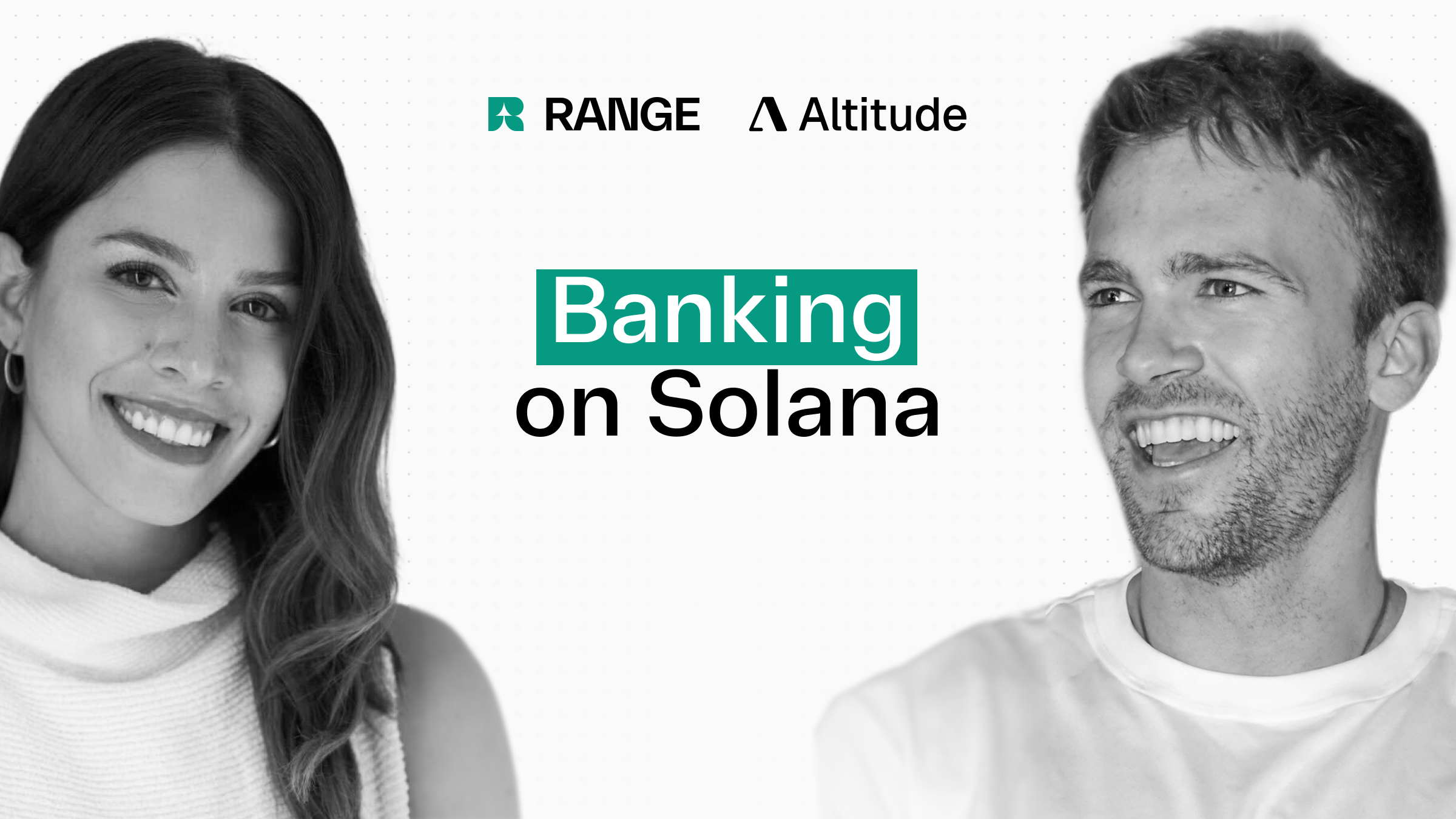
Stablecoins have already changed how quickly companies can move money. The harder question is what happens around the payment: who can approve it, how it reaches a bank account, how finance records it and how a company keeps control as its operations grow. That is the gap Altitude is designed to address. The combination of payment access and operational control determines whether the rail can support routine business activity.
In Episode 14 of Range Stablecoin Fireside, Paula Pettit, VP of Strategy and Growth at Range, spoke with Garrett Harper, who leads partnerships at Squads. Their conversation traced Altitude's development from Squads' smart-account infrastructure into a finance product for companies that use stablecoins alongside ACH, wire, SEPA and SWIFT. It also surfaced a broader operating principle: stablecoin adoption becomes durable when the underlying rail disappears into workflows that finance teams already understand. Local bank access remains uneven and some vendors still require fiat, so the operating account has to accommodate both forms of money without creating separate processes for each.
Altitude puts stablecoins beneath familiar finance workflows
Altitude grew from a clear split inside the Squads user base. Squads had built multisig infrastructure for technical teams securing tokens, program upgrade authorities and other onchain assets. As stablecoin balances grew, those customers wanted to use the same capital for bills, invoices, contractor payments and cash management. The people doing that work were finance and operations leaders with a different set of priorities from the developers managing programs. Harper summarized the product decision plainly: "And it's not just different people. They have very different needs."
That distinction led to a separate interface built on the same smart-account foundation. Altitude removes gas management and wallet prompts from the day-to-day experience, while giving businesses access to stablecoin payments and conventional banking routes. The architecture matters because the account is still programmable at its core. As Harper put it, "We're not built on a bank. Instead, we're built on an onchain programmable account, which is actually on Solana." The result is a finance surface designed around dollars and familiar payment methods, with stablecoins operating underneath. Altitude had been available only since December when the episode was recorded, but Harper said hundreds of teams were already using it for bill pay, SWIFT, ACH and stablecoin payments.
Range's view is that this interface problem sits inside a wider operating model. Range starts with regulatory and reporting requirements, translates them into operational controls, orchestrates the risk and compliance providers a company already uses and then runs monitoring, reconciliation and reporting from the same record. For teams using Range, that sequence provides financial control across stablecoins and fiat. The shared record lets finance answer the same questions for a wallet balance and a bank payment: who sent or received the funds, which policy applied, who approved the movement and how it was recorded. Altitude's example reinforces why the payment account itself also has to meet finance teams where they work.
Payment speed shifts the work to operations
The appeal of stablecoin payments is easy to see in the transaction itself. Funds can move globally without the hours, fees and geographic constraints attached to many bank routes. Yet a faster transfer does not complete the surrounding finance workflow. Teams still need to issue invoices, identify counterparties, track settlement, assign categories and close the books. Harper captured the tension with a line he uses when describing the market: "stablecoins sped up payments, but they slowed down everything else".
That slowdown often appears as fragmented infrastructure. Harper described companies moving between an exchange account, a hot wallet, a bank account and a fintech platform, then reconstructing the activity at month end. Altitude's response is consolidation: "So what Altitude can do is it collapses that from, like, four different logins to one." The product supports both fiat and stablecoin activity, labels transactions for finance workflows and provides a QuickBooks-ready CSV export. Harper also discussed instant accounting sync as an upcoming capability rather than a current one. In the interface, a user can read the balance in dollars and inspect the underlying USDC when needed. That abstraction is important for companies whose vendors may accept different payment methods, because the finance team can choose the rail without reorganizing its entire process around the asset.
For Range, this is the core stablecoin treasury management challenge. A company needs one system of record across every rail, with normalized transactions, matched counterparties and controls that travel with the money. Speed creates value when finance can explain each movement and produce the evidence required for review. The operating layer therefore has to connect payments, reconciliation and reporting, rather than treating the transfer as the finished product.
Smart accounts turn policy into transaction-level control
Altitude's control model begins with multisig infrastructure. Instead of one private key controlling an account, multiple members can be required to approve an action. Harper said each Altitude account is a multisig and described an additional layer in which each member has multiple keys from independent providers, including Turnkey, Privy and a passkey. The user does not have to manage that complexity directly, but the account avoids depending on a single credential or provider. This builds on several years of security work at Squads, including audits and formal verification. Harper framed the design challenge as balancing that security foundation with an experience a CFO can use without thinking like a protocol engineer.
Programmability also allows approval policy to respond to the transaction. Harper described planned thresholds that would require more approvers as payment values rise. His reasoning is direct: "a $10 transfer should not be treated the same as a million dollar transfer." Range's view is that this principle matters for digital asset treasury operations because static permissions force low-risk routine payments and high-value transfers through the same process. Transaction-level rules can preserve speed for ordinary activity while applying stronger review where the exposure is greater.
The same structure creates a measured path toward automation. Harper expects agents to take on more finance work, but he described adoption as a sequence rather than an immediate handoff. "Maybe the agent can't execute it on its own, but it could create the transaction." A later step could let the agent approve while a person retains the final decision. Range's view follows the same control-first logic: automation should operate inside policy-aware, pre-execution transaction controls, with approvals and evidence attached before settlement. That progression gives a finance team a practical way to test automation on recurring payments and activity across multiple entities before granting software authority to complete the full workflow.
Global access is the commercial case
Altitude's model uses stablecoins as a common layer between banking providers in different markets. A provider offering an on-ramp or off-ramp in one country does not need a direct relationship with every provider elsewhere. Altitude can add routes as it finds partners able to accept USDC or USDT and connect users to local banking systems. Harper explained the practical effect: "So because of that, we can work with and expand into new markets much faster."
The product still reflects the mixed reality of business payments. Harper said Altitude offered ACH, wire, SEPA and SWIFT alongside stablecoin transfers, with plans to add more local on-ramps and off-ramps. He described customers paying contractors in South America and elsewhere with stablecoins while continuing to use bank routes for other obligations. Altitude was accessible in more than 150 countries at the time of the conversation, although local fiat access varied by market. Harper contrasted low-cost stablecoin transfers with SWIFT payments that can carry correspondent banking fees, making speed, cost and access the immediate commercial advantages. The value comes from managing both sets of rails from one account instead of forcing a company to choose one.
Solana provides the account layer beneath that model. Harper emphasized the network's long focus on performance, low fees and resilience, as well as the maturity of its developer tooling. His strongest endorsement was also the simplest: "it's just there, and it works." In this context, reliability is a product requirement rather than a blockchain talking point. Businesses need settlement infrastructure that can support routine payments without making the chain itself part of every operating decision.
Altitude's next test is expansion beyond companies already comfortable with stablecoins. Harper pointed to accountants, designers and lawyers that encounter stablecoins through their clients, as well as global importers and exporters already using Altitude. The pattern starts with a payment request, then grows as the company sees the speed and access available through the rail. Harper's ambition is to make Altitude the account those businesses think of at that moment, while keeping the stablecoin mechanics in the background.
Financial control makes stablecoin adoption durable
Range's view is that stablecoins become business infrastructure when global settlement, familiar finance workflows and enforceable controls operate together. Companies need payment speed, but they also need a unified record, clear approvals and reporting across stablecoins and fiat. See how Range supports stablecoin operations.
About Altitude
Altitude is a financial operating platform from Squads that combines business accounts, stablecoin and bank payments and finance workflows in one product. It supports global transfers, stablecoin on/off ramps, bill pay and accounting-ready transaction records. Learn more at altitude.xyz.
Want to appear on Range Stablecoin Fireside? If you are building with stablecoins and want a seat on the show, get in touch by email or on X.
Protect your time and money
Get your unified treasury dashboard in 30 minutes.