Stablecoin Fireside
DFNS: Taking institutional wallet infrastructure into production
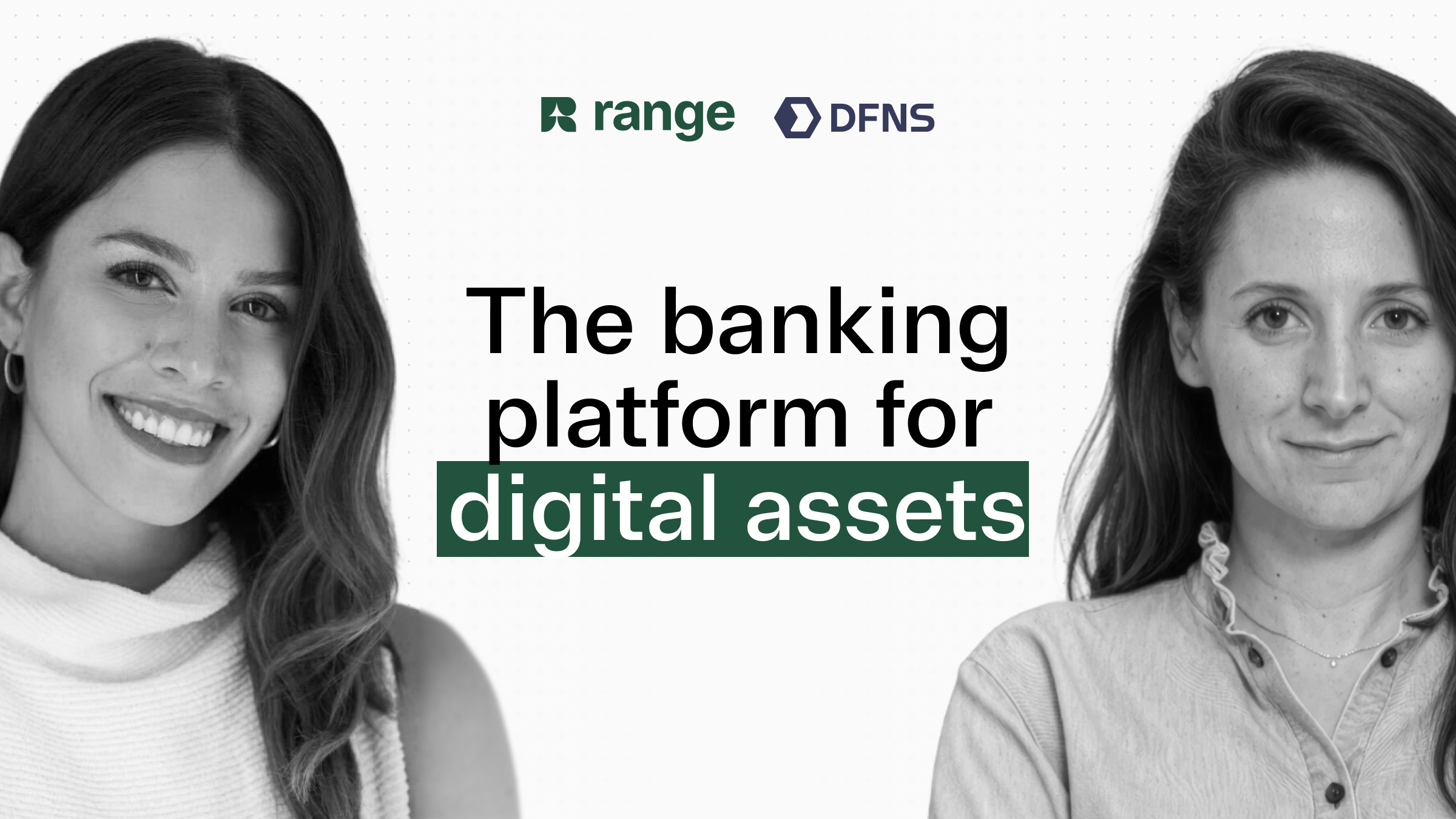
DFNS CEO Clarisse Hagège on why banks and fintechs need wallet, policy and treasury infrastructure that can run in production.
From experimentation to production rails
Clarisse Hagège came to blockchain through more than a decade in banking, where her work ranged from equity research and wealth management to trade finance. An early attempt to build a cross-border remittance application between the US and Mexico gave her a closer view of the technology, even though the market was too early to support the product. By 2019, after working with a blockchain company in a bank accelerator, she left banking to build Dfns.
That background shaped the company's direction. Hagège was interested in using blockchain to improve how capital moves across the world, rather than building another product for crypto investment. Dfns therefore began as API-first infrastructure that other teams could use to build financial applications. The choice anticipated a market in which banks, payment service providers and fintechs would need blockchain rails inside their existing products and systems.
The thesis arrived well before broad institutional demand. Dfns had to keep building through several cycles while prospective buyers worked out where blockchain belonged in their businesses. The uncertainty was about market timing rather than the underlying need for wallet infrastructure. In 2020, Hagège thought Dfns was already late and wanted the company to move quickly, then watched institutions continue to research and test before committing production volume. Hagège said, "Truth is, you know, the industry has really matured over the past year and a half." She identified Stripe's acquisition of Bridge, the US election and a developing regulatory framework as signals that payment companies and banks were moving closer to production.
The shift is visible in the questions institutions now ask. Earlier projects kept digital assets contained in a separate environment. Current conversations focus on how digital asset and traditional financial rails communicate, because both will coexist. In 2023, Dfns focused its roadmap on financial use cases and the fintechs bringing blockchain into a broader payments setup. That positioned the company for payment providers starting cross-border remittance products and banks moving from innovation and proof-of-concept work into production. Hagège framed the change directly: "Today is how do we become blockchain compatible? What is the easiest way?" That is a transformation question, with business leaders involved and production outcomes replacing exploratory proofs of concept.
MPC as institutional operating infrastructure
Dfns began with a concern about concentrating private keys in one place. Hagège saw a contradiction in using decentralized financial networks while recreating a central point of failure in key storage. Multiparty computation, or MPC, offered a different structure: the cryptographic process could distribute participation in key generation and signing, so one party did not need to hold the complete private key. Hagège said other providers used MPC in a co-custodial model, distributing shares among multiple parties that came together to authorize a transaction, similar in operating effect to a multisig.
The important decision was how to turn that cryptography into an operating model. Dfns initially considered a decentralized network for key storage, then retained MPC as it refined the product around institutional use. Hagège considers the technology particularly well suited to high-volume environments where many transactions must be signed within a limited period. Dfns designed its product so a bank or payment company employee does not need to keep a private key or key share on a phone. Hagège's rule is concise: "You should never merge the application and the storage layer." Separating the interface from the storage layer gives institutions a clearer security boundary while preserving the ability to authorize transactions through their applications.
For a bank, scalable key management also has to account for ordinary organizational change. Employees move roles or leave, authorization groups change and transaction volumes increase. Rebuilding the signing setup whenever that happens creates operational friction. Hagège reduced the requirement to three words: "You need to scale." In her view, the architecture should support many authorized employees signing transactions without requiring a new key ceremony every time a team changes.
Range's view is that custody architecture becomes operational infrastructure once a digital asset treasury reaches production. The cryptography, permissions and transaction controls must work as one system, while finance, security and compliance teams retain a clear record of who could approve what. That operating record also has to survive changes in personnel, transaction volume and the mix of rails used by the business. For teams using Range, the record extends across wallets, custodians, exchanges and bank accounts, giving multi-custody treasury management the same control context across stablecoins and fiat.
Dfns stays on the infrastructure side
Dfns made a second structural choice: it would provide technology without becoming the regulated counterparty to its own customers. The decision carried an immediate commercial tradeoff. Hagège recalled a board discussion in which a regulated payment provider wrapping Dfns technology appeared to generate far more revenue in a short period, creating pressure to move into the same layer. The comparison made the near-term opportunity concrete, but it did not change Dfns's view of its core competence or the market it wanted to serve.
She returned to the problem Dfns was built to solve. Regulation and margins can change, and operating a regulated financial service requires a different set of competencies. More importantly, combining infrastructure and financial services can make a provider compete with the companies building on its platform. As Hagège put it, "it was always very weird to offer a platform for clients and then compete with them because some people do that."
Clear responsibilities became part of the trust model. Dfns supplies programmable wallet infrastructure, while its clients remain responsible for the regulated products and services they deliver. That division also keeps Dfns focused on the capabilities shared across customers instead of building a financial service for one vertical. Hagège said that customers value the fact that "there's very clear boundaries on what we do, what they do." For banks and large payment service providers, that separation provides confidence that the infrastructure company is not shaping its product around a competing custody or payments business.
Range sees the same principle in the wider operating stack. A stablecoin operating layer should orchestrate the risk and compliance providers a company already uses, not obscure their responsibilities or replace regulated decision makers. Range starts with regulatory and reporting requirements, translates them into operational controls, orchestrates existing providers, then runs transaction monitoring, reconciliation and reporting from the resulting record. Clear boundaries allow each provider and internal team to be accountable for its part of the system.
Banks and fintechs converge on programmable control
Banks and crypto-native fintechs enter the market at different speeds, but Hagège sees a shared product requirement. Both want infrastructure they can embed into existing or evolving systems, with enough programmability to support their own applications. Hagège explained, "Fast go to markets, they all want solution that they can embed, programmable solution that can embed with existing infrastructure or infrastructure that is evolving." The implementation context changes, while the need for an adaptable core remains.
Large financial institutions bring established authentication, policy and electronic banking systems. They expect new blockchain infrastructure to fit those controls rather than require teams to recreate them. Authentication has to connect with systems already running, and transaction rules have to respect controls the bank has already vetted. In Dfns's bank due diligence, permissions and policies receive the deepest scrutiny because they determine how an institution keeps authority over a transaction from its initial intent through signing and onchain broadcast.
Fintechs put more immediate pressure on feature coverage, chain support and performance because their volumes can grow faster. Banks move through longer evaluation and production cycles, but expect the infrastructure to accommodate their existing control frameworks. Despite those differences, Hagège said the use cases increasingly overlap. Work completed for one group can strengthen the same programmable foundation used by the other.
The production data shows increasing use at scale. Hagège reported that Dfns moved from $5 billion in monthly volume in June to more than $10 billion in July, alongside growth among bank clients. For Dfns, that increase matters because customer count alone cannot prove that the infrastructure will perform at meaningful volume. The company also grew from 30 people at the end of the previous year to 51, while Hagège emphasized the need to grow with the market rather than ahead of it. She pointed to payment providers acquiring crypto-native fintechs, and to bank interest in payments, corporate treasury, tokenized collateral and digital cash. Transaction banking teams are starting to consider corporate treasury management alongside tokenized deposits and other forms of digital cash. Range's view is that these use cases require a unified operating record: stablecoin treasury management cannot sit apart from bank accounts, policy, reconciliation and reporting when both rails support the same business.
Build the operating layer across stablecoins and fiat
Dfns's experience shows that institutional adoption depends on infrastructure that can fit existing controls, scale with transaction volume and preserve clear responsibility between providers and regulated firms. Range gives finance and compliance teams one control layer across those rails, from requirements and policies through monitoring, reconciliation and reporting. See how Range supports stablecoin operations.
About DFNS
DFNS provides core banking infrastructure for digital assets to banks, fintechs and other businesses. Its platform includes wallets, transaction and treasury management, tokenization, workflows, policy controls, governance and key management. Learn more at dfns.co.
Want to appear on Range Stablecoin Fireside? If you are building with stablecoins and want a seat on the show, get in touch by email or on X.
Protect your time and money
Get your unified treasury dashboard in 30 minutes.