Stablecoin Fireside
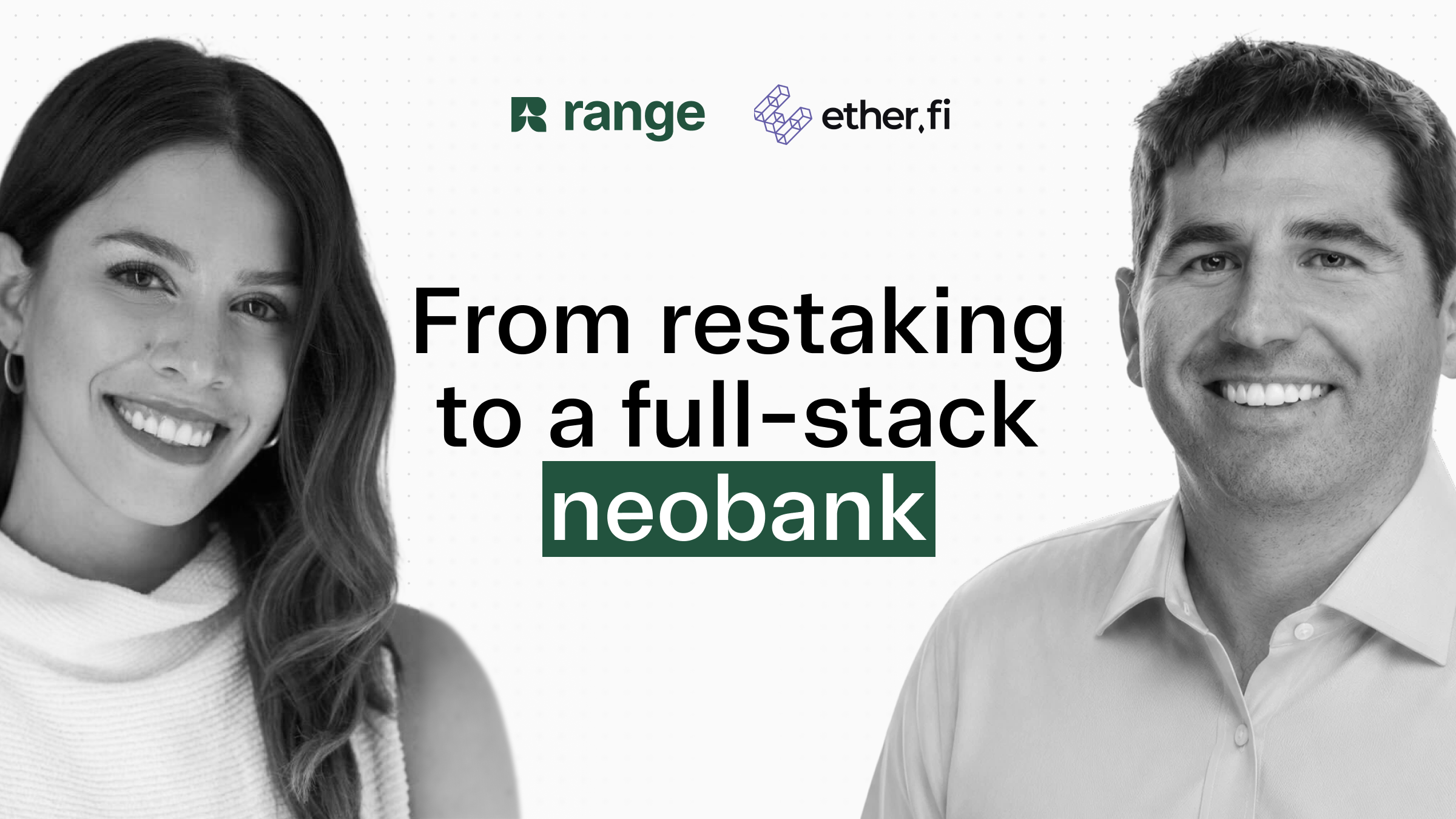
ether.fi: Building an everyday account from onchain finance
ether.fi's Rok Kopp on how staking distribution grew into an account for holding, earning and spending across crypto and fiat.
A restaking wedge became distribution
ether.fi did not begin with a finished neobank blueprint. Rok Kopp, Co-Founder and Chief Growth Officer at ether.fi, described a team entering crypto as Terra Luna and FTX collapsed, then looking past trading toward the utility of blockchain infrastructure. Kopp later contrasted the team's long-term company-building mindset with founders who launch a token, secure liquidity and stop innovating. The first opening was staking. Lido had already demonstrated demand and scale, while a market full of liquid staking tokens left room for a product with a distinct return profile.
The team met EigenLayer at ETHDenver in 2023 and spent roughly six months building toward a fall launch. Initial total value locked stayed in the low tens of millions before liquid restaking found product market fit. From December 2023, Kopp said deposits grew at roughly 10% a day for a period. Kopp captured the pace of that growth: "The compounding was crazy." The shift was visible in the unit economics of demand: in June, 100 ETH felt like a major staking target; by January, approximately 100 ETH was arriving every second.
Pendle supplied the moment when that growth became legible. A pool launched in December 2023, fixed returns in the high teens drew funds and the yield-token side also produced strong returns. That combination reached retail users and professional capital at the same time. It gave ether.fi deposits from both retail users and funds. The broader staking product later provided the distribution for liquid vaults, and the card followed as a natural continuation.
Kopp connected that expansion to the time required to build a durable company. The team originally considered a ten-year vest, an unusually explicit signal that it expected the work to continue beyond a token launch or one market cycle. Range's view is that distribution becomes strategically valuable when a company can turn it into a broader operating relationship. For stablecoin treasury management and consumer finance alike, that means giving users a reason to keep assets in the product, move them and understand what happens across each rail.
The card depends on the full product suite
ether.fi now organizes its offer around three products. Stake is the place for assets a user wants to hold. Liquid introduces vault strategies with more risk and a higher return profile. Cash makes those balances spendable. The familiar bank-account analogy matters because the products are designed to reinforce one another: holding creates the balance, vaults create additional uses for it and the card brings that balance into daily activity.
That structure also answers the economics of a crypto card. Kopp said, "Doing a card in and of itself, you have to get to massive scale to make it make sense." Customer acquisition is expensive and interchange alone does not recover that cost quickly. Kopp said a standalone card offers limited differentiation. Within ether.fi, its purpose is broader. Spending makes the product useful in the physical economy, while the staking and vault products support the wider customer relationship.
The strategy follows the team's earlier expansion from staking into liquid vaults. Kopp framed distribution as the advantage that allowed ether.fi to make an existing vault concept land with users. Cash was the next extension, since spending turns a portfolio product into something closer to a primary financial account. The company is therefore competing for frequency as well as assets: a successful card creates repeated use, while the rest of the suite carries the economics. That product cadence has continued through a weaker market because the team sees the opportunity as a financial institution built over years, not a feature completed in one cycle.
Range's view is that this shift changes the operating requirement. Range starts with regulatory and reporting requirements, translates them into operational controls, orchestrates the risk and compliance providers a company already uses, then runs monitoring, reconciliation and reporting from the same record. A product that joins an onchain portfolio to fiat settlement needs that control layer to follow the transaction across both environments without losing context.
Stablecoins connect balances to everyday spending
The ether.fi Cash flow begins with an account application, including proof of address, a liveness check and identification in an approved country. The user receives a digital card that can be added to Apple Pay or Google Pay, with a physical card available as well. Card issuance runs through Rain and Visa. At the same time, ether.fi creates a vault that functions as the user's account and holds the assets available for spending.
Transactions are recorded onchain through Optimism and balances are deducted in real time. In direct pay mode, the card behaves like a debit card funded by stablecoins in the vault. This is the practical role stablecoins play in the product described by Kopp: they give the user an onchain balance that can fund a conventional card purchase, while the transaction remains visible onchain.
Borrow mode changes the source of the payment. A user can supply Bitcoin, ETH or a position in an ether.fi liquid vault as collateral, then borrow against it at 4%. Kopp described borrowing of up to 50% against a liquid Bitcoin position as an example. The credit is overcollateralized, there is no 30-day float and no separate loan origination step. "You start paying interest immediately if you're borrowing." Rok Kopp contrasted that structure with US credit cards, where unsecured borrowing commonly carries a much higher rate and users often repay after a monthly grace period. The benefit is access to spending power without selling the collateral, paired with limits intended to reduce liquidation risk.
Custody and access are split by product. The stake and liquid products are open DeFi products without KYC, while use of the card requires KYC and is limited to supported countries. Kopp described the custody model: "Again, we don't take custody of these assets." For teams operating across stablecoins and fiat, Range's view is that the customer experience depends on preserving a trustworthy record as value moves between a self-directed onchain balance, a card network and fiat settlement.
The long-term bet is Ethereum as a global ledger
ether.fi's roadmap centers on bringing more assets into the account, making fiat on-ramps and off-ramps easier and expanding borrowing. Kopp described incoming fiat, outgoing wires and support for more assets as the practical work required to let users run more of their financial lives through one product. The goal is a mobile account that travels, rather than a new local bank account for every country where a user needs to pay a bill.
The currency thesis is more specific than a general prediction that crypto replaces fiat. Kopp said the US dollar remains the dominant global currency, particularly through stablecoins. ether.fi is designed to support other ERC-20 assets as demand changes, but the infrastructure bet sits below any single currency. Rok Kopp said "what we're betting on is that Ethereum will be the global ledger." If assets and transactions settle there, a crypto-first financial account can serve users across borders without depending on one asset winning permanently. Kopp used the example of people moving from an inflationary local currency into US dollars onchain to preserve purchasing power, while leaving room for demand to move toward other currencies later.
Adoption still depends on access. Kopp said, "I think the biggest thing is getting money in." He sees an easier case for self-custody in countries where people have low trust in financial institutions, because the need is already clear. He said the harder adoption challenge is in markets with high trust in financial institutions. As Rok Kopp put it, "The actual function of the blockchain is super valuable."
The competitive benchmark follows from that ambition. ether.fi looks toward Nubank, Chime and Revolut, established neobanks moving from traditional finance into crypto. ether.fi is moving in the other direction, starting crypto-first and building toward the same category of primary financial relationship. Kopp also expects competition among emerging financial institutions to benefit end users through better products and aggressive customer acquisition. Range's view is that this convergence raises the standard for digital asset treasury and stablecoin operations. The winning product has to make complex rails feel coherent while keeping custody, compliance, settlement and reconciliation explicit underneath. That standard includes protecting funds as the industry matures, a need Kopp tied to the continued prevalence of hacks and scams.
Control is part of the financial product
ether.fi's argument is that onchain finance becomes useful when holding, earning, borrowing and spending work as one system.
Range's view is that the same integration must extend to financial controls: requirements become policy, policy governs transactions, existing risk providers stay connected and every movement feeds one record for monitoring, reconciliation and reporting.
See how Range supports stablecoin operations.
About ether.fi
ether.fi offers personal and business accounts for holding, earning, borrowing, spending, trading and sending digital assets. Its products include an account, card and onchain earning and staking services. Learn more at ether.fi.
Want to appear on Range Stablecoin Fireside? If you are building with stablecoins and want a seat on the show, get in touch by email or on X.
Protect your time and money
Get your unified treasury dashboard in 30 minutes.