Stablecoin Fireside
Fhenix: Keeping stablecoin settlement confidential and composable
Fhenix's Carter Woetzel on using fully homomorphic encryption to keep stablecoin activity confidential without cutting it off from DeFi.
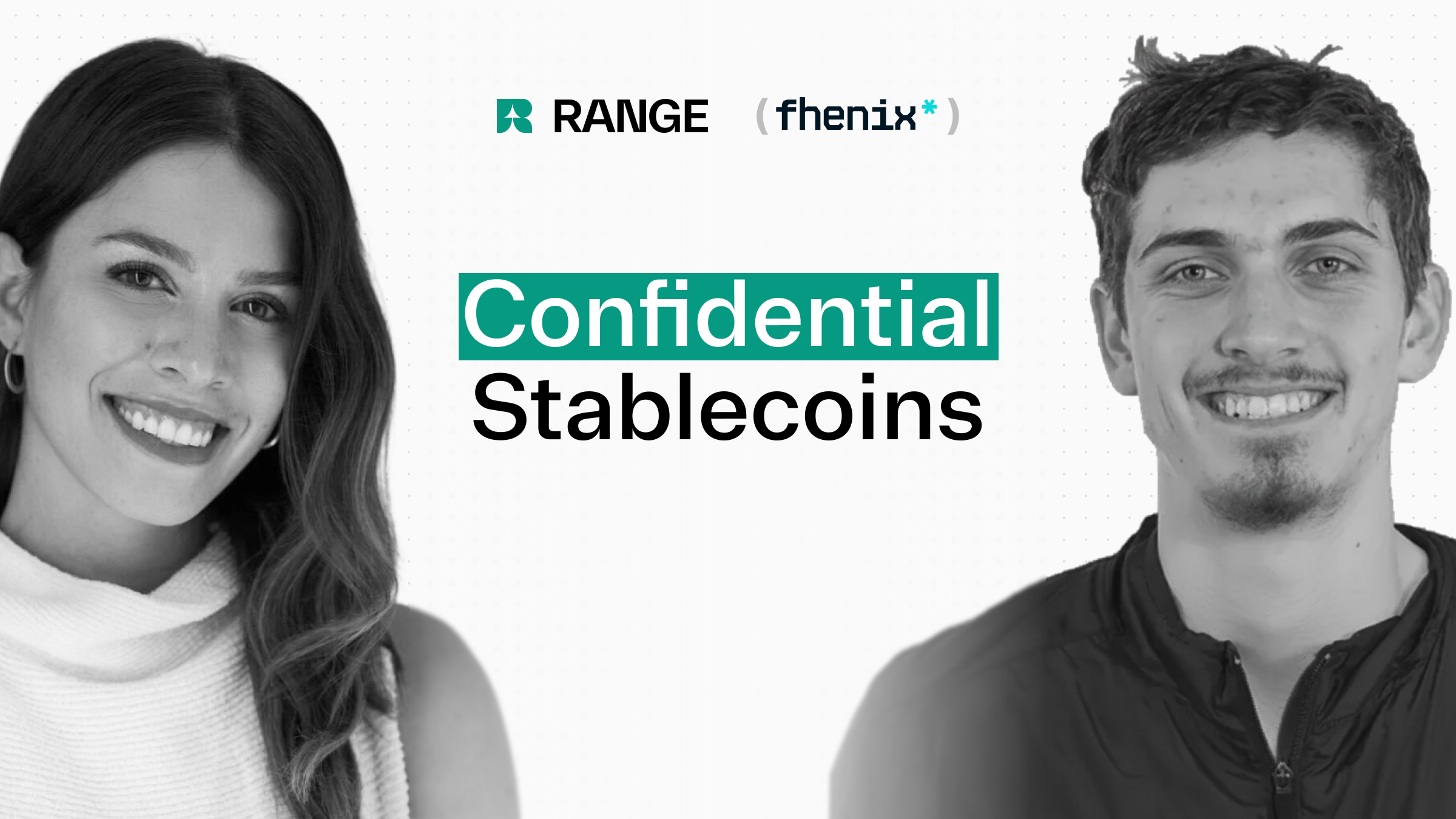
Carter Woetzel, Head of Business Development at Fhenix, joined Paula Pettit, VP of Strategy and Growth at Range, for Episode 15 of Range Stablecoin Fireside. His route to Fhenix ran through building an encrypted DeFi suite at Shade Protocol and leading North American business development at MakerDAO and Sky, where he helped bring USDS to Solana and Base. That experience puts stablecoin design, institutional requirements and privacy infrastructure in the same conversation.
The discussion starts with a constraint that has become harder to ignore. Smart contract activity is public by default, including balances, counterparties, settlement details and the financial logic embedded in applications. Range's view is that the next phase of adoption requires companies to control which data is public, which data remains confidential and who can access it.
Range's view is that confidentiality becomes useful when it fits the wider operating model. For companies operating across stablecoins and fiat, Range starts with regulatory and reporting requirements, translates those requirements into operational controls, orchestrates the risk and compliance providers a company already uses, then runs transaction monitoring, reconciliation and reporting from the same record. Privacy is one part of that control structure, alongside visibility, policy enforcement and evidence.
Confidentiality becomes an institutional requirement
Woetzel described the underlying issue in direct terms: "We believe that in order to truly onboard hundreds of millions of users, there has to be some degree of data privacy." The point is practical. Payroll, procurement, treasury activity, liquidation thresholds and settlement instructions can all expose commercially sensitive information when they are written to a public blockchain.
His view has remained consistent since his earlier work on confidential products, but the market around it has changed. Privacy was once treated as an optional feature or a longer-term research problem. Woetzel now hears institutions place confidentiality alongside the requirements their customers are already asking them to address. As he put it, "The biggest transition, though, I've seen from 2020 to, let's say, 2023 to 2026, these kind of three year increments, is that now there is starting to be compressed and urgent demand for privacy."
Competition is helping turn that demand into product decisions. Woetzel said institutions entering crypto are looking for an advantage beyond their existing distribution and customer relationships. Optional confidentiality on an onchain real-world asset can become one such distinction, particularly when multiple tokenization platforms otherwise offer similar access to public rails. Range reads this as changing the partner conversation from a broad endorsement of privacy to a specific product question: which fields should remain private, and can the asset keep the utility that made issuing it onchain valuable?
Range's view is that the requirement should be specified before a privacy architecture is selected. A company needs to define the business data that must remain confidential, the parties allowed to disclose it and the controls that still need to run before settlement. That framing keeps privacy connected to operating policy rather than treating it as an isolated cryptographic feature.
Fhenix moves encrypted computation into a coprocessor
Fhenix's approach centers on a coprocessor that can perform logic across encrypted data for EVM smart contracts. In Woetzel's example, an onchain contract can hold encrypted values associated with addresses, while the offchain coprocessor performs a calculation and updates the underlying state without seeing the plaintext. The encrypted state remains on a public blockchain while the data being processed stays confidential. Woetzel contrasted this model with privacy systems that require activity to move to a separate layer or chain. Fhenix is intended to bring confidential computation directly to public blockchains.
That separation is designed to reduce the work required from application developers. Woetzel said Fhenix had more than 25 design partners and builders using the system at the time of the conversation. He attributed the inbound interest to a Solidity library that hides the cryptographic complexity: "We've abstracted away all of the complexities of fully homomorphic encryption, all the lattice based math mathematics."
The same simplification shapes Fhenix's answer to a common adoption objection. Teams often assume confidentiality adds a large engineering project to an existing application. Woetzel said the core token extension can be added with a limited amount of Solidity and a small amount of interface work. His shorthand was clear: "You can add in confidentiality with 25 lines of code."
Woetzel also separated the major privacy technologies by the jobs they perform. In his account, zero-knowledge proofs are strong when an application needs to prove something without revealing the underlying information. Trusted execution environments can provide a faster route for less sensitive workloads, with hardware trust as the tradeoff. Fully homomorphic encryption is suited to applications that need computation across shared encrypted state. Range's view is that this distinction matters for any stablecoin operations or digital asset treasury workflow: the right primitive follows from the data, computation and disclosure policy the business needs.
Confidential settlement has to preserve DeFi composability
When Fhenix asks institutions what they want to keep private, Woetzel said the immediate answer is settlement. Advanced applications such as confidential lending, credit lines and derivatives remain part of the design space, but the current institutional request is narrower. In his words, "And the answer is resoundingly settlement."
That request comes with a second condition. Institutions want tokenized assets to remain usable across protocols such as lending markets, exchanges and other DeFi applications. Woetzel argued that wrapper-based confidential token models create a poor experience because users must move between an original token and a separate private representation. The additional contract can also limit composability with the wider DeFi market.
Fhenix is working on a dual-balance token model intended to keep confidential and non-confidential balances within one ERC-20 design. Woetzel said the extension adds roughly 25 lines of code and lets a holder move between the two modes while keeping the asset compatible with DeFi. He reported that this combination, confidentiality without a separate wrapper contract, was resonating in institutional conversations. He also said selective disclosure was already part of the design, while the exact expectations from regulators remained an open question.
The boundaries are equally important. Woetzel explained, "Confidentiality is when you protect the body of the message, the the content of the actual, like, transaction. Anonymity is where you're actually hiding sender and receiver." Fhenix supported confidentiality at the time of the episode and was planning to add anonymity after further work on throughput and regulatory clarity. He also connected that future capability to agentic finance, where software agents may want to protect payment details, treasury movements and the strategies they execute through sub-agents. Range's view is that finance and compliance teams should keep those requirements separate. Protecting transaction content, controlling identity disclosure and screening a transaction are distinct policy decisions, even when they sit in the same settlement flow.
Stablecoin design starts with liabilities and liquidity
Range reads Woetzel's discussion of stablecoin primitives as a reminder that confidentiality does not repair an unsound balance sheet. He described stablecoin issuance as a form of underwriting. An issuer accepts an asset and creates a liability that holders expect to redeem, which makes the quality and liquidity of the backing central to the design.
That standard goes beyond checking whether assets exceed liabilities at a point in time. Woetzel emphasized the volatility of the backing asset, the depth of available liquidity and the behavior of the balance sheet during a concentrated wave of redemptions. Those questions determine whether a peg can survive stress. They also explain why a design that scales quickly in favorable conditions can fail when confidence and liquidity contract together.
Woetzel traced an industry progression from algorithmic models toward overcollateralized systems, followed by yield-bearing structures backed by assets such as existing stablecoins or treasuries. He acknowledged that early experiments often applied weak financial logic, including work he participated in. His conclusion was concise: "sound financial logic is what has survived and persisted, and, that's been the biggest change." He pointed to a stablecoin system that processed a full unwind and later grew again as evidence that solvency under redemption pressure is a more useful test than growth alone.
Range's view is that this balance-sheet discipline must carry into stablecoin treasury management. Companies need a single record across reserves, liabilities, custodians, bank accounts and onchain positions, with controls derived from regulatory and internal policy. Reconciliation, counterparty intelligence and pre-execution enforcement then support the same outcome: knowing where value sits, what obligation it backs and whether the next movement can proceed within policy. This is also where privacy and financial control meet. Confidentiality can protect sensitive settlement data while the operating record still supports approvals, investigations and reporting. The data does not need to be public to everyone for the right parties to remain in control.
Put confidentiality inside the operating model
Fhenix's argument is that confidential settlement can become practical without severing assets from DeFi, while sound issuance still depends on liquidity, solvency and clear redemption obligations. Range's view is that companies should connect privacy to the same requirements, controls, provider orchestration and financial record that govern every other transaction: See how Range supports stablecoin operations.
About Fhenix
Fhenix builds confidential DeFi infrastructure for EVM-compatible blockchains using fully homomorphic encryption. Its CoFHE coprocessor lets smart contracts process encrypted data while values remain confidential. Learn more at fhenix.io.
Want to appear on Range Stablecoin Fireside? If you are building with stablecoins and want a seat on the show, get in touch by email or on X.

Protect your time and money
Get your unified treasury dashboard in 30 minutes.