Stablecoin Fireside
M0: Why fintechs want control of stablecoin infrastructure
M0 Chief Strategy Officer Joao Reginatto on why fintechs may choose custom stablecoins and how shared infrastructure can preserve liquidity and issuer choice.
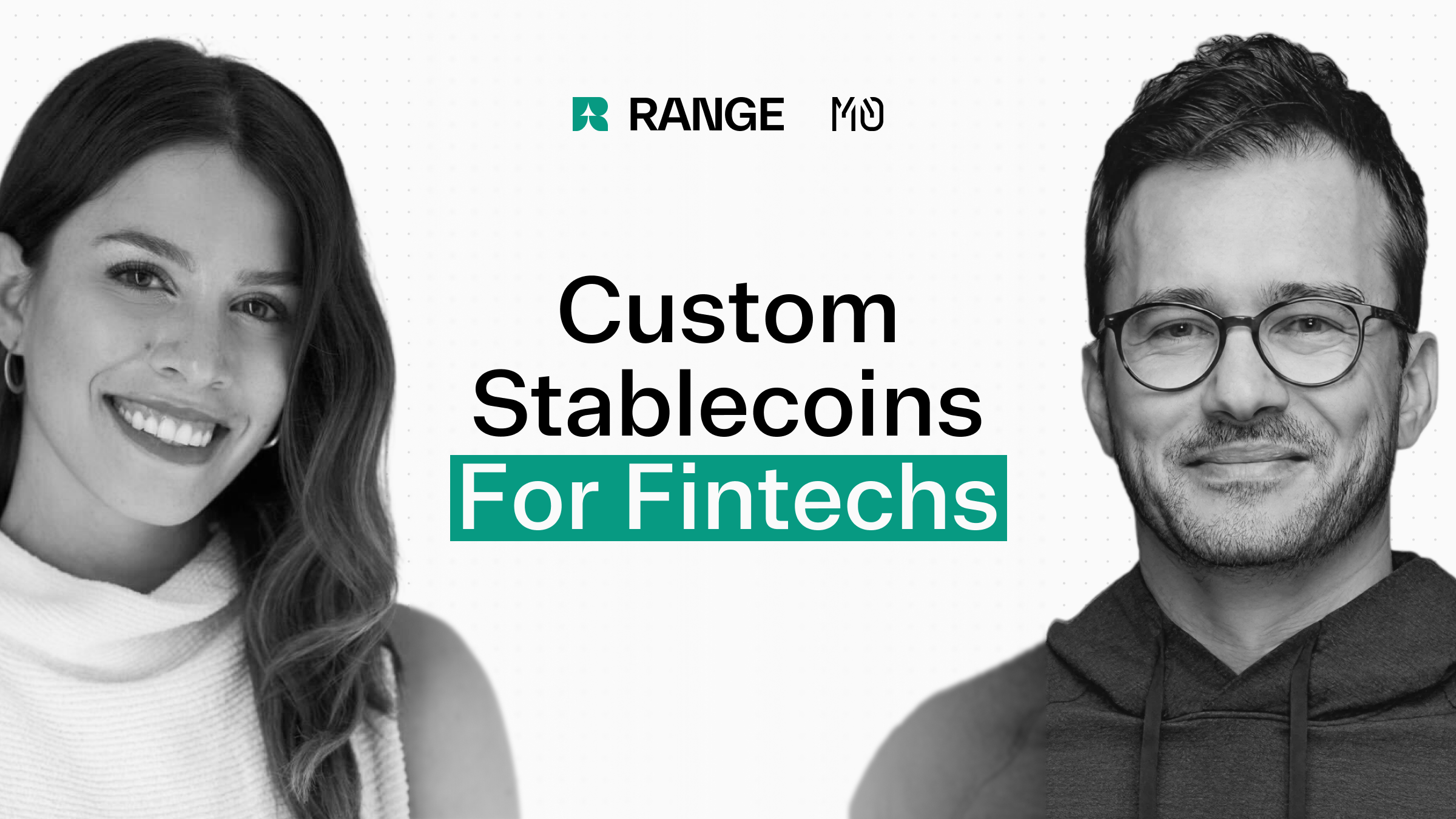
Stablecoin growth has largely been defined by general-purpose assets: digital dollars designed to work across exchanges, applications and blockchain networks. Joao Reginatto, Chief Strategy Officer of M0, sees another model emerging alongside them. In a conversation with Paula Pettit, VP Strategy and Growth at Range, he explained why more fintechs and financial institutions are exploring stablecoins designed for their own products and users.
Reginatto joined M0 in 2023 after eight years at Circle, where he led the buildout of USDC. That experience shaped his view of the relationship between issuance and distribution. When Binance introduced BUSD, moved users away from USDC and grew the asset beyond $20 billion in supply, the episode clarified where leverage sat. As Reginatto put it, "we don't own these use cases." An issuer can build the asset, but the applications with direct customer relationships decide which asset their users encounter.
A custom stablecoin is infrastructure for a specific ecosystem
Reginatto distinguishes general-purpose stablecoins from the assets that brands and applications increasingly want to create. USDT and USDC need to serve many different contexts, so their onchain functionality remains deliberately narrow. Much of their value comes from representing dollars on blockchain rails, where users can transfer value quickly across applications and networks.
A company launching its own stablecoin usually has a different objective. Its focus is the financial component inside a product it already operates, rather than exchange listings or competition with the largest issuers. Reginatto summarized the purpose: "Usually, they wanna build a stablecoin to facilitate the infrastructure within their ecosystem." That purpose changes the design brief from broad acceptance to specific behavior.
The opportunity comes from making the asset configurable. A product team might define who can hold it, constrain transfer behavior or decide how yield generated by the asset is allocated. Reginatto compares this with the way fintechs build product behavior over bank accounts and payment rails. Stablecoins can bring the underlying dollar and the application logic closer together. Reginatto described the gap directly: "People talk a lot about programmability. There's not a lot of people programming these assets."
That model still asks builders to manage smart contracts, blockchain-specific languages, APIs and private keys. Reginatto identified developer accessibility as the main condition for custom stablecoins to move from dozens of applications to hundreds or thousands. Better tooling has to reduce that technical burden while preserving the ability to define how the asset works. Range's view is that greater configurability also raises the standard for operating control. A company must start with its regulatory and reporting requirements, translate them into transaction controls, orchestrate the risk and compliance providers it already uses, then run monitoring, reconciliation and reporting from the same record. That sequence turns a programmable asset into financial infrastructure that finance and compliance teams can operate with confidence.
M0 separates product behavior from regulated issuance
Traditional stablecoin-as-a-service models often combine the technology provider and issuer. The same provider builds the token, holds the reserves and handles minting and burning. M0 takes a different approach. Reginatto stated the architectural choice plainly: "We have decided to break this model into two." The application defines the stablecoin and its behavior, while a regulated issuer performs the narrower issuance function.
On the application side, M0 helps a team specify transfer rules, minting and burning behavior, holder access and the treatment of yield. The company can continue changing that functionality as its product develops. M0 also supports issuers, and its shared framework lets an application connect its stablecoin to an issuer using the same technical standard.
The issuer then holds reserves, mints and burns tokens and distributes the asset to the application. Reginatto described this as an unbundling of the functions required for a stablecoin to exist. Product functionality remains with the company that owns the use case and distribution, while the regulated entity remains responsible for issuance. This gives each participant a clearer role without requiring the application to become the issuer on day one.
For Range, the separation is operationally significant. Stablecoin treasury management has to connect token behavior with reserve relationships, approvals, counterparties and reporting obligations. A stablecoin operating layer also needs to preserve a consistent control record as those responsibilities move across providers. Clear technical boundaries help, but finance teams still need one view of balances and transactions across their stablecoin and fiat accounts.
Shared orchestration addresses liquidity fragmentation
A purpose-built stablecoin starts without the installed user base of a general-purpose asset. Many users already hold USDC or USDT, so a new stablecoin needs a conversion path. M0's onchain orchestration product is designed to provide liquidity between a newly issued asset and those established stablecoins. It also supports interoperability among stablecoins built through the M0 framework.
Within a single issuer, M0 can facilitate a swap by burning one stablecoin and minting another against the same reserve base. Reginatto explained the mechanism: "Without liquidity, you can actually destroy one stablecoin to recreate the other stablecoin." Because the issuer already controls the shared reserves, the conversion does not require a separate pool of market liquidity for every pair of assets.
Interoperability across different issuers requires another step. The issuers must exchange collateral in the backend when an asset issued by one is converted into an asset issued by another. M0 has built technology for that process, but Reginatto was explicit about its current status: "We have the technology for that. It's not live. It's not turned on yet" because the company is waiting for further compliance rulemaking and legislation. The distinction matters. Same-issuer interoperability is available through the model he described, while cross-issuer interoperability remains a future capability.
Reginatto expects more applications and more issuers to enter the market, which will introduce fragmentation at both layers. His assessment was direct: "It will get messy" as the industry works toward interoperable, open standards. Range's view is that this fragmentation makes a unified operating record more important. Finance teams need continuous visibility across wallets, custodians and bank accounts, with pre-execution transaction controls and reconciliation that follow value across rails.
Control and optionality should shape stablecoin strategy
For a company assessing its stablecoin strategy, integrating an existing asset has obvious advantages. General-purpose stablecoins are liquid, broadly adopted and accessible through established blockchain rails. They are also faster to integrate because the company does not have to design and operate its own asset. Reginatto's challenge is to examine the other side of that decision with equal care.
Reginatto identified the central downside as giving another company control of the money layer. A third-party stablecoin determines the asset's functionality, the networks it supports and who can program it. The issuer may also retain the economic upside generated by deposits from users that another company acquired and serves. For fintechs building a broader financial product, those constraints can affect product design, customer economics and the ability to introduce new behavior. The question is larger than which token has the most liquidity today. It concerns who will control the infrastructure as the product expands.
Owning the infrastructure carries its own burden. The company takes on more technical and operational responsibility and may take longer to reach market. Reginatto described the choice as renting another company's stablecoin or operating infrastructure of your own. The right answer depends on how much control the company needs, what it wants to customize and whether it expects to monetize the deposit base it creates. Existing stablecoins can be the practical answer when speed and broad liquidity matter most. Custom infrastructure becomes more relevant when product rules, economics and distribution are strategic parts of the business.
Open infrastructure adds another form of control: the ability to change providers or assume more responsibility later. Reginatto said an open platform gives builders choice and future optionality. A company may begin with an external issuer, move to another issuer as its needs change or eventually become an issuer if its licenses, operational capabilities and scale support that step. That path lets the operating model mature with the product instead of fixing every long-term responsibility at launch. Range's view is that a stablecoin strategy is an operating-model decision that begins before token selection. Teams should define ownership, policy, counterparties, approvals and reporting before choosing the asset architecture. They also need to decide how exceptions are escalated, how activity is classified across fiat and onchain rails and which record supports an audit. For a digital asset treasury, control depends on connecting those requirements to daily execution across every rail, while keeping the evidence needed for reconciliation and regulatory review.
Put stablecoin strategy under operational control
Custom stablecoins expand what fintechs can design, and shared standards can preserve liquidity and issuer choice as the market grows. For teams using Range, the operating thesis is clear: connect regulatory and reporting requirements to controls, providers, monitoring and reconciliation across stablecoins and fiat. See how Range supports stablecoin operations.
About M0
M0 provides modular infrastructure for companies building stablecoins. Its platform separates application design, distribution and issuance so builders can configure product behavior, connect to shared liquidity and choose an issuance model. Learn more at m0.org.
Want to appear on Range Stablecoin Fireside? If you are building with stablecoins and want a seat on the show, get in touch by email or on X.
Protect your time and money
Get your unified treasury dashboard in 30 minutes.