Stablecoin Fireside
Quantoz: Why settlement should determine the payment rail
Quantoz CEO Arnoud Star Busmann on choosing e-money, stablecoins or existing payment networks according to the settlement problem.
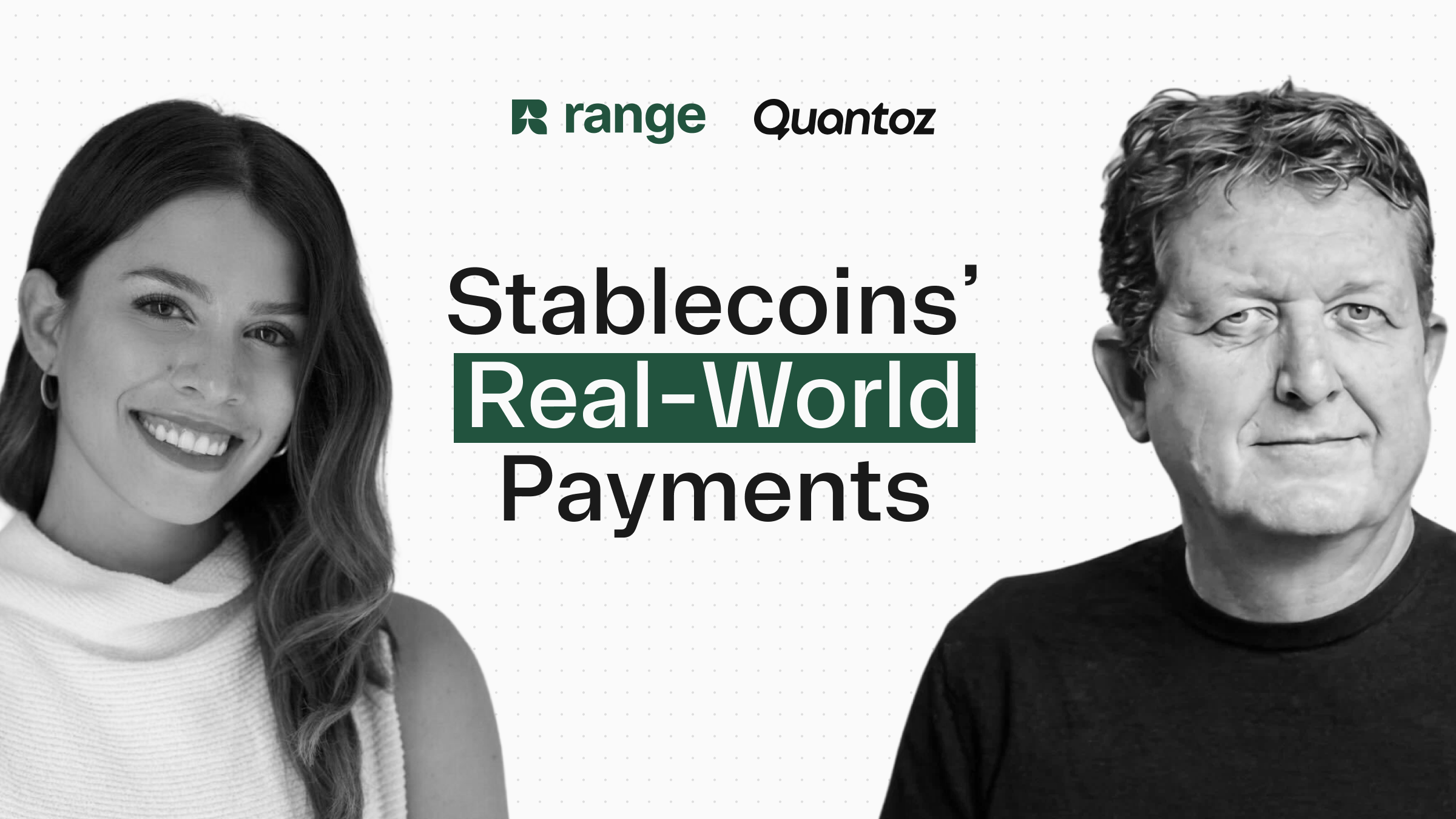
Stablecoins are often presented as a replacement for existing money and payment networks. Arnoud Star Busmann, CEO of Quantoz, takes a more practical position. Companies have settlement problems, liquidity costs and operating constraints. The useful question is which form of money solves each problem with the least friction. His sequence for describing Quantoz makes that priority clear: a technology company first, a financial institution second and a stablecoin issuer third.
That principle runs through Quantoz's approach to e-money, stablecoins and card networks. Each has a different role. Internal ledgers can make repeat payments inside a known network immediate. Public blockchains can move balances outside that network. Existing payment networks can make those balances spendable without requiring every merchant to adopt a new asset. The result is a layered model in which a company can change the rail without changing the commercial purpose of the payment.
For finance teams, that reframes the decision. The starting point is not whether a company should use stablecoins. It is where its current settlement process breaks, what certainty the payment requires and which rail can deliver it without tying up unnecessary capital. It also recognizes that adoption fails when the operator has to understand every component underneath the payment before moving money.
Settlement is the problem Quantoz starts with
Star Busmann's route into stablecoins began in banking and commodity supply chains. Physical trade could move faster as processes became digital, but the money still lagged behind in the banking system. Faster commercial activity did not remove batch settlement, reconciliation delays or the limits of correspondent banking.
Those limits become most visible when a payment has to move between real-time settlement networks. Domestic systems can be fast within their own boundaries, but a payment between networks still returns to correspondent banking. Quantoz focuses on corporate and platform payments that need to cross those boundaries, often across currencies as well as countries.
The practical requirement is 24/7 settlement without cutoff times and with confidence that funds will arrive when expected. That includes trade between Europe and Asia, commodity flows linking Africa or Latin America with European buyers and payments among European countries that remain on different currencies and systems. Even within Europe, a common regulatory umbrella still contains the euro, krona, zloty and other currencies running on separate systems. The shared problem is not geography alone. It is moving value between networks that do not settle together.
Stablecoins are one answer, not the whole answer. Star Busmann put the boundary plainly: "I don't think stablecoins are gonna rule everything and replace everything." Quantoz instead treats e-money, stablecoins and established payment rails as components of one settlement infrastructure. That approach also avoids building liquidity between every proprietary token and every local currency. Outside Europe, for example, Quantoz works with exchanges and OTC desks that can reach USDT and then convert into local currency. The choice depends on the transaction rather than a commitment to one technology.
E-money and stablecoins do different jobs
In Star Busmann's description, e-money is a named balance on Quantoz's internal ledger. That structure lets the company move balances between known accounts immediately. For regular suppliers, customers or companies within the same commercial network, an internal ledger can remove settlement latency without sending each payment to a public blockchain.
A stablecoin changes the ledger and the reach of the balance. A user can mint against an e-money balance, select one of the six public blockchains Quantoz supports and move the resulting stablecoin beyond accounts recorded in Quantoz's own system. As Star Busmann explained, "It's just suddenly you've got this public administration of balances, and the money can move to accounts that are not recorded in our system."
That distinction gives each form of money a clear purpose. E-money works for a known, closed network. Stablecoins become useful when a payment has to leave it, reach an external supplier or global workforce, or access an onchain instrument. Quantoz also sees interest in tokenized money market funds because a stablecoin can provide access to ways of making cash buffers productive that an internal e-money balance cannot. In this model, adoption can begin with digital money on a familiar account structure before a company experiments with public blockchain settlement.
Range's view is that the operating model must follow the same sequence. Start with regulatory, reporting and settlement requirements, translate them into controls for each transaction, then orchestrate the risk and compliance providers already in use. Monitoring, reconciliation and reporting should run from the resulting record. Range is the platform for companies operating across stablecoins and fiat, so the choice of rail can remain flexible while finance and compliance teams retain one control layer across them.
Distribution makes digital money useful
Ledger design does not solve acceptance. If e-money can only be spent with merchants inside the issuer's network, every merchant has to join. If a stablecoin can only be used where a specific token is accepted, the same distribution problem remains in another form. Quantoz's Visa principal membership is intended to connect those forms of digital money to a payment network merchants already use.
"But what Visa does, it unlocks that distribution completely." Star Busmann said the network can take a form of money and deliver it to the point of sale in the format the merchant wants. Corporate customers could use that access for spend management or branded cards for employees and suppliers. Fintech platforms could add spending to a financial-services product without requiring users to remain inside the platform.
Star Busmann also described Visa as more than a card rail. Its payout reach connects payment service providers across markets, operating alongside the bank-to-bank reach of Swift. For Quantoz, that makes Visa another channel next to virtual accounts and blockchains, and another way to deliver funds according to the recipient's needs.
This is the same orchestration principle at a wider scale. The settlement objective comes first, then the infrastructure selects the appropriate form and channel. Sometimes the direct answer is still a Swift payment. Sometimes e-money is more efficient. Sometimes a stablecoin provides the required reach or programmability. The value sits in making that decision operational rather than asking the customer to assemble wallets, exchanges and payout partners themselves.
Corporate adoption depends on abstraction and control
Quantoz sees the largest adoption gap on the corporate side. A finance leader may understand the benefit of real-time cross-border settlement but still face a long list of reasons to say no, including regulatory status, accounting treatment, counterparty risk and the work required to connect the infrastructure. The expected experience is a payment instruction with an amount, destination and deadline, not a project to choose a token and build a wallet stack.
Star Busmann's prescription is direct: "I think it needs to be abstracted." He argued that regulatory clarity has already removed one major objection. The next unlock would be clear treatment of stablecoins or digital money as cash equivalents, with auditors comfortable enough that companies do not have to redeem balances into bank accounts at the end of each day. Quantoz's own ambition for the next 18 months centers on that change.
Controls also shape the company's experiments with AI agents. Quantoz begins with closed-loop payment networks in which every wallet owner is identified and transfers to unidentified wallets are programmatically blocked. Agents can then be limited to purchasing from identified providers that have passed KYC checks. Fast, low-cost rails also make it possible to fund agent wallets in small increments instead of leaving large liquidity buffers exposed across thousands of wallets. Star Busmann was careful not to overstate the market, saying agent payments were not yet commercially viable as a standalone offering.
The same discipline applies to enterprise infrastructure. Quantoz emphasizes its Dutch regulatory relationship, access to larger banks for reserves and payment networks, ownership of its technology stack and certifications that corporate procurement teams expect. Yet the broadest statement of its position is simpler. Its customers include different business models because they share the same underlying settlement and liquidity problem. Those users include a remittance company, an African bank, commodity traders and a consumer app. As Star Busmann said, "we're much more infrastructure than an application for a specific user."
Operate across rails without losing control
Quantoz's argument is that digital money works when the form of money and the payment channel follow the settlement objective. Range's view is that finance, compliance and risk teams then need one record for requirements, controls, provider orchestration, monitoring, reconciliation and reporting across those rails. See how Range supports stablecoin operations.
About Quantoz
Quantoz provides regulated digital money infrastructure for real-time settlement across fiat and blockchain rails. Its products include the EURQ and USDQ stablecoins, e-money accounts and APIs for embedded payments and treasury operations. Quantoz Payments is an electronic money institution licensed by De Nederlandsche Bank; learn more at quantoz.com.
Want to appear on Range Stablecoin Fireside? If you are building with stablecoins and want a seat on the show, get in touch by email or on X.
Protect your time and money
Get your unified treasury dashboard in 30 minutes.