Stablecoin Fireside
Superset: How unified liquidity makes onchain FX work
Superset CTO and co-founder Ben Haslam on how unified virtual pools can turn stablecoin liquidity across multiple chains into one market.
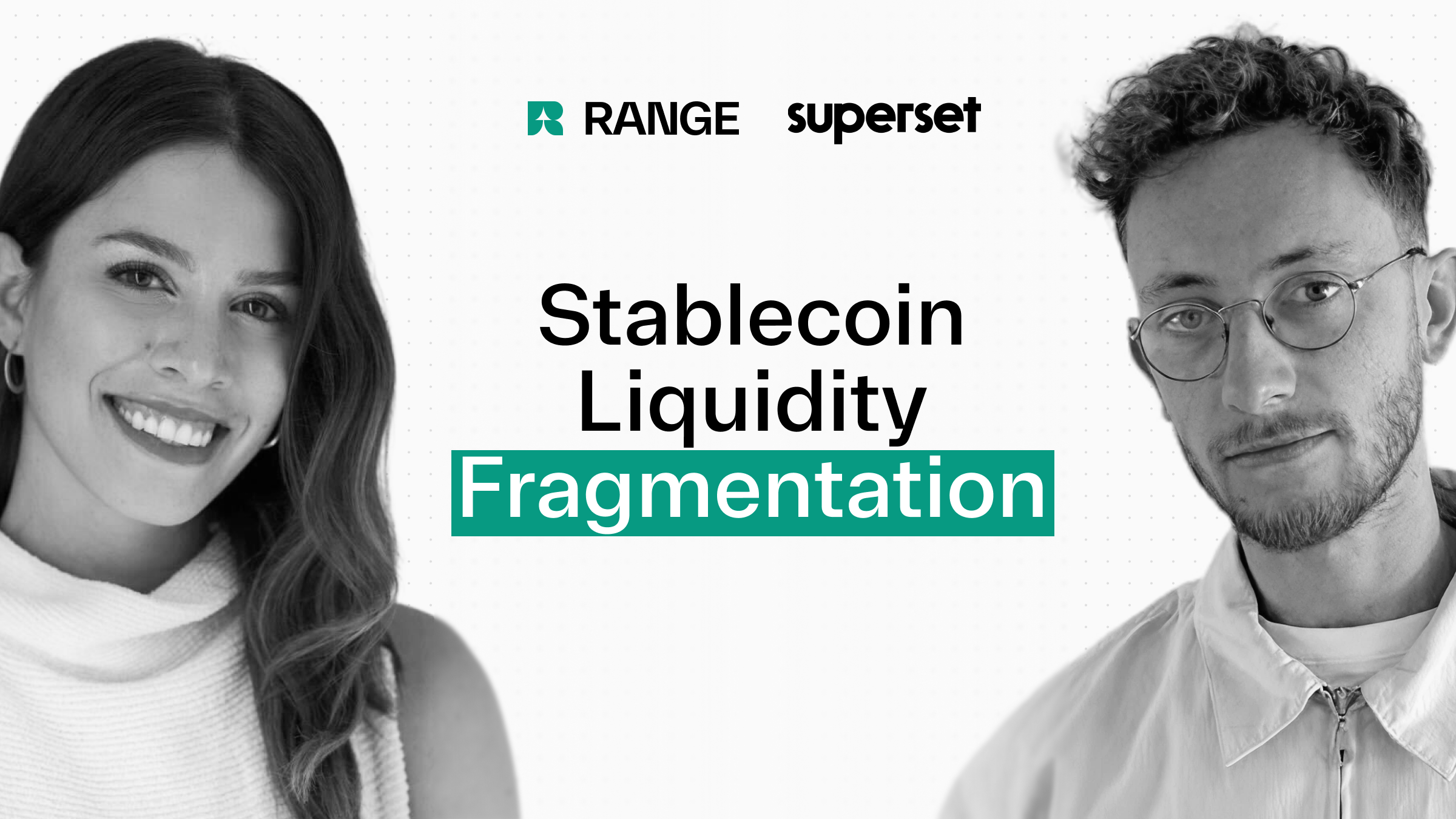
Fragmented liquidity limits usable markets
In Episode 13 of Range Stablecoin Fireside, Paula Pettit spoke with Ben Haslam, CTO and Co-Founder at Superset, about the market structure behind stablecoin trading. Haslam met his co-founder while they were working at a cybersecurity company, where they built a quantum-safe Ethereum wallet using post-quantum signatures. They later moved into stablecoins and payments, combining that security background with Haslam's experience in DEX integrations, node operations and cross-chain systems. Superset is now building a hub-and-spoke architecture for stablecoins deployed across multiple chains.
Haslam described the current constraint in direct terms. A stablecoin may trade through separate decentralized exchanges on Ethereum, Arbitrum and other networks, with each venue holding its own reserves. A user on one chain can access only the liquidity on that chain, which produces more slippage, inconsistent prices and a lower practical ceiling on trade size. Superset's proposed answer is to virtualize those separate reserves so that, as Haslam said, "everyone is trading against total liquidity, much better rates, less slippage, and a consistent price everywhere."
The idea emerged from Superset's work with teams making multichain deployments. Haslam said new issuers would launch on several chains to reach a larger market, then face an immediate allocation decision: how much cash to place on each chain and how much to spend on market makers to keep prices aligned. This burden was especially acute for issuers starting with limited total value locked. The early commercial proposition became concise: "make any stablecoin as liquid as Tether."
Range's view is that better market structure and stronger operating control have to develop together. For regulated companies, Range starts with reporting and regulatory requirements, turns them into controls for each transaction, orchestrates the risk and compliance providers the company already uses, then runs monitoring, reconciliation and reporting from the same record. Unified execution can improve access to liquidity, while stablecoin treasury management still needs a clear record of where capital sits, which controls applied and how each movement settled.
One virtual market, with assets held on spoke chains
Superset's design separates physical custody of liquidity from the market used to calculate a trade. Each spoke chain has singleton vaults, one vault for each token on that chain. The hub keeps track of the liquidity held across those spokes and hosts the virtual automated market maker that acts as the source of truth for execution.
When a user submits a swap request, the request specifies the input token, output token, input amount and minimum acceptable output. The input token enters a vault on the originating chain. A message then reaches the hub, where mirror tokens represent the asset received on the spoke. The trade runs through a virtual AMM based on Uniswap v3, using concentrated liquidity positions that represent reserves held across several chains. The hub calculates the output, updates its accounting and sends the result back to the originating chain, where the output token is released from its local vault.
That design keeps the swap itself local at the asset layer even though its price reflects a broader market. Haslam emphasized the distinction: "we're not actually bridging the tokens at all. It's just using the tokens that are already on chain a in this example." Cross-chain messages create the market and coordinate the accounting, while the tokens used for that trade enter and leave vaults on the same spoke.
The distinction matters because Superset does move assets between chains for a different purpose: rebalancing. If repeated flows create a shortage on one spoke and a surplus on another, the protocol can shift tokens between them. According to Haslam, the transfer mechanism follows the token's existing standard, including CCTP for USDC or OFT for USDT0. Superset has built separate integrations for standards whose burn-and-mint mechanics differ, while relying on bridging functions that any participant can call instead of requiring privileged issuer access. The choice of transport still belongs to the asset issuer. As Haslam put it, "it's not up to us. It's up to the issuer."
Capital efficiency has to sustain participation
Superset's liquidity thesis starts with execution quality. Combining reserves into one virtual market gives a trade access to more liquidity, reducing its price impact and increasing the trade size the market can support. The protocol is designed so liquidity placed on one spoke can support trading activity initiated on other spokes. In Haslam's words, "the liquidity is never inactive because if they put liquidity in onchain, it will still be used for trades happening on the other chains."
The same mechanism is intended to improve the economics for liquidity providers. More trading can occur against the same distributed base of reserves, which creates more fee-generating use per unit of liquidity. Haslam contrasted that structural efficiency with incentives that eventually expire. Superset does include chain-specific fees tied to trading volume, giving an LP a reason to move a position toward a chain with more activity, but the main trading fee reflects use across the combined market.
Rebalancing also turns a maintenance function into a permissionless action. An LP places assets on a chosen spoke, defines a price range and receives an NFT representing the position, much as an LP would when using Uniswap. The hub can count those positions to determine how much of each token should sit on a spoke, then compare that target with the assets actually held there. From that state, it calculates a surplus or deficiency between two chains. An external participant can identify the opportunity, initiate the prescribed transfer and receive a reward proportional to its size. Haslam's core security point was simple: "the entire state is onchain."
Superset sees solver networks and aggregators as potential distribution rather than direct substitutes. Haslam described solver auctions in which participants fill a trade from their own inventory or find liquidity through a decentralized exchange on the relevant chain. In the latter case, the user still faces the depth and slippage of that local market, with the solver's cut added to the route. That model can prioritize convenience for smaller trades, where price impact matters less. Superset aims to supply a deeper onchain venue underneath those interfaces, and Haslam said the team was already speaking with aggregators about integration.
Payments may lead institutional onchain FX
Haslam characterized institutional onchain FX as early and uneven. In his account, meaningful decentralized exchange liquidity is concentrated on Ethereum mainnet, with some activity on Solana, while Canton activity is more closely associated with OTC and request-for-quote trading. The practical consequence is that a company may choose another network for affordable transactions or application activity, then still have to return to Ethereum when it needs deeper liquidity for conversion and settlement.
Payment processors are the first likely source of institutional volume in Haslam's view. Businesses supporting onramps, offramps and payments accumulate daily exposures that have to be converted and settled, while also maintaining enough liquidity on multiple chains to keep those services available. That creates regular demand for cross-chain swaps. He described current workflows that involve trading into one token, transferring it to a centralized exchange, waiting for the deposit and withdrawing to another chain, with time and fees added at each stage. A unified onchain market would give those operators another way to perform the conversion where their liquidity already sits.
The opportunity expands as more currencies gain stablecoin representations. Haslam expects non-USD stablecoins to grow and said Superset was speaking with euro stablecoin teams, a UK stablecoin team, and issuers working on Australian dollar and New Zealand dollar assets. These currencies need markets against the dollar and, over time, against one another. His longer-term ambition is for the distribution of onchain currency liquidity and trading pairs to more closely resemble global FX demand, including major euro-dollar and euro-pound markets. In that scenario, an application could use stablecoins for the transaction without requiring its customer to understand wallets or the underlying network.
Superset is initially building for EVM networks and is working toward integrations with Canton and Solana, followed by other chains. Haslam also expects users to encounter the system through higher-level applications, without needing to understand which stablecoin or network completes an FX transaction. Range's view is that this abstraction raises the standard for the operational layer. A cross-chain treasury still needs continuous visibility into balances, counterparties and settlement flows even when the execution path disappears from the user's view. Finance teams also need consistent transaction records across the chain where liquidity is held, the market that determined the price and the system where the resulting exposure is reconciled.
Range's view: build execution and operational control together
Superset's thesis is that deeper onchain FX markets come from coordinating distributed liquidity, pricing trades once and rebalancing only when flows make it necessary. Range's view is that companies operating across stablecoins and fiat also need one system of record for controls, reconciliation and reporting as those execution paths become more abstract. See how Range supports stablecoin operations.
About Superset
Superset is a cross-chain liquidity protocol that combines stablecoin liquidity from multiple blockchains into unified virtual pools. Its execution layer lets traders on supported chains access the same global liquidity instead of separate local pools. Learn more at superset.finance.
Want to appear on Range Stablecoin Fireside? If you are building with stablecoins and want a seat on the show, get in touch by email or on X.
Protect your time and money
Get your unified treasury dashboard in 30 minutes.