What Franklin Templeton's SEC relief says about daily reconciliation
Daily reconciliation, segregated wallets and independent verification sit at the center of the SEC's conditions for Franklin Templeton's tokenized fund structure.

On 12 August 2026, the SEC's Division of Investment Management issued a no-action letter allowing Franklin Templeton's registered funds to hold shares of an onchain money market fund as cash and as securities-lending collateral.
The underlying fund is the Franklin OnChain U.S. Government Money Fund, or FOBXX, which runs on the BENJI platform and held roughly $720 million in net assets in late August, according to Morningstar.
The conditions attached to the relief are more useful than the approval itself. Condition 11 requires the funds to “maintain internal accounting controls that subject all confirmations from FTIS to daily reconciliation against the investing Fund's transaction authorizations”
For this arrangement, daily reconciliation is part of the control framework on which the relief depends.
The SEC relief updates older custody rules for a tokenized fund structure. Those rules were originally written for physical securities, so SEC staff looked to earlier book-entry precedents and adapted the same safeguards to a blockchain-based ownership record.
Because Franklin Templeton Investor Services is affiliated with the funds, the arrangement is treated as self-custody, so these rules apply.
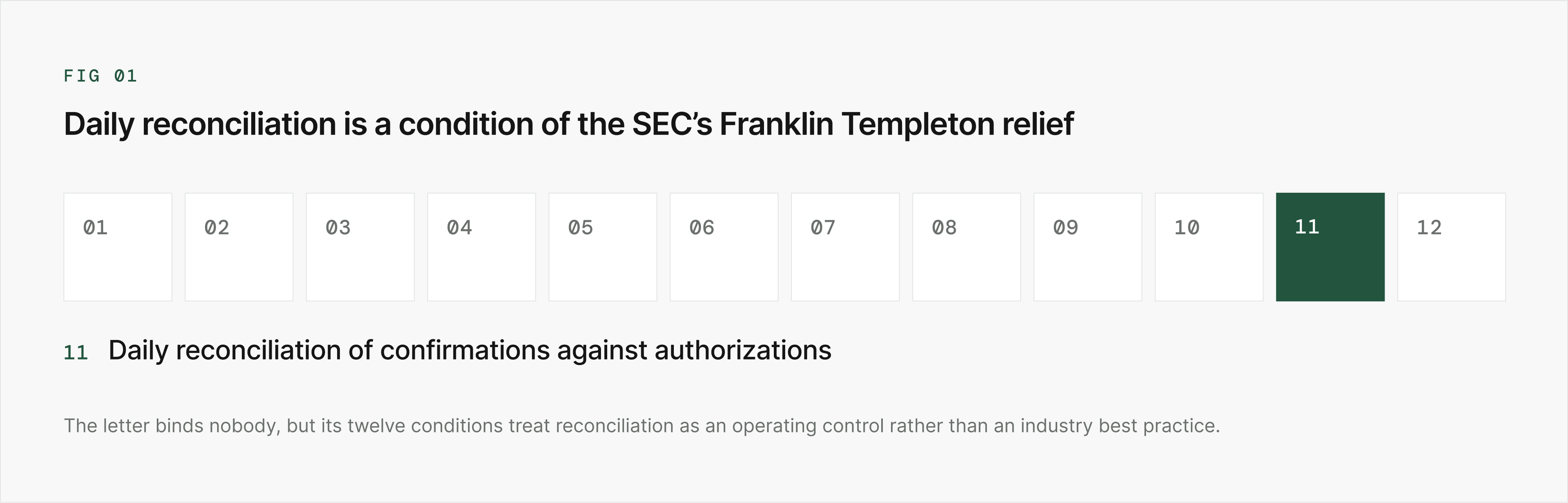
Twelve conditions, read as operating controls
The scope matters. This is staff no-action relief for one described arrangement between affiliated parties. It is not a rule and it does not create an obligation for other firms.
What it does provide is a public example of the controls SEC staff accepted for this specific tokenized structure.
The twelve conditions, condensed from the letter and a Faegre Drinker summary, translate into a fairly concrete operating model:
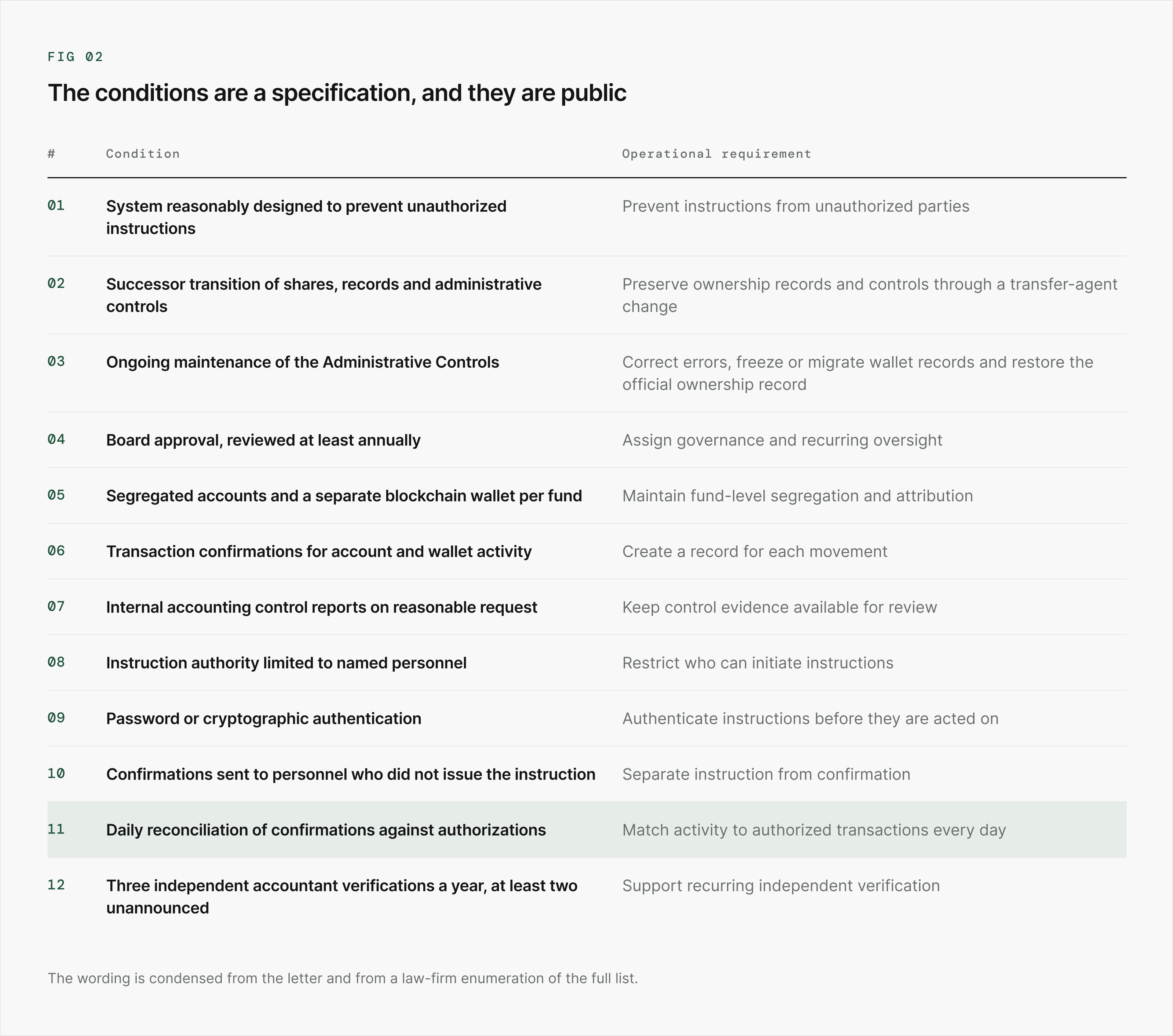
Four things stand out: every position needs to be clearly attributed, reconciled daily, checked by someone other than the person who initiated it and backed by records that can be reviewed at any time.
Condition 3 is especially important. FTIS must be able to correct errors or unauthorized transactions, freeze or move wallet records when needed and restore the official ownership record.
In other words, the blockchain record is not enough on its own. The transfer agent still needs a reliable record of who owns what and the ability to fix it when something goes wrong.
The conditions follow the same sequence Range is built around: requirements, controls, reconciliation and reporting.
Range sits above the tools a company already uses, connecting their data into one record so positions can be reconciled daily and backed by an evidence trail.
In Brazil, daily position data becomes a filing requirement
The Franklin conditions are internal controls, whereas Brazil approaches the same operational problem through reporting rather than fund custody.
Resolutions BCB 519, 520 and 521, dated November 10, 2025 and effective February 2, 2026, brought virtual asset service providers into the National Financial System as SPSAVs. Article 88 of Resolution 520 gives firms already operating 270 days to file an authorization application, putting the deadline at October 30, 2026.
Filing also starts an ongoing reporting calendar. From the filing date until the central bank rules otherwise, a provider owes CADOC 5711 every business day, with a three-business-day deadline. CADOC 5710 is monthly, with a five-business-day deadline.
We break down the authorization process, reporting calendar and operational requirements in our Brazil SPSAV regime report.
Three details make that schedule harder than it sounds. The difficult part is producing that data reliably.
The documents are sequential, so the previous base date must be accepted before the next can be received.
Precision is unforgiving. Quantity fields support up to 42 digits with 32 decimal places, so precision has to survive every system in the reporting path.
Positions are reported per client, while omnibus wallets aggregate clients by design, so per-client positions have to be reconstructed from internal records rather than read directly from a wallet balance.
Two regulators, on two continents, working from different statutes and different concerns, created different obligations within nine months of each other, and both bite into the same daily position data.
The legal obligation is different from Franklin Templeton's. The operational requirement is similar: position data has to be attributable, current and reproducible on a fixed cadence.
GENIUS asks for a monthly number, which is a daily problem
The GENIUS Act, signed July 18, 2025, adds a third example, with an important distinction. It is pre-commencement, effective the earlier of January 18, 2027 or 120 days after final rules, and there are no final rules yet.
Once in effect, the law will require Permitted Payment Stablecoin Issuers to maintain 100% reserve backing in cash, short-term Treasuries and other eligible liquid assets, and to publish reserve disclosures every month.
Unlike the Franklin Templeton relief, the GENIUS Act does not require daily reconciliation.
The operational implication comes from the monthly disclosure requirement. GENIUS does not require daily reconciliation, but monthly disclosure is much easier to support when reserve accounts and circulating supply are checked throughout the month rather than assembled only when the report is due.
That is an operating judgment, not a requirement written into the Act.
GENIUS also requires issuers to seize, freeze or burn stablecoins when required by law. That is different from the Franklin controls, which focus on correcting errors and restoring the official ownership record. In both cases, the issuer or recordkeeper still needs to intervene after issuance.
The three examples apply to different types of firms. The Franklin relief concerns registered investment companies. Brazil's regime applies to virtual asset service providers. GENIUS will apply to permitted payment stablecoin issuers once it takes effect.
The common thread is not that the rules are the same. It is that each one depends on firms being able to maintain position data that is current, attributable and easy to reproduce when needed.
Many crypto and fintech finance teams still reconcile manually. Bank statements, invoices and onchain activity come from different systems, then get joined in spreadsheets or re-entered into accounting software.
That can produce the right number at month end. What it struggles to produce is yesterday’s position today, with a clear audit trail and no manual assembly.
That is usually where the gap shows up: a rejected filing, an unexpected review or a simple question about who approved the number and why.
Can your controls produce the evidence?
For finance, compliance and risk teams, the practical test is not whether a reconciliation policy exists. It is whether the underlying record can produce evidence on demand.
Six questions expose the gap quickly:
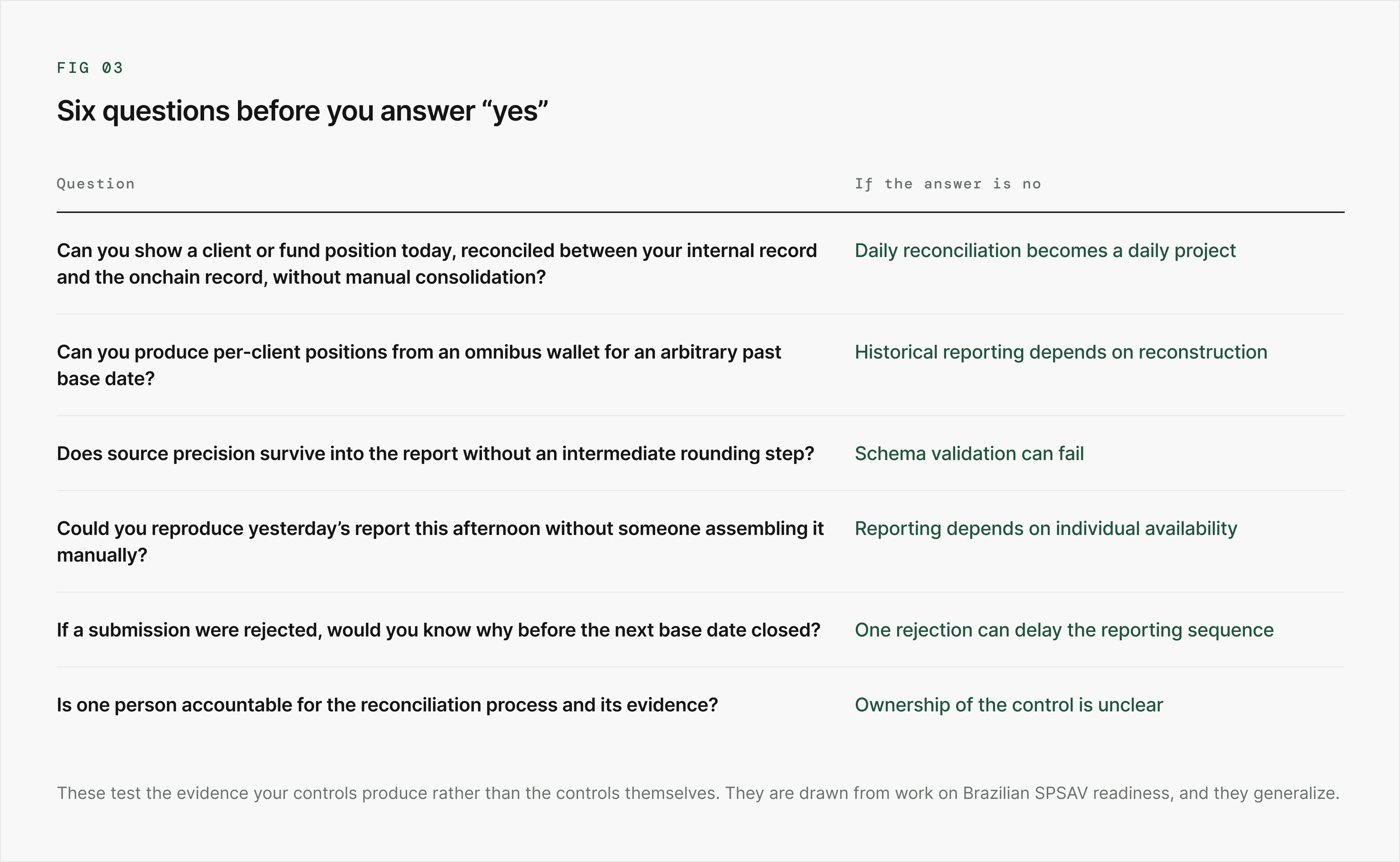
A control that exists only as a manual month-end process is difficult to reproduce on a daily cadence. That is where the requirements above become an operating systems problem rather than a policy problem.
Where this leaves your finance team
Range is the platform for companies operating across stablecoins and fiat. It connects wallets, custodians, exchanges and bank accounts into one real-time ledger, then runs monitoring, reconciliation and reporting on that record.
Range feeds enriched onchain data into Xero, QuickBooks, NetSuite and SAP so finance systems receive classified transaction data instead of manually retyped entries. Onchain transaction controls can run before settlement, while alerts can monitor fiat account activity.
Compliance responsibility stays with the regulated firm. What Range supplies is the record and the evidence underneath it, so the answer to "can you reconcile this daily?" does not depend on who is at their desk.
The Franklin letter, Brazil's SPSAV reporting rules and GENIUS impose different obligations on different firms. Taken together, they show why the operating standard is moving toward records that are current, attributable and reproducible at the cadence regulators or auditors ask for.
For finance teams, the useful question is simple: if someone asked for yesterday's position today, could you produce it without rebuilding the answer by hand? If the answer is no, get in touch. We can help you build the record and controls to get there.



Protect your time and money
Try every capability with your real data in a sandbox before you commit.