ABN AMRO: Where tokenized deposits fit in banking
ABN AMRO Innovation Manager Elie Naba on where stablecoins, tokenized deposits and central bank money fit and what banks need to operate them.
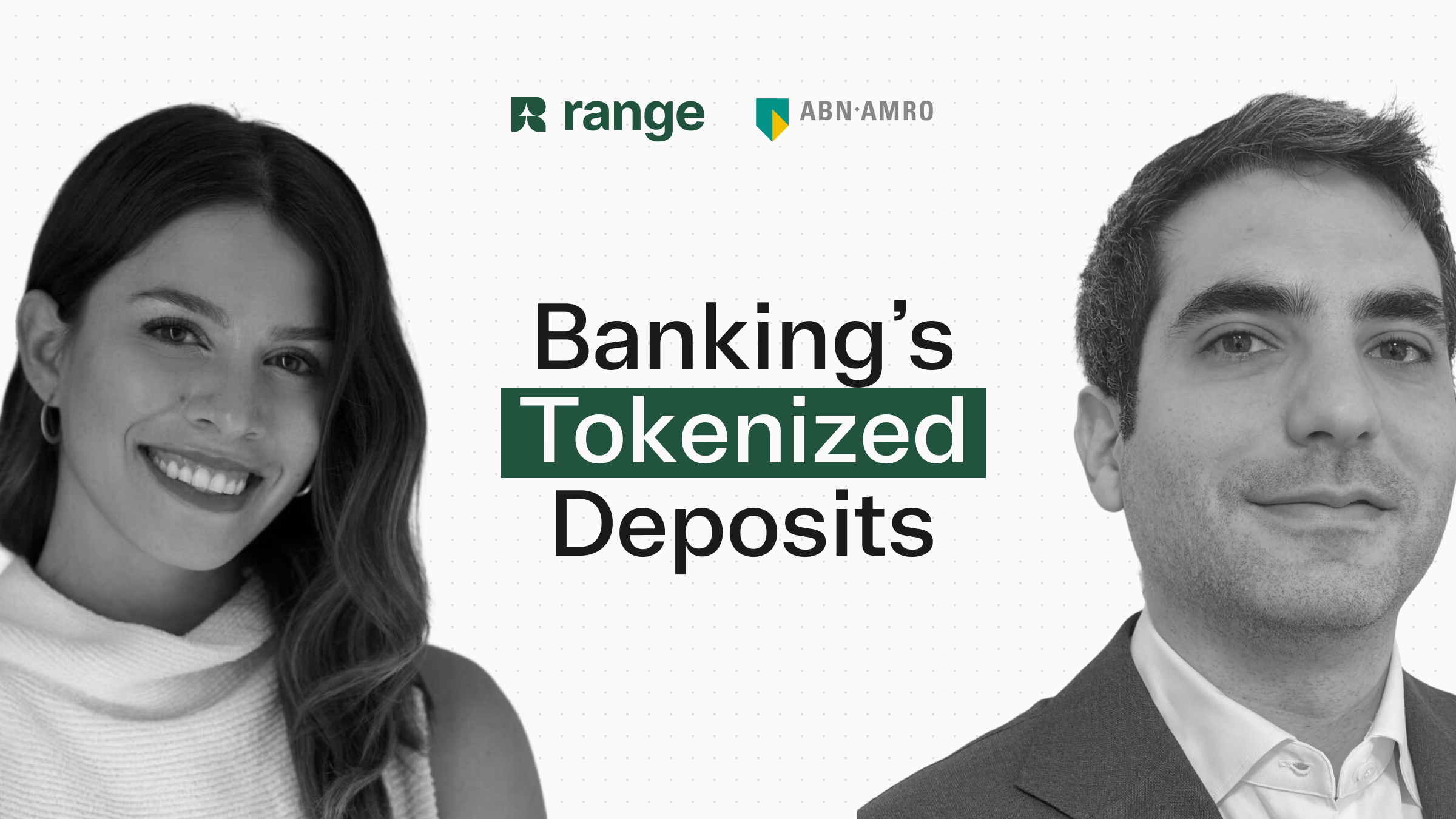
The debate around stablecoins and tokenized deposits is often framed as a choice between two competing forms of digital money. Elie Naba, Innovation Manager at ABN AMRO, offered a more practical view in Episode 4 of Range Stablecoin Fireside. Stablecoins, tokenized deposits and central bank digital currencies represent familiar forms of money in a new technical environment. The more useful question is how each form can serve the function it is best equipped to perform.
Banks need infrastructure that supports assets moving onchain, reconciles activity with core banking systems and applies familiar controls to transactions that settle continuously. Meeting those requirements lets institutions expand how customers hold, move and invest money while preserving the protections built into regulated finance.
Build a unified control layer around the infrastructure Naba described. Start with your institution's regulatory and reporting requirements, translate them into operational controls and coordinate the risk and compliance providers you already use. Run transaction monitoring, reconciliation and reporting from the same record across wallets, custodians, exchanges and bank accounts. That lets you govern blockchain and core banking accounts together while preserving the differences between them.
Three forms of money, brought onchain
Naba began with a simple observation: "these three versions of money have always existed." A central bank digital currency represents central bank money in digital form. A stablecoin issued under electronic money rules represents value inside a digital network. A tokenized deposit represents a commercial bank deposit onchain. The instruments differ in issuer, economic function and regulatory treatment even when they share blockchain infrastructure. A shared technical rail does not make them interchangeable. Identify the claim each token represents, the entity responsible for it and the rules that govern its use.
For customers, Naba connected bank deposits with two familiar benefits: deposit protection up to the applicable threshold and the ability to earn yield on idle money. He also placed deposits within the broader role banks play in the economy. Deposits provide funding that banks can lend, linking the value held by customers with credit extended to the economy. In his account, that model developed through repeated cycles of expansion, risk and tighter oversight. The modern deposit is therefore both a customer product and part of a regulated system for managing reserves and lending.
That economic role explains his preference for tokenized deposits. Naba said: "I think they are the most efficient form of money that exists today, and we should basically try to see how we can bring that efficient form of money on chain and make it work for our customers." Tokenization can bring that form of money into environments where assets and instructions are represented onchain, while the underlying deposit retains its role inside the banking system.
The distinction matters because blockchain changes how money is represented and moved while each instrument retains its purpose. In Naba's account, MiCA organized blockchain-issued assets into familiar regulatory categories rather than treating every token as a new asset class. Preserve those distinctions in your systems of record. A stablecoin balance, a bank deposit and a tokenized security may appear in the same operational view, but they carry different obligations and controls.
Stablecoins for movement, deposits for productive capital
Stablecoins have a clear advantage when money needs to move. Naba described a regulated stablecoin as money that can be held by different actors and settle immediately. In his words, "it's money that travels at Internet speed." That portability gives stablecoins a strong role in payments, particularly where the existing path crosses borders or involves assets already issued onchain. European stablecoins remain an early market in his assessment, which leaves room for new applications to emerge as issuers and institutions build within the regulatory framework.
Tokenized deposits offer a different value. Naba argued that their connection to bank lending makes them more elastic for the economy, while their structure gives customers the safety and yield associated with deposits. His preferred outcome is coexistence: stablecoins can support movement, then value can return to a tokenized deposit or another yield-generating instrument when it is no longer in transit.
This model becomes more dynamic when software manages balances. Naba described AI agents converting value into stablecoins when a payment is due, sending the payment and moving idle value back into a yield-bearing instrument afterward. The point is continuous allocation. Money can use the rail suited to the immediate task while a portfolio remains productive between transactions.
Yield also brings regulation into focus. Naba traced bank oversight to repeated cycles in which institutions offered higher returns by taking greater risk. His conclusion was direct: "Let them abide by the same rules that we we play by and then, sure, offer yield." If stablecoin issuers want to provide deposit-like returns, his position is that they should follow the same rules as banks. Develop product design and control design together so the operating model can enforce the obligations attached to the asset, whatever its label.
Connect wallets and core banking systems through one operating layer
For banks beginning this work, Naba's first priority was straightforward: "I think the first thing that that banks should be looking at is their infrastructure." Core banking systems typically record a defined asset against an account. A blockchain wallet can hold stablecoins, tokenized deposits, securities, yield-bearing instruments and other crypto assets in one address. Reconcile these data models before offering blockchain-based accounts. That reconciliation supports custody, accounting and customer service, giving each team a view of the same assets through its own operational lens.
Naba outlined a practical sequence. Institutions first need wallet infrastructure that lets customers hold assets with the bank. They then need data to move between those wallets and the core banking system, creating the on-ramp and off-ramp. Once value can enter and leave a customer's bank account, compliance teams need to know the sender, receiver and source of funds, and determine whether a transaction is safe to process.
Know-your-transaction capabilities from Range were part of Naba's answer for banks receiving tokens or supporting cash-outs. Put screening inside the flow of funds, with the policy, counterparty context and resulting evidence attached to each transaction. Finance and compliance teams can then decide consistently whether value can move and retain a usable record of why the decision was made.
A 24/7 market changes liquidity, settlement and privacy
The harder transition is operational. Naba framed the risk directly: "So I think the biggest risk that we still have not experienced with is what does it mean to actually operate in a twenty four seven economy." Continuous movement affects how banks manage deposits, capital reserves and customer relationships. He also questioned current demand for round-the-clock corporate payments because corporate treasurers still work conventional hours.
ABN AMRO explored that issue through a theoretical exercise around tokenized securities. The model required a tokenized security, a blockchain that operates continuously, a smart contract to support exchange and a cash leg on the same network to trigger purchases and sales. The cash leg needed to sit on the same blockchain as the tokenized security.
Naba was candid that banks are not ready today to operate fully around the clock, and he questioned whether corporate payment demand yet requires them to do so. He saw a clearer near-term case in investments, where customers may want to enter and exit yield-bearing assets at any time. He also identified cross-border payments and payment-versus-delivery securities transactions as areas where blockchain-based money can gain traction. This points to adoption by use case rather than a wholesale migration of money onchain. In markets with efficient domestic payment infrastructure, a blockchain rail has to offer a meaningful improvement before customers have a reason to switch.
Network choice adds another constraint. Naba said: "I'm a big believer in permissionless blockchains." He also recognized that private networks can suit transactions between banking counterparts. Privacy remains the dividing issue. Public networks expose transaction data that financial institutions may have sound reasons to keep confidential, particularly when disclosure could influence markets. In his view, stronger privacy on public blockchains would reduce the appeal of private alternatives. Whichever architecture you choose, retain attributed counterparties, policy-aware controls and reconciliation that connects settlement activity to your institution's books.
Upgrade the operating model for tokenized money
Naba's closing recommendation was to upgrade finance by making it faster and more efficient, rather than rebuild banking from zero. Range gives institutions the unified record and operational controls needed to put that principle into practice across stablecoins and fiat. See how Range supports stablecoin operations.
About ABN AMRO
ABN AMRO is a bank serving retail, private banking and corporate banking clients, with its primary focus in Northwest Europe. It offers banking products, services and financial advice through digital and personal channels. Learn more at abnamro.com.
Want to appear on Range Stablecoin Fireside? If you are building with stablecoins and want a seat on the show, get in touch by email or on X.
Related reading
Stablecoin Fireside
Bastion: Selling trust to enterprises building on stablecoins

Stablecoin Fireside
Aon: How digital asset insurance is underwritten, and where it stops
Stablecoin Fireside
Eco: Routing stablecoins when a dollar is not a dollar across chains
Protect your time and money
Try every capability with your real data in a sandbox before you commit.