Eco: Routing stablecoins when a dollar is not a dollar across chains
Eco Co-founder and CEO Ryne Saxe on why stablecoin speed and cost are largely solved, and why fragmentation and execution now decide whether institutional money moves onchain.
Stablecoin transfers already settle quickly and at a flat cost. The harder problem for institutions begins when a dollar from one issuer on one chain has to become a dollar from another issuer on another chain. That movement crosses markets with different risk profiles, and it brings slippage, failed legs and execution risk that an offchain trading or treasury desk would not accept.
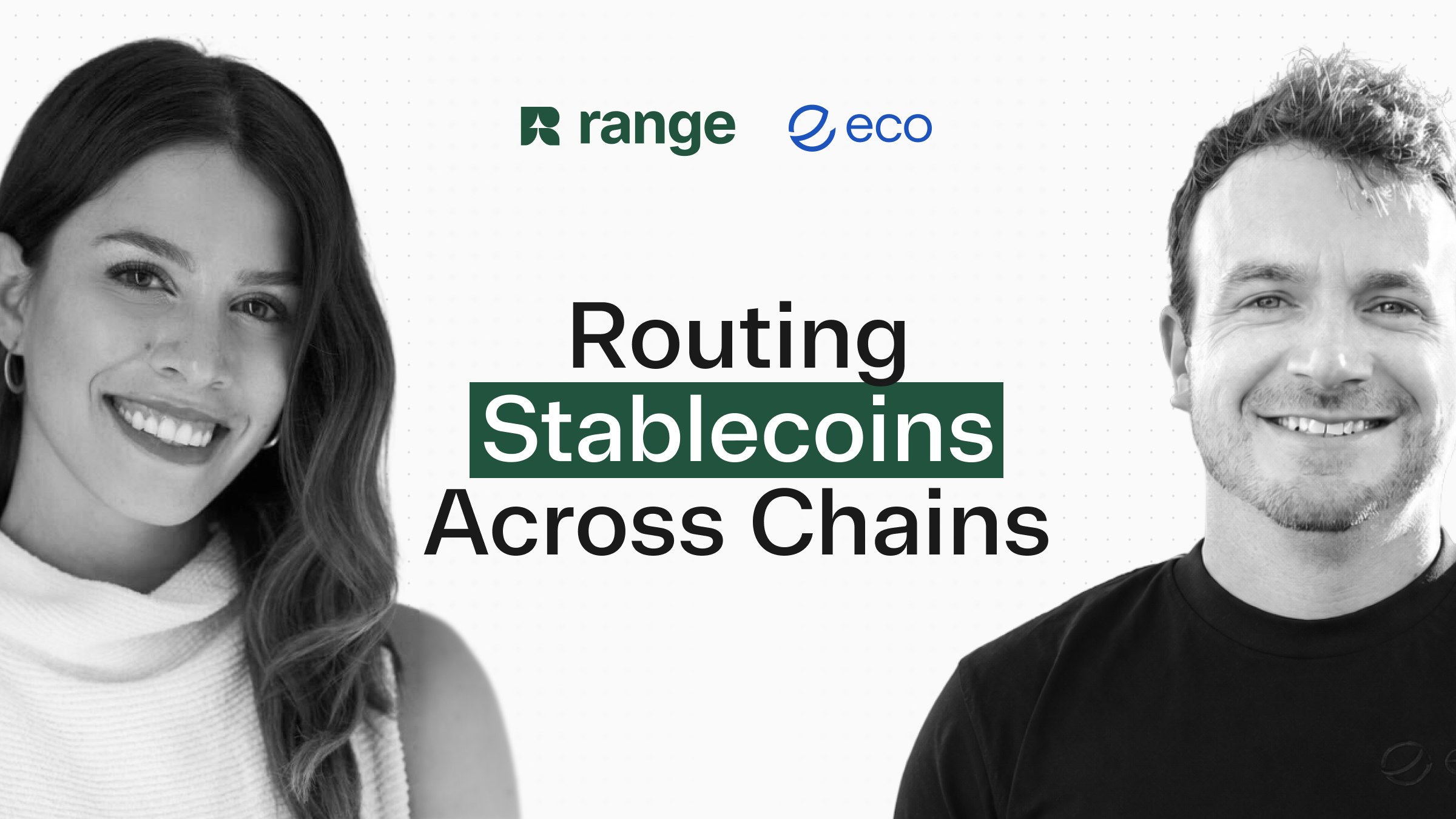
Ryne Saxe, Co-founder and CEO of Eco, joined Paula Pettit, VP of Strategy and Growth at Range, to discuss that gap. Ryne has built for the stablecoin use case since 2017 and 2018, which he called way too soon. Eco now builds stablecoin infrastructure that connects onchain markets through stablecoins, solving complicated routing problems for institutional money movers: payment settlement at scale, treasury operations that have adopted stablecoins and trading platforms that need an offchain order to map into an onchain route.
Before a route is chosen, a company moving stablecoins at volume should set its regulatory and reporting requirements, turn them into controls on each transaction, connect the risk and compliance providers it already uses, and run monitoring, reconciliation and reporting off one record.
Fragmentation turns stablecoins into a foreign exchange problem
Ryne described Eco's core problem as market fragmentation. In his words, "your dollar is not your dollar everywhere you want it to be your dollar." Stablecoins are meant to be tightly priced dollar assets, yet moving them across chains and markets with different risk profiles behaves like "a hostile foreign exchange market" with unexpected slippage and unexpected transaction failures for anyone who does not know how to move them safely. His conclusion was direct: "And that is keeping a lot of sophisticated money movers and institutional capital flow offchain." Those institutions manage risk well offchain, and Ryne said that sophistication breaks once they come onchain.
Regulation has deepened the problem. Ryne said the GENIUS Act accelerated a path Eco was already on, and that "GENIUS actually made the fragmentation problem worse." The law brought more institutions into issuance, which meant "more flavors of digital dollars floating around." He sees Clarity, and the market structure frameworks it would create for yield vaults and tokenized real-world assets, as the next driver, because those markets are usually entered and crossed through a stablecoin. He expects that within twelve months most of the volume on Eco's own network will be routing between those onchain markets, as opposed to flows that both begin and end with a stablecoin.
Paula asked about Ryne's description of stablecoin interoperability as incestuous. Part of what he meant is that the same volume is often counted two or three times, by the wallet, by the DeFi protocol and by the bridge or interoperability protocol. Competitors also rely on each other, and one bridge might use a competing bridge to rebalance its own book: "You'd have two competitors moving money back and forth between right pocket and left pocket, counting the money twice." He described it as an immature market structure that is gradually stratifying into layers.
Fragmentation lands on the finance team as much as on the router. Every issuer, chain and wallet adds a balance to value, reconcile and report. If you hold several flavors of dollar, keep them in one real-time ledger by asset, network and counterparty, with depeg and concentration alerts set before balances grow.
Execution is the unfinished part of programmable money
Paula asked where the gap with traditional payment rails sits: speed, cost or execution. Ryne focused on execution, because speed and cost are well established. As he put it, "it's incredible that I can send $10 or $10,000,000 for the exact same fee so long as there's sufficient liquidity." What crypto has not yet delivered, after more than a decade of discussion, is programmable money, and he placed the gap precisely: "DeFi has given us programmable markets and programmable finance, but I don't yet have programmable money to get in and out and across those things, and that's a stablecoin."
For Ryne, programmable money means encoding logic about how, why and when money moves across very different market environments, within a set risk tolerance. He described the result as the ability to "program the world's smartest limit order" and to have "all or nothing execution against your goals" inside a single stablecoin transaction.
Institutions do not agree on what good execution looks like. As Ryne said, "Everyone has a different definition of their own SLA." Some partners want a 99% transaction success rate in ten seconds or less on every chain whose block time allows it, while others want predictable costs across designated pairs, whether a transfer clears in thirty seconds or ten minutes. A treasury team rebalancing its liquidity a few times a day cares about slippage more than timing. The requirement common to all of them is all-or-nothing execution: "No partial fails, no partial failures, no reversions." On a multi-hop transaction with poor information, a failed leg means "you can actually end up spitting out the wrong asset on the wrong chain."
An all-or-nothing route still needs a complete record around it. Finance needs to know which policy approved the transfer, who received it and how each leg posts to the ledger. Compliance needs to show why it was allowed. Apply those controls before execution, then match the settled transaction back to the books.
What winding down Eco's earlier app taught about dependencies
Eco's current focus followed a pivot. Ryne said the team lost conviction that crypto wallets and Ethereum would scale and become accessible quickly enough, while keeping its conviction in stablecoins, so Eco built its own app on custodial USDC. The product worked well for a while. It was built as a regulated product that depended on a number of banks in the background, and Ryne was clear about what that meant: "those banks for us were infrastructure dependencies."
When bank regulators cracked down after FTX in 2023, those partners stopped supporting the product one by one. A year after strong traction and a real sense of product market fit, Eco was in a year-long defensive posture with no end in sight, and it decided to wind the product down and downsize the company around it. Ryne put it plainly: "It was like startup hell. It was an incredibly painful year." He still considers it the right decision, because a regulated, high-burn US fintech product cannot keep building when it is unclear whether it will be allowed to exist.
The experience shaped how Eco operates. Ryne said the team now knows the moment when "the push into the market becomes a pull from the market" and, having scaled to about 60 people, it would solve the problems of growing from 25 to 60 multiples faster today. He also pointed to a credibility that outlasted the product: "A lot of the insights learned from that product are relevant to companies we support and partner with today."
The same lesson applies to companies adding stablecoins. Banks, custodians, issuers and liquidity providers are dependencies, and any of them can change terms. Keep every account and counterparty in one verified record, with balances visible across providers, so you can see your exposure to any one partner and move flows on your own schedule.
Agentic payments and the next season of stablecoin growth
Asked what excites him most, Ryne set aside the noise around agentic payments. He called the category promising but not yet that interesting, since programmatically sending USDC is a stepping stone. He expects an agent use case to take the market by surprise and open a transaction category nobody predicted, without claiming to know what it will be. He sees that moment as a new leg of the programmable money thesis, and said "our infrastructure is well positioned to serve that state of the world" when it comes.
His more definite view concerned markets that grow alongside stablecoins: tokenization, institutional onchain yield strategies and onchain FX. As those three categories grow over the next couple of years, he said, "I believe that the stablecoin growth that we're so excited about that we've seen over the last two years is going to look miniscule." He expects growth rates and volume figures to rise tenfold over that horizon.
Either way, the requirement is the same. Whether volume grows tenfold through tokenized markets or through software initiating payments, every person, agent and system has to work through one set of controls. Test reconciliation, screening and exception handling against that volume now, so more throughput doesn't become a longer manual review queue.
Design early and stop treating chains as path dependencies
Paula asked what institutions should do to prepare. Ryne answered, "I think I would say design early." He expects about a year of solutions engineering with the real demand drivers in these categories, many of which have significant appetite to build internally even when their product and business teams are not yet aligned on strategy. His advice is to involve infrastructure partners such as Eco, Morpho and Relay early, chosen by use case. He has seen partners discover deep in the flow that they need something slightly different, then go back through design and alignment loops. His assessment: "If we had been a part of the conversation three to six months before that, there would have been way more internal alignment and way more pace on execution."
The most common correction, he said, is that companies need to be freed from thinking about blockchains as path dependencies. A company has a customer and a goal for that customer, and which chain holds the best opportunity should not be its concern. As Ryne put it, "it's our job to not make them think about that" and to keep each route safe against an agreed SLA.
Ryne closed by noting that traditional financial markets have already solved many efficiency problems, and that "there is still an enormous opportunity for crypto infrastructure to just close the feature parity gap with the good solutions that already exist." A trading platform can offer sophisticated algorithms on offchain liquidity, yet once its customers want onchain liquidity, "the trading algorithm we have offchain doesn't exist onchain in any safe way." Many market structure problems now appearing onchain were solved offchain over the last few decades, and he argued those solutions can be pattern matched before new possibilities are built on top.
Design controls before committing to chains and routes. Start with your regulatory and reporting requirements, turn them into transaction controls and decide which existing risk and compliance providers those controls will draw on. Involve finance and compliance from the start so the flow that goes live already produces the evidence it will be examined against.
Bringing stablecoins into your stack
Moving stablecoins is already fast and cheap. What's left is making every route, issuer and chain predictable enough for an institution to rely on. That takes a control layer next to the routing layer: one record of every token, chain, wallet and counterparty, with the controls, reconciliation and reporting finance and compliance teams need. That's what we build at Range.
If you are moving stablecoins across chains and issuers and need that activity under control, talk to us: See how Range supports stablecoin operations
About Eco
Eco connects digital asset markets through stablecoins, giving developers and enterprises real-time routing and orchestration to program money movement across blockchains, tokenization platforms and institutional liquidity venues. Its Routes product sends and swaps stablecoins across supported chains using intent-based execution. Learn more at eco.com.
Want to appear on Range Stablecoin Fireside? If you are building with stablecoins and want a seat on the show, get in touch by email or on X.
Related reading
Stablecoin Fireside
Bastion: Selling trust to enterprises building on stablecoins

Stablecoin Fireside
Aon: How digital asset insurance is underwritten, and where it stops
Stablecoin Fireside
Paxos: What adding a stablecoin demands from your finance controls
Protect your time and money
Try every capability with your real data in a sandbox before you commit.