Anchorage Digital: What institutional stablecoins require
Anchorage Digital Global Head Sergio Mello on how regulation, distribution and continuous control shape institutional stablecoin adoption.
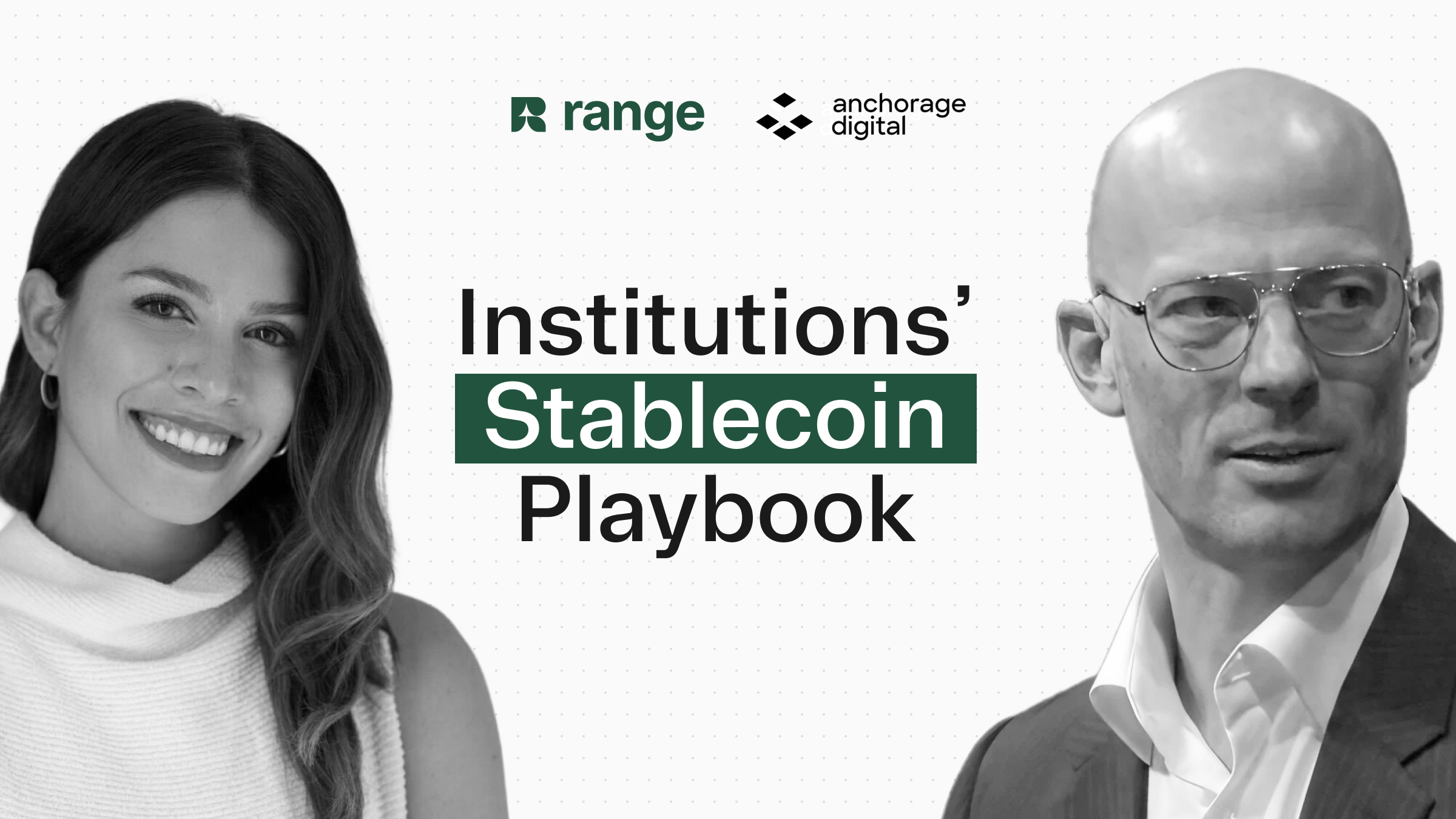
Sergio Mello, Global Head of Stablecoin Solutions at Anchorage Digital, joined Paula Pettit, VP of Strategy and Growth at Range, to explain how regulated institutions are approaching stablecoins. Mello described Anchorage Digital as a global financial infrastructure provider for crypto companies and institutions, with nearly a decade in digital assets and five years operating under an OCC charter. Its foundations span custody, settlement, trading, staking and governance, with stablecoin issuance and services for banks now added to that infrastructure. Those bank services cover dollar settlement, stablecoin maintenance and burns, liquidity on fiat rails and the infrastructure for moving crypto assets.
Anchorage began issuing stablecoins after the GENIUS Act was signed. Mello said the company had prepared for that opening over several years, building toward regulated issuance and coordinating with its regulator on how the activity should operate. He named Ethena as its first issuance client, followed by Tether, Western Union and OSL. He also drew a precise line around the current position: legislation has passed, but OCC and Treasury rulemaking is still in progress. As Mello put it, "There's no such thing as GENIUS compliance yet until this happens towards the end of twenty twenty six."
That distinction matters because regulated institutions need more than a future intention to comply. Mello's point was that Anchorage's issuance activity is already conducted as a federally regulated bank product. He expects completed rulemaking to bring more providers and more institutional demand into the market. He also sees regulatory frameworks developing outside the United States, with countries responding to US legislation as they shape their own rules. In his view, greater alignment can unlock the cross-border component in both directions and support a broader financial infrastructure network.
Regulatory and reporting requirements have to become controls you can apply to each transaction. Range orchestrates the risk and compliance providers an institution already uses. We run monitoring, reconciliation and reporting from the same financial record, giving finance, compliance and risk management teams a stablecoin control and operations platform that connects policy to day-to-day activity. The institution retains its existing providers and gains the treasury context to apply its own rules consistently across stablecoins and fiat.
Distribution determines which issuers can build lasting usage
Institutional participation does not mean every institution needs its own token. Mello separated the decision to use stablecoins from the decision to issue one: "Do we see all banks coming in? Yes. Do we see all banks issuing their own stablecoin? Not necessarily." Banks can gain access to stablecoin settlement, custody and liquidity without taking on the economics and operational demands of building a new currency product.
For Mello, the case for issuance starts with an existing route to users. "The need to start a new stablecoin is justified based on distribution capability." He pointed to Tether's reach in the stablecoin market and Western Union's network of 400,000 locations as examples of distribution that already exists. In his account, Tether is bringing a product toward the regulated US banking and financial market, while Western Union can place stablecoins into a network built over generations of global money movement. Large technology companies and global retailers may have similar advantages when a widely used app, customer base or physical network can put a stablecoin into circulation.
Distribution can extend beyond direct customers. A company with a connected network of users, suppliers and vendors may be able to make its stablecoin useful across its ecosystem. Mello linked that broader use to the economics of money held in circulation. The value comes from recurring use and a network that already has reasons to transact. Before issuing, establish who will hold the stablecoin, where they can use it and how they can move between stablecoins and fiat.
Creating a token leaves those questions open. Mello was direct: "Issuing the token is the easy part." Regulated circulation, safe operation and broad distribution are the harder work. He argued that a global distribution network cannot simply be bought after the token exists. Organizations that combine access to users with the financial infrastructure to keep issuance, redemption, liquidity and settlement operating as one system will shape the institutional stablecoin market.
A shared ledger changes global settlement
Cross-border payments are the most visible stablecoin use case because the limitations of existing settlement systems are clearest across countries and time zones. Mello distinguished the payment instruction from the point at which money movement becomes final. Domestic systems sit within their own banking and central-bank structures, operate on different schedules and were not designed to settle directly with one another. Each additional boundary adds coordination between ledgers and institutions. Mello compared that process with passport checks, where messages and credentials have to be verified again when a traveler crosses into a new system.
Stablecoins change the architecture by placing participants on common infrastructure. "Blockchain networks allow to have a single ledger that is shared by multiple parties regardless of where they are located in the world." In Mello's framing, a global bank, a regulated digital asset institution, a small business in South Africa and a retail user in South Korea can all access the same settlement network. Common access to the ledger creates a different architecture from an international wire. It also allows a wider set of banks to participate without relying on the limited and costly gateways Mello associated with round-the-clock US payment systems.
That access supports institutional uses beyond consumer payments. Mello said larger institutions are becoming comfortable moving high-value flows into stablecoins as regulatory clarity develops. Collateral is one example: "Moving collateral and funding collateral accounts and moving it across border, across time zones, it's something that wasn't possible before." A continuously available rail can reduce the constraints created when collateral accounts and counterparties operate on different local schedules. For foreign banks, Mello tied that availability to liquidity and capital, especially if local regulators grant stablecoins treatment equivalent to cash.
Foreign exchange provides another illustration. Conventional settlement leaves one party exposed when it has delivered one currency but has not yet received the other. Mello described how tokenized currencies can be exchanged atomically, either through Anchorage's settlement infrastructure or a smart contract, so both sides of the exchange complete together. He expects dollar stablecoins to reinforce the dollar's role while other jurisdictions develop digital versions of their own currencies that can interoperate with blockchain dollars. The ratio between major currencies may remain familiar even as a larger share of each currency moves onchain through more efficient settlement systems.
Institutions need custody, governance and treasury controls
Access to a stablecoin rail is only one layer of institutional readiness. Mello grouped the required operating infrastructure into four areas: custody, regulated settlement, governance and treasury management. Together, they determine how assets are held, how value moves, who can authorize a movement and how institutions enter or exit positions across fiat and digital assets. Anchorage historically served asset managers, investors and ultra-high-net-worth individuals, and Mello described banks in the United States and abroad as a growing part of that institutional base.
Mello established the first priority clearly: "Custody is the most fundamental component." Governance turns an institution's risk framework into permissions: multi-party approvals, transfer limits and operating roles determine whether a movement matches its intended policy. For a bank or asset manager, these controls are part of the product because stablecoin settlement can remain available beyond domestic payment systems' operating hours. Continuous settlement needs an equally continuous authorization model.
Treasury management connects those controls to liquidity. Mello described the need for predictable ways to move principal between counterparties, wallets and corporate entities, alongside the ability to move between fiat and different digital assets. Anchorage's Atlas settlement layer is designed for transfers between institutions and transactions involving several parties. Keep custody, approvals, liquidity and settlement aligned in your stablecoin treasury management process. Verifiable wallet balances and segregated funds across wallets can then support a fintech's product safety.
For the larger shift, Mello's term is direct: "We call it replatforming the dollar." He compared it to the arrival of internet APIs ten to fifteen years ago and said builders can work backward from the user experience they want, using stablecoins to power it. That design freedom makes the control layer more important. If you operate across stablecoins and fiat, keep one real-time ledger across banks, custodians, wallets and exchanges, with pre-execution transaction controls, counterparty context, reconciliation and reporting applied to the resulting activity.
Build the operating model around the stablecoin rail
Stablecoins give institutions a common settlement layer, while regulation, distribution, custody, governance and liquidity determine whether it can support durable financial activity. At Range, we connect those requirements in one control model across stablecoins and fiat, from policy and provider orchestration through transaction monitoring, reconciliation and reporting. See how Range supports stablecoin operations.
About Anchorage Digital
Anchorage Digital is a global crypto platform for institutions, providing custody, staking, trading, governance and settlement services. Its businesses include Anchorage Digital Bank, a federally chartered digital asset bank in the United States, alongside licensed entities in Singapore and New York. Learn more at anchorage.com.
Want to appear on Range Stablecoin Fireside? If you are building with stablecoins and want a seat on the show, get in touch by email or on X.
Related reading
Stablecoin Fireside
Bastion: Selling trust to enterprises building on stablecoins
Stablecoin Fireside
Aon: How digital asset insurance is underwritten, and where it stops
Stablecoin Fireside
Eco: Routing stablecoins when a dollar is not a dollar across chains
Protect your time and money
Try every capability with your real data in a sandbox before you commit.