Moody's: Bringing ratings and governance into onchain finance
Moody's Cristiano Ventricelli on bringing credit ratings, risk analysis and governance into the infrastructure where onchain assets operate.
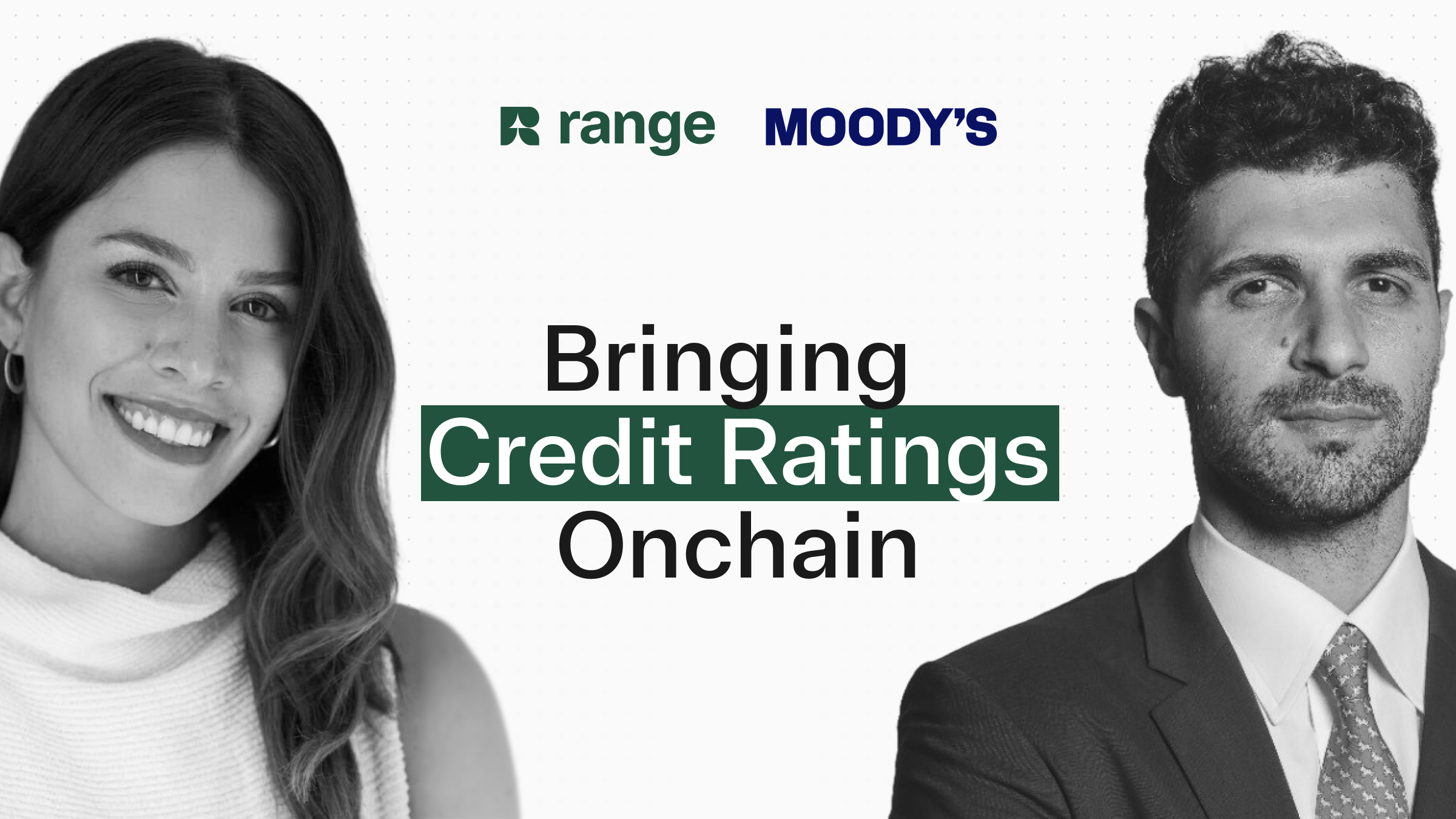
Moody's created its digital economy team in 2022 to assess how established risk frameworks apply to new financial instruments and infrastructure. Cristiano Ventricelli described a remit spanning digital bonds, tokenized funds, research and the technical work required to connect with the blockchains its clients use. The team is also broadening digital-finance knowledge across the rating organization so more analysts can assess these risks. Ventricelli acknowledged that the precision and accuracy expected of a rating agency can make it structurally slower than other market participants, while giving its assessments a distinct role. That work has moved beyond a roadmap: Moody's had rated a Bitcoin-backed structured bond, was rating tokenized money market funds and expected the scope of rated instruments to expand.
That structure reflects the central argument Ventricelli made throughout his conversation with Paula Pettit, VP of Strategy and Growth at Range. As Ventricelli explained, "We see digital finance as the modernization of certain aspects of traditional finance, and we do not see digital finance as a replacement but rather as a complement to the existing financial infrastructure." The financial instruments are changing, but credit risk, market risk, operational risk and governance remain recognizable categories. The task is to assess how blockchain architecture changes their expression and their interaction.
Moody's is therefore preparing to ingest blockchain data and disseminate ratings through the same infrastructure. Ventricelli expects market participants to check a rating on the chain where the relevant asset is deployed, removing a separate website visit from the process. Ventricelli summarized the point: "And that's why we need to be on chain as well." The location of the rating matters because the asset, the portfolio rules and the transaction logic can all operate in the same environment. Distribution becomes part of the rating infrastructure alongside the analysis.
Build the operating model around your obligations. Range starts with regulatory and reporting requirements. We translate them into operational controls and orchestrate the risk and compliance providers a company already uses, with monitoring, reconciliation and reporting running from the same record. That gives finance, compliance and risk management teams a clear control layer across stablecoins and fiat while preserving their specialist systems.
A stablecoin rating reaches beyond the reserve
Ventricelli framed a rating as an opinion about whether a company or instrument can honor its promise to pay. "A rating is basically an opinion on the ability of an instrument or a company to basically honor the promise to pay you." Ventricelli said that for a stablecoin, the promise centers on redemption at par. The assessment becomes more complex because the holder depends on the reserve portfolio, the issuer's operating structure and the blockchain infrastructure that supports the instrument.
Reserve credit quality is one part of that assessment. Government bonds may bring relatively low credit risk, while funds, private credit exposures and corporate bonds extend the risk spectrum. Market risk then asks whether those assets can be sold at par when redemptions arrive, particularly when an issuer has to act quickly. An asset can be high quality and still create a loss if it has to be sold under pressure. Segregation adds another question: whether reserve assets are genuinely separated from the issuer so that they remain available if the issuer fails. The legal form can look clear at a high level while the practical effect depends on the details of the structure.
Technology introduces another dependency. "On top of the credit risk, there are other risks such as market risk, liquidity risk, and operational risk introduced by the blockchain that simply didn't exist before." Ventricelli said a sound reserve cannot make a holder liquid when the underlying network is unavailable. A compromised mint contract can also create supply that the reserves were never designed to cover. The relevant unit of analysis is therefore the complete redemption system, including the asset pool, legal segregation, infrastructure and operational authority.
Accountability remains a human concern. Ventricelli stressed that "behind the technology, there is always human involvement" and pointed to developers, audits and upgrade authority as areas that market participants can overlook. Apply the same breadth to stablecoin treasury management: keep a unified record of wallets, custodians, exchanges and bank accounts, with policy controls, counterparty risk, reconciliation and reporting connected to each movement. Use that visibility to make controlled decisions before settlement and maintain an audit-ready record afterward.
Onchain ratings make financial policy executable
Putting ratings onchain changes what can consume them. Ventricelli used the example of an asset manager whose mandate permits investment only in investment-grade assets carrying a specified rating. Today, checking each instrument can remain a separate process outside the fund's infrastructure. A smart contract-based fund could query ratings for eligible assets, select instruments that satisfy the mandate and replenish the portfolio according to those rules.
Collateral eligibility can use the same approach. A machine-readable rating removes a manual interpretation step from portfolio logic and shortens the path from independent risk opinion to an enforceable investment rule. Automated financial activity depends on that input's integrity and availability, raising the standard for how ratings are published, updated and consumed. If your mandate can act on a rating automatically, make the policy for a rating change as explicit as the policy for entering the position.
AI agents extend the question from machine-readable information to machine-directed action. Ventricelli was careful to note that agents can use fiat, but stablecoins place them in a continuously available environment with faster settlement. The control advantage comes from separating the agent's probabilistic decisions from deterministic boundaries. As Ventricelli put it, "And one important thing is that you can enforce limits at the smart contract level instead of the agent level." The agent can decide within its remit while the surrounding contract constrains what it is permitted to do.
An agent can route payments incorrectly, fail to replenish collateral after a margin call or create disputes across jurisdictions. It has no human or legal identity, leaving accountability unresolved. Ventricelli described organizations preparing multiple layers of governance and limits, enforced automatically or through human supervision and intervention. Before an agent moves money, define the permitted asset, eligible counterparties, transaction limits, approval points and human intervention path. Turn those requirements into pre-execution controls that check policy before a transaction proceeds. Existing risk and compliance providers can supply signals, while a unified ledger preserves the transaction, reconciliation and reporting record.
Governance will shape the next phase of digital finance
Ventricelli's practical guidance for AI-enabled finance begins with the form of digital cash itself. Companies need to know whether the stablecoin supports the intended users and redemption paths. He noted that some stablecoins allow direct redemption only for a limited set of institutional participants, leaving other holders to sell through intermediaries. An agent that transacts with people and institutions needs an asset whose access model matches the use case.
Interoperability expands the operational perimeter. A seemingly simple transaction can depend on multiple protocols, wallet providers and platforms; if one component fails, the transaction can fail with it. Maintain continuous visibility into those dependencies across stablecoins and fiat, establish clear counterparty ownership and apply controls where they can be supervised and enforced. Use one control model across the complete operating path, connecting every alert to the affected transaction and counterparty.
Quantum computing pushes the same governance question further out. "So we think that quantum is a current risk. It doesn't necessarily mean it's a current driver for rating changes." Ventricelli's concern includes encrypted data being collected now for possible decryption later, as well as the migration of digital assets toward quantum-resistant infrastructure. He also connected wallet exposure to encryption design, public-key exposure and the quality of randomness used to create private keys. Because permissionless assets may lack a party capable of making a holder whole after a loss, custody design and migration execution carry direct financial consequences.
Govern the transition across cryptography, controls and asset movement, including the ability to intervene when required. That fits Moody's broader expectation for the market. "We think it would be slow but steady expansion. We do not necessarily see a hockey stick growth like many people predict." Ventricelli pointed to regulation as a key part of that pace, with jurisdictions moving at different speeds and market structures responding over multiple iterations. Progress will depend on converting new technical capabilities into controlled, accountable financial operations.
Build control into stablecoin operations
Moody's analysis points to a consistent operating requirement: reserve quality, infrastructure, governance and accountability have to be assessed together. Range gives companies one control layer across stablecoins and fiat, from requirements and pre-execution controls through provider orchestration, monitoring, reconciliation and reporting. See how Range supports stablecoin operations.
About Moody's
Moody's provides credit ratings, research, data, analytics and workflow tools that help organizations understand risk. Its services include ratings and fixed-income research as well as data and decision tools for banking, insurance and compliance workflows. Learn more at moodys.com.
Want to appear on Range Stablecoin Fireside? If you are building with stablecoins and want a seat on the show, get in touch by email or on X.
Related reading
Stablecoin Fireside
Bastion: Selling trust to enterprises building on stablecoins

Stablecoin Fireside
Aon: How digital asset insurance is underwritten, and where it stops
Stablecoin Fireside
Eco: Routing stablecoins when a dollar is not a dollar across chains
Protect your time and money
Try every capability with your real data in a sandbox before you commit.