Schuman Financial: How payments can scale euro stablecoins
Schuman Financial CEO Martin Bruncko on why euro stablecoins need useful distribution, corporate payments and settlement demand from tokenized finance.
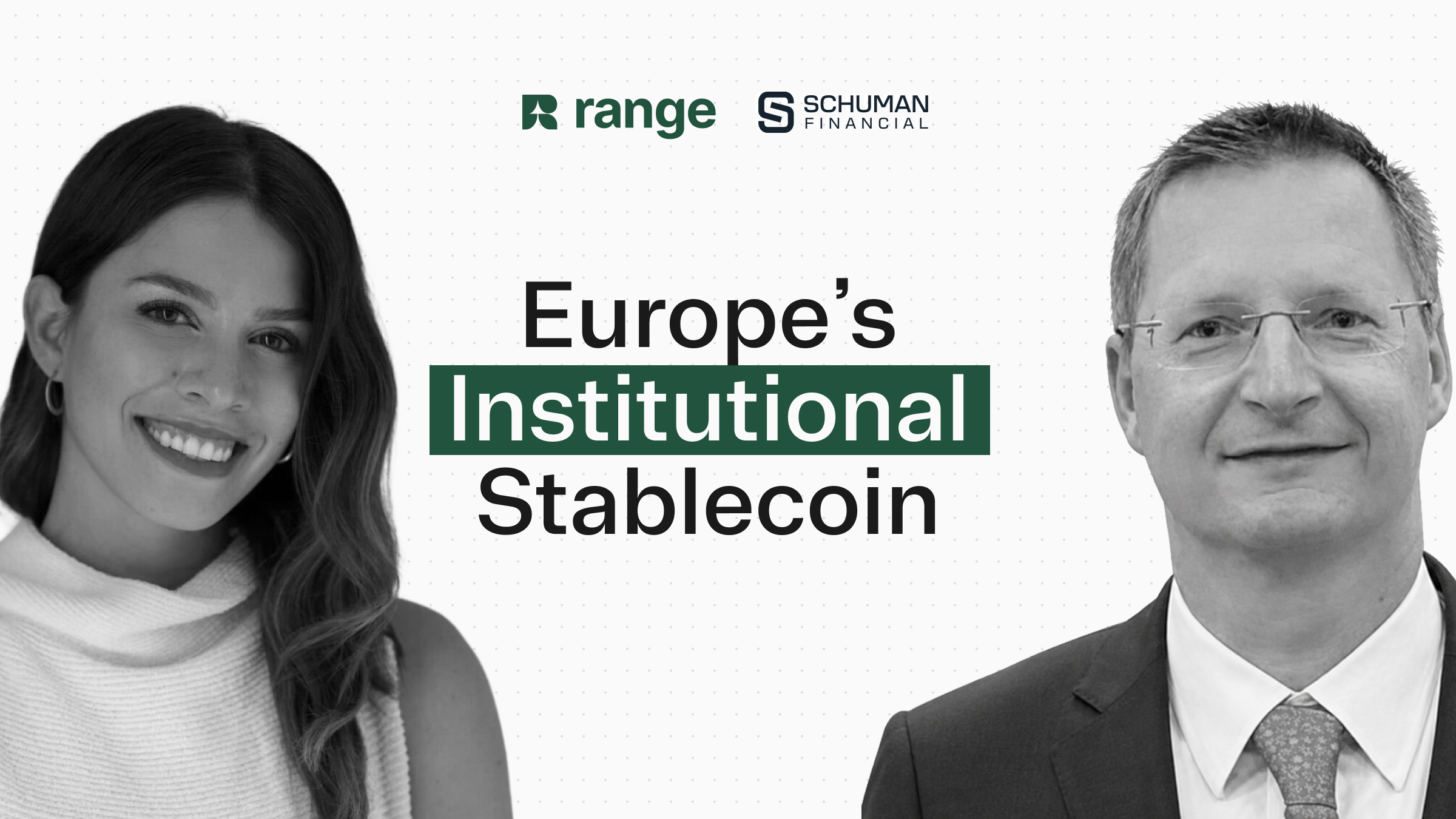
In Episode 2 of Range Stablecoin Fireside, Paula Pettit spoke with Martin Bruncko, founder and CEO of Schuman Financial, about the conditions a euro stablecoin needs to become useful at institutional scale. His starting point was the issuer itself. Bruncko defines an independent issuer as one that is not owned by a bank or another large corporation, and he sees that structure as central to how a stablecoin earns distribution. His view draws on experience across government, technology and finance: he served as a deputy finance minister, helped write Slovakia's euro adoption strategy, spent much of the past two decades in technology and led European operations at Binance while it secured licenses in France and other European countries.
His argument begins with incentives. When one bank uses a stablecoin issued by another, Bruncko said, the first bank has to move money from its own balance sheet into reserves held by a competitor. That creates a practical reason for banks to avoid each other's stablecoins. An independent issuer can sit outside that balance sheet competition and pursue adoption across institutions.
Bruncko also connected independence with operating speed. Large banks can issue stablecoins from their own balance sheets, but their product, technology and compliance processes move through a much larger organization. In his words, "you just can't be moving at a speed of a bank." Schuman Financial's response has been distribution-led. Bruncko described a "huge focus since day one on the ecosystem to make sure that we're sort of ubiquitous and accepted everywhere". He pointed to exchange listings, DeFi integrations and external holders as evidence that utility has to exist beyond the issuer's own balance sheet. The adoption test is whether other participants choose to hold and use the stablecoin, rather than whether the issuer can create supply from its own resources.
Broad distribution creates a parallel operating requirement. Range starts with the regulatory and reporting obligations a company must satisfy. We translate them into transaction controls, orchestrate the risk and compliance providers it already uses, then run monitoring, reconciliation and reporting from the same record. Broad acceptance across stablecoins and fiat becomes durable when finance, compliance and risk management teams retain control across every rail.
Corporate payments turn stablecoins into working capital infrastructure
Schuman Financial is focused first on corporate payments, with retail payments later in its sequence. Bruncko described several routes into that market, including companies that serve retail customers and businesses that want to hold balances in a stablecoin rather than fiat. Some of those corporate customers have retail users of their own, which lets Schuman Financial support consumer-facing activity indirectly while keeping its direct focus on businesses. The central use case, however, is cross-border settlement into and out of Europe.
The initial focus is the euro-dollar pair, including payments between Europe and the United States, Latin America and potentially Africa. Bruncko described a flow in which a customer requests a quote, confirms it and receives a local bank payout. He said Schuman Financial can "basically process the payment and pay it out into a euro account in Europe, like, in a matter of minutes" once the customer confirms. Schuman Financial works with integrated partners for foreign exchange conversion, which Bruncko said lets the company access rates close to interbank levels while controlling the wider payment flow. The company uses its own licensing and payment infrastructure to reduce the number of intermediaries involved.
Control over working capital is the more consequential benefit. Bruncko gave the example of a large company moving money from Europe to Africa and pre-funding a local account as much as seven days in advance because bank settlement can take that long. Those balances carry a cost and depend on a forecast of future cash needs. With stablecoin-based settlement, he argued, "you can move money instantly." He sees demand from large traditional companies as well as crypto businesses. Measure the value in cash released from idle balances, shorter settlement times and fewer intermediaries.
Faster settlement raises the standard for operational control. Keep one real-time record across bank accounts, custodians and wallets, with the counterparty, purpose and status of each movement attached. Apply policy through pre-execution controls before an onchain payment is broadcast, then reconcile the stablecoin leg, conversion and bank payout to confirm they reached the intended destination. Speed becomes financially useful when evidence and controls stay connected to the payment.
MiCA leaves room for products built around a stablecoin
Payments are one side of Schuman Financial's strategy. Bruncko also outlined plans for a broad DeFi ecosystem across several chains, supported by partners building yield-bearing products. Schuman Financial was already available across multiple networks at the time of the conversation and planned further expansion, including to Solana. His reasoning is grounded in access: familiar financial products, including money market funds, can be difficult for individuals and smaller companies to buy through existing financial infrastructure.
Tokenization can change the form in which those products are distributed and traded. Bruncko argued that tokenized money market funds, securities and bonds should be easier to buy and sell because they can bypass parts of the existing securities infrastructure. He compared the opportunity with earlier smartphones: the component ideas existed before mass adoption, but demand arrived when the product put them together in a form that worked for ordinary users. The regulatory environment is available, in his view, but demand still depends on presenting the product in a form people actually want to use.
That distinction also matters under MiCA. Bruncko said an issuer cannot pay yield simply because someone holds its stablecoin, particularly when that payment functions as interest tied to the holding period. The rule does not eliminate separate investment products: "MiCA says nothing about you taking the stablecoin and then putting it into investment and savings products that generate yield." In his framing, the issuer provides the stablecoin and the investment or savings product generates the return.
Separate the payment asset from the financial product to make the operating model clearer. Treat issuance, custody, investment and redemption as distinct activities, then apply the relevant approvals and reporting requirements to each. A unified ledger across fiat and stablecoins preserves that separation while giving you a complete view of balances, counterparties and transactions.
Tokenized finance changes the scale of the euro opportunity
Bruncko explained dollar stablecoin dominance through the market's current use cases. He estimated that roughly 95% of stablecoin activity is related directly or indirectly to crypto trading, including derivatives collateral and liquidity movements between exchanges. Because that trading has historically been denominated in dollars, dollar stablecoins became the default settlement asset for the market that exists today.
His thesis changes when traditional financial activity moves onchain. Based on Schuman Financial's earlier back-of-the-envelope calculations, Bruncko said daily trading in the euro-dollar foreign exchange pair alone was roughly an order of magnitude larger than trading across every pair on centralized crypto exchanges. He said that "once traditional financial services start properly moving on chain, the whole crypto trading market will be dwarfed." If European financial activity remains denominated in euros, its tokenized products will need a tokenized euro for settlement. The growth case for euro stablecoins therefore depends on the financial activity moving onchain, rather than taking share from dollar stablecoins inside today's crypto trading market.
Bruncko treats DeFi distribution as essential to becoming the stablecoin of choice. He sees DeFi products becoming more like traditional savings products while traditional instruments, including money market funds, move into DeFi. He argued that "if you want to be the stablecoin of choice, you basically need to provide kind of universal usability and acceptance." In practice, that means making the stablecoin available across the chains, exchanges, liquidity venues and products where its users already operate. Payments supply a concrete corporate use case, while broader acceptance gives the same asset a role in the tokenized products that settle around it.
Bruncko expects private stablecoin issuers and central bank digital currencies to coexist. He placed stablecoins in the customer-facing layer used by businesses and consumers, with a possible role for central bank digital currencies in wholesale settlement. His case for private issuance rests on the investment, product development and ongoing implementation required to make the technology useful. This mixed architecture increases the need for continuous visibility across systems. Track where liquidity sits, which entity controls it, what policy applies and whether every leg has settled, across bank accounts, public blockchains and wholesale networks.
Build control into stablecoin operations
Schuman Financial's thesis is that euro stablecoins gain scale through useful distribution, faster corporate payments and settlement for tokenized financial products. If you adopt those rails, keep one operating record across stablecoins and fiat, with controls applied before transactions and reconciliation completed afterward.
See how Range supports stablecoin operations
About Schuman Financial
Schuman Financial provides technology and infrastructure for euro-denominated payments, foreign exchange and investment management onchain. Its core product is EURØP, a euro-denominated stablecoin issued by Salvus SAS, a French electronic money institution regulated by the ACPR. Learn more at schuman.io.
Want to appear on Range Stablecoin Fireside? If you are building with stablecoins and want a seat on the show, get in touch by email or on X.
Related reading
Stablecoin Fireside
Bastion: Selling trust to enterprises building on stablecoins

Stablecoin Fireside
Aon: How digital asset insurance is underwritten, and where it stops
Stablecoin Fireside
Eco: Routing stablecoins when a dollar is not a dollar across chains
Protect your time and money
Try every capability with your real data in a sandbox before you commit.