Sphere: Connecting stablecoin payments to compliance and settlement
Sphere's Daniel Cartolin on why stablecoin payments need compliance, banking access and transparent settlement economics to work across borders.
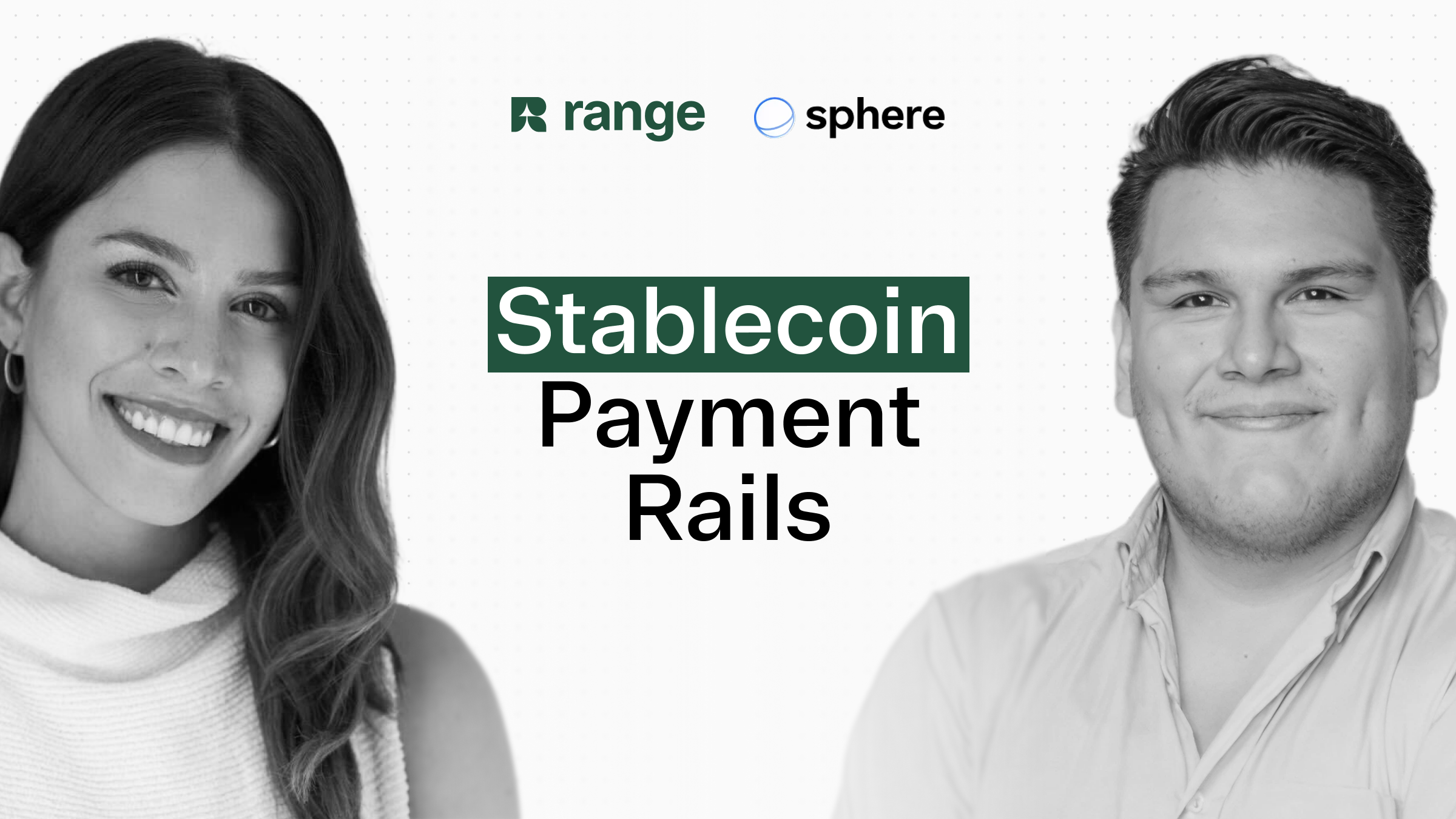
Sphere started as a Solana hackathon project with a broad concept: build a Stripe-like experience for crypto. That premise changed as Stripe entered the space. The team narrowed its focus to a more concrete problem, helping people and businesses move money across borders. Daniel Cartolin, Head of Sales at Sphere, described the company in direct terms: "Sphere Labs is a payments API for stablecoins cross border."
The problem was personal for Sphere's founders and much of its team. Cartolin explained that many were immigrants whose families had struggled to send money home. That experience shaped an early focus on access to US dollars in Latin America, Africa and Asia-Pacific. The product then developed around customers already comfortable with crypto who needed a practical way to use dollars for payments, including moving money between markets such as Brazil, the US and China.
That focus brought Sphere into ordinary business activity. Cartolin cited import and export payments, overseas bills and employee payroll as examples of the flows customers were running. These were familiar commercial needs with difficult cross-border execution. Sphere initially described the stablecoin component as electronic money used for settlement, then spoke more directly about stablecoins as regulations developed and market adoption increased. Cartolin said Sphere processed billions in volume.
Sphere now concentrates on infrastructure for fintechs, payment service providers and other businesses that aggregate payments. Its API connects fiat entry and exit points in the US, Mexico, Brazil and Europe, with the stablecoin layer handled at the back end. Cartolin traced the market's use of stablecoins from an entry point into DeFi toward payments, a shift he said accelerated over the previous year and a half to two years. Start with the payment problem, then evaluate whether the infrastructure can deliver reliable dollar access, settlement and local currency conversion.
Compliance determines whether a stablecoin rail can scale
Cartolin came to Sphere after working in blockchain analytics, where he spent time with crypto companies, banks and governments across Latin America. He watched the regional conversation move from illicit finance concerns toward store of value, remittances, investment and payments. That experience also exposed a gap. A business could buy compliance software and still struggle to secure a bank account, access US dollars or help its customers move between fiat and crypto.
Compliance and direct banking relationships underpin Sphere's payment infrastructure. Cartolin put it simply: "It all goes back to compliance." Stablecoin settlement still depends on banking access because customers need fiat entry and exit. He described bank relationships as the most important asset for a stablecoin orchestrator. A provider's licensing position, AML program, KYB process and banking partners shape what it can offer as much as its blockchain connectivity does.
The right provider also depends on the buyer's role. A business sending its own cross-border payments can use a product that packages infrastructure from other providers if the service meets its needs. A licensed fintech that already aggregates payments needs to understand who owns the underlying rail, who holds the direct bank relationship and who can support the full path from on-ramp to off-ramp. As buyers mature, their questions move from broad concerns about crypto toward jurisdictional permissions, settlement terms, fees and the operating details of compliance. Sphere's stated focus for 2026 is the US, Mexico, Brazil and the EU. Cartolin described the company's proposition around regulated operations, owned banking relationships, its compliance stack and liquidity capabilities.
Begin with regulatory and reporting requirements, then turn them into transaction controls. Range orchestrates the risk and compliance providers a company already uses. We keep those providers in place and run transaction monitoring, reconciliation and reporting from the same record, connecting policy, execution and evidence across fiat and onchain activity.
Strong corridors combine demand, regulation and liquidity
Cartolin's framework favors markets where dollar access or local liquidity is difficult, stablecoins can improve the path between currencies and a workable regulatory structure exists. Low-liquidity corridors can offer stronger economics because the existing options are constrained. They also demand more local work. Providers need counterparties that can convert stablecoins into local fiat, a clear understanding of money transmission rules and controls aligned with local AML requirements.
Cartolin pointed to Africa and Southeast Asia as attractive markets where stablecoin-to-fiat liquidity has historically been harder to access. He also emphasized that adoption takes time because providers have to educate local partners and address persistent concerns about crypto. He expects emerging-market use to spread beyond the largest existing Latin American hubs, particularly where local expertise and sustained on-the-ground work remain scarce. The commercial opportunity and the compliance burden arrive together. A corridor with demand but no credible way to operate within local rules does not provide a durable foundation for payment volume.
Regulation can increase operating costs and competition, but Cartolin sees it as a source of legitimacy and institutional readiness. "I think that the countries that regulate this, that's where you wanna be because it's just a cleaner way to do it." He identified Brazil as a particularly active Latin American market, while also pointing to grassroots adoption in Southeast Asia and regulatory development in the Middle East. His broader criterion was movement: markets beginning to formalize stablecoin activity give providers an opportunity to establish a trusted local position. He expects the same dynamic to drive institutional growth: "I see a lot more adoption at the institutional level."
Corridor coverage is only the first screen. Examine the provider's local licenses, direct bank relationships and support for the relevant fiat currencies. Test how it sources liquidity and converts it into executable rates. Cartolin described licensing, banking and product development as the difficult core of building these rails, particularly in the US, where money transmission licensing can extend across all 50 states. Establish whether the provider controls enough of the payment path to give you clear accountability as funds move between a bank, a stablecoin and a local payout rail.
The real cost includes FX and time in settlement
When Paula Pettit asked which factor buyers care about most, Cartolin answered, "Cost. Cost." The useful comparison goes beyond the fee printed on a transaction. A traditional bank may charge a small wire fee while earning through its FX rate. A stablecoin provider may charge on the transaction itself. Buyers need a common view of both structures, including the reference FX rate, the spread, every additional fee and the amount ultimately received by the counterparty.
Cartolin said experienced finance teams test pricing rather than accept a single quote. They can query an API repeatedly over a period and compare the returned rates with independent market data. That process reveals how the rate moves and where the provider's economics sit. Transparency is especially important in cross-border stablecoin payments because a faster rail does not compensate for an opaque conversion rate or an unexplained charge at the fiat edge.
Settlement time adds another cost. Cartolin described a million-dollar payment that can remain in transit for a day or two under traditional banking arrangements. During that period, the company cannot use the capital for interest, payroll, investment or expansion. The direct transaction fee may appear competitive while the business absorbs a larger opportunity cost through delayed access to its own money. That cost becomes more material for companies moving millions of dollars across multiple payments. For stablecoin settlement, Cartolin's expectation was clear: the entire message is same-day access.
Custody belongs in the same evaluation. Establish whether assets sit with a qualified custodian, an MPC technology provider or a bank with the relevant custody license, and whether you can bring your own wallet. Check currency coverage and settlement commitments too. Institutions bring larger volumes and more detailed diligence, increasing the importance of licenses, AML controls, KYB standards and direct access to banking partners. Adoption at this scale depends on operational control: every fast payment still needs an attributable counterparty, an approved policy, a reconciled ledger entry and evidence for compliance review. Finance, compliance and risk teams need to see the same transaction from initiation through settlement, across fiat and onchain systems.
Operate stablecoin payments with control
Sphere's experience points to a clear operating thesis: durable stablecoin payment rails combine local access, regulated infrastructure, transparent FX, appropriate custody and same-day settlement. Range gives companies a unified record and transaction controls across stablecoins and fiat, so payment activity remains visible, attributable and audit-ready. See how Range supports stablecoin operations.
About Sphere
Sphere provides stablecoin payment infrastructure for global businesses through APIs, a dashboard and a private desk. Its products support cross-border payments, on/off ramps, dollar access and treasury and liquidity workflows. Learn more at spherepay.co.
Want to appear on Range Stablecoin Fireside? If you are building with stablecoins and want a seat on the show, get in touch by email or on X.
Related reading
Stablecoin Fireside
Bastion: Selling trust to enterprises building on stablecoins

Stablecoin Fireside
Aon: How digital asset insurance is underwritten, and where it stops
Stablecoin Fireside
Eco: Routing stablecoins when a dollar is not a dollar across chains
Protect your time and money
Try every capability with your real data in a sandbox before you commit.