ZIGChain: How stablecoin capital reaches productive assets
ZIGChain co-founder Abdul Rafay Gadit on how visible yield sources, liquidity and equal access can connect stablecoin capital with investment products.
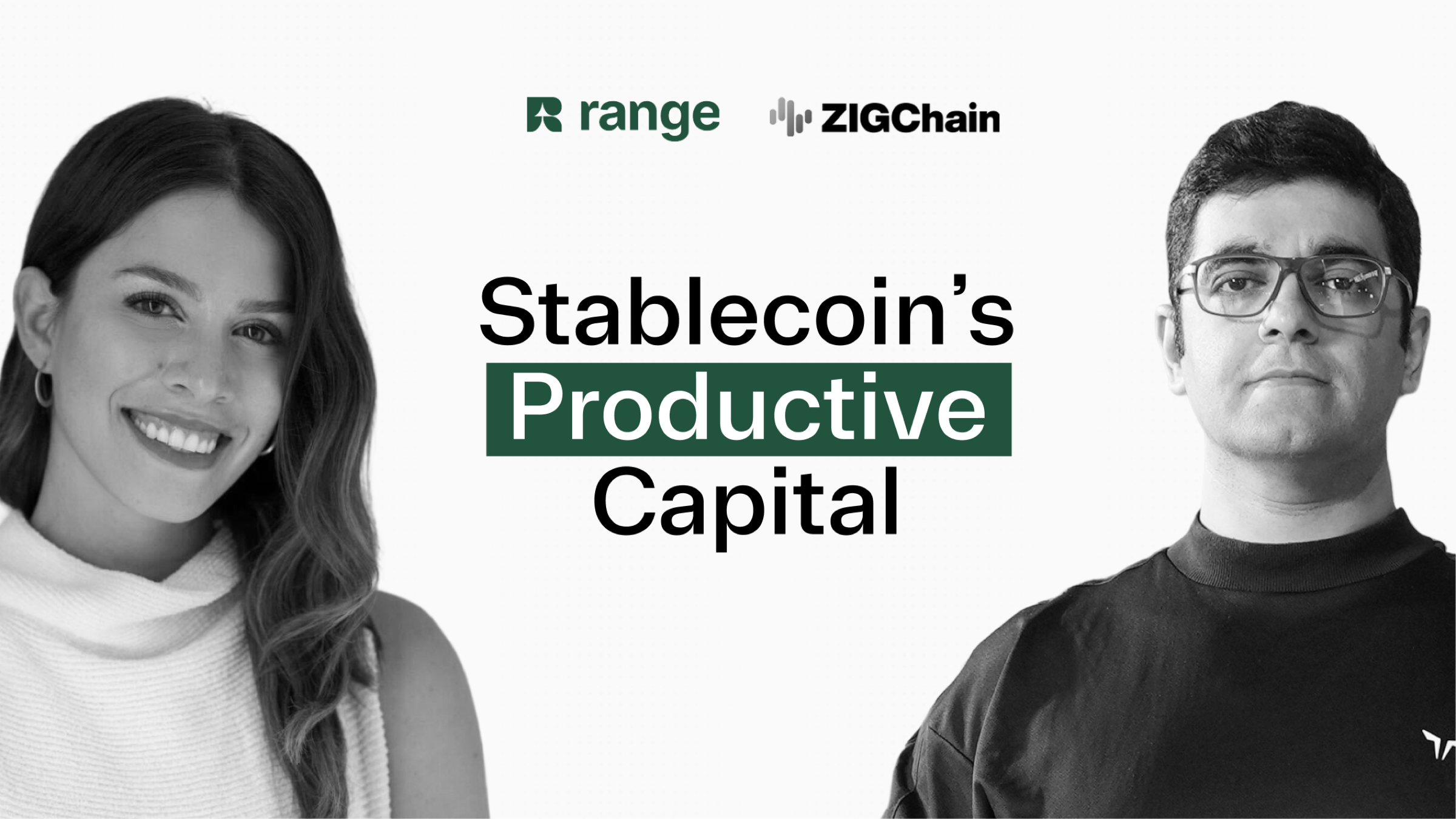
Stablecoins have created a large pool of onchain capital. Putting it to work requires access to an asset with understandable economics, credible controls and usable liquidity. In Episode 9 of Range Stablecoin Fireside with Paula Pettit, VP Strategy and Growth at Range, Abdul Rafay Gadit, Co-Founder of ZIGChain, discussed how ZIGChain approaches that market.
Gadit described ZIGChain as a layer-one blockchain built to bring investment products onchain for institutional and retail users. The project extends the community and token behind Zignaly, which began as a copy-trading platform and developed into a crypto fund-management platform. Its operating premise is that blockchain should support financial products as infrastructure, while product builders serve the end customer.
The discussion connected four parts of the same operating model: where stablecoin demand meets tokenized assets, how investors can verify the source of yield, how liquidity can reach those assets and how infrastructure can serve institutions without excluding smaller participants.
Stablecoin capital needs credible opportunities
Gadit framed the stablecoin market as early relative to the global fund market. In the episode, he put collective stablecoin supply above $320 billion and the global fund market at $120 trillion. He also said the pace of new stablecoin issuance is higher than the pace at which opportunities are being created. In that framing, idle stablecoins represent capital waiting for an investable structure, rather than an absence of demand.
Moving stablecoin balances into a vault does not make them productive. Evaluate the underlying asset, source of return and path back to liquidity to determine whether the structure can support serious capital. Gadit argued that fragmentation keeps capital and investable opportunities disconnected across markets, structures and distribution channels. As he put it, "in the world, neither the liquidity is a problem nor that opportunity is a problem. A problem is the fragmentation that they are so far apart."
He identified private credit as the largest asset category being tokenized and linked its appeal to returns above those available through conventional banking products. He described an adoption sequence that began with familiar cash-fund structures, where institutions could test the operational flexibility of tokenized assets, then moved toward private credit as confidence developed. Stablecoins can lower the cost and time involved in moving capital into these structures, while KYC and investor protections remain part of the model. In this account, tokenization improves access and settlement rather than removing the legal and operational requirements around the asset.
Before committing stablecoin capital, establish a complete record of the transaction and the obligation behind it. Know which entity issued the asset, where the return originates, which counterparties participate and what conditions govern redemption. Stablecoin treasury management requires that context alongside any yield presentation.
Yield infrastructure starts with a visible source
Gadit drew a sharp line between yield supported by an identifiable asset and yield generated by recirculating capital across crypto markets. For an institutional-grade product, investors need a look-through to the underlying private credit or other real-world asset, plus a structure that protects both the investor and the party deploying the capital. A vault without that explanation asks the investor to trust an interface instead of evaluating an asset.
The regulatory layer is part of the product architecture. Gadit described structures in which a regulated entity provides the foundation, tokenizes the asset and distributes different access paths to institutions and retail users. He also said KYC requirements are common across established vault products because serious capital requires a clear legal and compliance basis. In his words, "this is how you manage the risk by making sure that at least certain level, you have a look through to the to the yield that's been coming in, and you have some certain sort of a partner or having yourself the compliance layer on top of it."
Apply the same discipline across the stablecoin operating stack. Range starts with regulatory and reporting requirements. We translate them into operational controls applied to transactions and orchestrate the risk and compliance providers a company already uses, while monitoring, reconciliation and reporting run from the same record. That sequence gives finance and compliance teams control over stablecoin activity while keeping policy connected to execution.
Treat a yield position as an operating exposure. Record the counterparty, asset, custody venue, chain, policy requirements and transaction history. Pre-execution transaction controls can then enforce the company's rules before an onchain transaction is broadcast, while reconciliation and reporting preserve the evidence after settlement. This turns investment policy into an operating process: the information used to approve the position remains available to monitor it and account for every movement.
Liquidity is a network of access paths
Redemption risk cannot be reduced to whether an asset is onchain. Gadit opened his answer on the subject with a compact principle: "liquidity is a spectrum." Even large traditional funds can experience a liquidity mismatch when investors need cash faster than the underlying positions can provide it. Tokenization can widen the set of potential buyers and venues, but it does not eliminate the economics of credit or guarantee an immediate exit.
His proposed model brings traditional and decentralized finance into the same liquidity structure. An instrument can receive capital through banks, onchain markets and other distribution channels, with blockchain operating in the background. Gadit said users would care about relevance, utility and comfort while the underlying settlement mechanism becomes less visible, much as payment users do not need to see the messaging infrastructure behind an international transfer.
This is also why he rejected a single-channel answer to liquidity. Onchain markets remain small relative to the fund market figures he cited, so tokenized instruments still need the routes through which traditional capital moves. His conclusion was direct: "you need all the pipes in one place, and this is how you solve for the liquidity."
Plan liquidity with continuous visibility across stablecoin and fiat positions. View balances, settlement obligations and counterparty exposure across wallets, custodians, exchanges and bank accounts together. Finance teams can then decide where to commit capital and where to keep it available for payments, redemptions and working-capital needs. Keep that decision connected to policy: an attractive return does not answer when the asset can be sold, which venue supports the exit or which obligations compete for the same capital.
ZIGChain treats the blockchain as infrastructure for builders
ZIGChain's position on vaults follows its broader platform model. Gadit said, "we believe that blockchains are enablers." He compared a chain with a mobile operating environment: the platform should give application builders the conditions to build useful businesses, rather than compete with those applications for the same customers.
In practice, he said ZIGChain focuses on providing builders with access to the institutional components they would otherwise need to assemble themselves, including custody, bank integrations, licensing and a compliant backend. That support is intended to reduce the time and cost involved in bringing a regulated tokenized product to market. The chain then remains below the customer relationship. As Gadit explained, "We don't want to acquire the end customer ourselves, but we want to enable every single one."
That approach also shapes ZIGChain's institutional relationships. Gadit connected credibility with an understanding of how money and working capital move, a team with experience across banking and crypto and an ability to follow through on the operational details behind a partnership. Token creation is the smallest part of the work. Asset sourcing, compliance, distribution and liquidity determine whether a tokenized product can operate beyond an announcement. He also emphasized the discipline of rejecting opportunities that may produce short-term activity without supporting the chain's longer-term business model.
Retail distribution remains a firm requirement in that model. Gadit recalled removing a $35 monthly subscription from Zignaly because it placed a 5% monthly hurdle in front of an average user investing $700. Gadit described that as failing his own standard: "that is me not delivering on my promise of equality and equal access." He also described pilots on Zignaly, powered by ZIGChain, that made private-credit yield available to users with $10, and stated the longer-term commitment as equal terms for retail users even at a $1 investment.
Build productive stablecoin operations around control
Productive stablecoin capital requires traceable returns, policy-led controls, connected liquidity and a complete record across stablecoin and fiat rails. See how Range supports stablecoin operations for finance and compliance teams that need to evaluate opportunities, enforce policy before settlement and reconcile the resulting activity.
About ZIGChain
ZIGChain is a public blockchain network focused on infrastructure for tokenization, decentralized applications and financial products. Its ecosystem includes developer tools, smart contracts, validators, governance and a native utility token for fees and network participation. Learn more at zigchain.com.
Want to appear on Range Stablecoin Fireside? If you are building with stablecoins and want a seat on the show, get in touch by email or on X.
Related reading
Stablecoin Fireside
Bastion: Selling trust to enterprises building on stablecoins
Stablecoin Fireside
Aon: How digital asset insurance is underwritten, and where it stops
Stablecoin Fireside
Eco: Routing stablecoins when a dollar is not a dollar across chains
Protect your time and money
Try every capability with your real data in a sandbox before you commit.