Party type
Vendor, customer, investor, partner, exchange or other.
Connect a counterparty's wallets, bank accounts and documents. Assess each address against your risk policy and keep Travel Rule information and verification evidence with the transfer.
Counterparty verification
Your team needs to establish who the party is, whether the address meets policy and whether the required transfer information has been collected and exchanged. Range connects those records while keeping the evidence for each check identifiable.
Counterparty identity
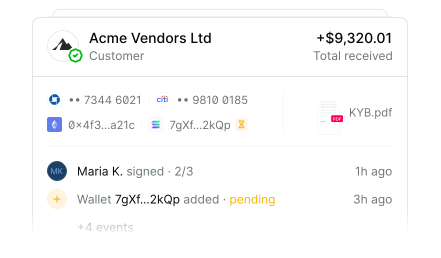
Create a directory of vendors, customers, investors, partners and exchanges. Attach their identifiers and supporting documents so finance and compliance work from the same party record.
Keep labeled onchain addresses across networks on one party.
Record bank accounts alongside the party's wallet addresses.
Attach KYC, KYB and contracts to the counterparty record.
Review sent and received activity with amounts and transaction links.
What the record holds
Vendor, customer, investor, partner, exchange or other.
Labeled addresses with their networks.
Bank, account type, currency and masked identifiers.
Supporting files kept with the party.
Sent and received amounts linked to source transactions.
Manage the same counterparty identifiers through the API.
Address risk
Screen each address to see its attribution, flagged sent and received volume and suspicious behavior. Drill into the counterparties and categories behind the result.
Review flagged shares, dollar amounts and counterparty counts.
Inspect labeled counterparties, their categories and net flows.
Review sanctions, fraud, phishing and other flagged categories.
Open signal evidence and previous screens for that address.
Risk policy
The directory establishes the party record. Address screening applies your risk policy to each wallet.
Set severity for sanctions, blacklists and threat attribution.
Configure severity percentages and a minimum USD floor.
Inspect the counterparties and patterns behind the assessment.
Category volumes can overlap when a counterparty matches several categories. They should not be added together as a unique exposure total.
Travel Rule
Range collects originator and beneficiary information, identifies the receiving VASP and routes the exchange through integrated VASP network providers.
Pair the transfer with the required message and acknowledgment.
Retain proof of control for the self-hosted address.
Document incomplete exchanges and unidentified recipients for review.
The transfer record retains the information, verification evidence and reviewer decision.
Ongoing review
A counterparty's identifiers and risk can change. Monitor wallet activity and use your existing identity provider for entity-level checks.
Alert on sanctions, blacklist changes and high-risk interactions.
Flag activity with addresses outside your configured allowlist.
Bring provider-based entity checks into ongoing counterparty review.
Entity-name screening is separate from onchain address attribution and exposure analysis.
How it works
Link wallet and bank identifiers with KYC, KYB and contracts.
Apply your attribution, exposure and behavior policy.
Route Travel Rule information and retain self-hosted wallet proof.
Review exceptions and keep the evidence with the transfer.
Range products
Protect
Pre-execution sanctions, fraud, operational and counterparty checks on onchain payments, with alerts on fiat activity.
Unify
Normalized, classified and matched activity across fiat and stablecoin rails.
Unify
Risk, reconciliation and regulatory reporting workflows, reviewed on the same ledger.
Protect
Required controls tested against your real transactions, with an examiner-ready report in 1 to 4 weeks.
Isolate your workspace, control encryption keys and use private connections. Range engineers manage the environment with your team.
Talk to an expertCounterparty questions
More questions on Travel Rule, see the full FAQ.
Case Studies
“I've had the privilege of collaborating with Range since their early days. Most recently, we worked together on a pioneering project aimed at simplifying and enhancing transparency around USDC cross-chain transfers. Throughout our ongoing collaboration, Range has consistently demonstrated exceptional technical and security-focused expertise.”
John Letey, Director of Engineering at Noble

Customer data is isolated and encrypted. Range does not hold your assets or private keys.
Screening activity, policies and sensitive workspace data are separated between customers.
Range maintains GDPR-aligned processing, access, retention and privacy controls.
Range is undergoing an independent external SOC 2 Type II audit.
Encryption, role-based access, least privilege and monitoring protect the platform.
Bring a counterparty and a transfer flow. See how the identifiers, risk findings and Travel Rule evidence connect.