Fiat and stablecoin legs
Match pay-ins, settlements, payouts and operating movements.
Match fiat payments, stablecoin transfers and ledger entries in one record. Classify activity, investigate breaks and review corrections before they reach your books.
The reconciliation gap
A customer pay-in, stablecoin transfer and bank payout can appear in different systems, with fees and FX changing the amounts between them. Range matches the related records, explains the movement and brings unresolved differences to finance for review.
Reconciliation scope
Match pay-ins, settlements, payouts and operating movements.
Account for bank, payment-processing and network fees.
Match movements across currencies and conversion amounts.
Match each movement to the ledger entry that should carry it.
Identify movements between your own accounts.
Surface duplicate, missing, delayed, failed and unmatched records.
One reconciled movement
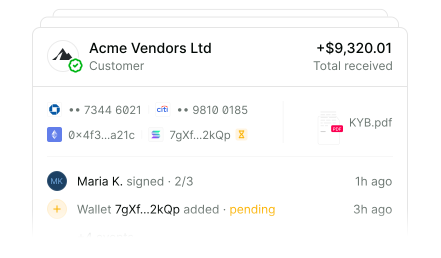
Finance can see which records belong together and where a movement stops matching.
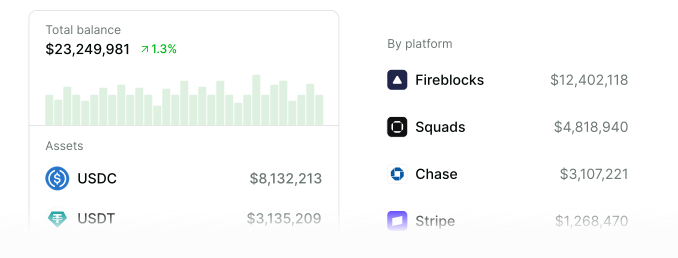
Bring bank, wallet, custodian, exchange and PSP records together.
Match the transfer, conversion, fees and accounting entry.
Keep unresolved amounts visible for investigation and approval.
Unified ledger
Search by transaction hash, address or asset. Filter by date, status, account, category and amount, then open the source details behind a movement.
Distinguish successful, pending, timed-out and errored activity.
Use 20 default categories, create your own and recategorize transactions.
See sender, receiver, network and the balance change for each party.
Add notes and save the counterparty address for later work.
Exception management
Range reconstructs unmatched activity and proposes a correcting entry. Finance reviews the evidence and approves each entry before it posts.
Trace the missing or mismatched record across connected sources.
Give the exception an owner and retain its review context.
Review the proposed accounting entry before posting.
Accounting handoff
Range connects the operating records and prepares the accounting output your finance team needs.
Use QuickBooks or Xero ledger connections alongside account data.
Send enriched onchain data to Xero, QuickBooks, NetSuite or SAP.
Import the reviewed output through your existing finance process.
Connection and export support depends on the system. Range does not replace your ERP.
How it works
Bring in bank, wallet, custodian, exchange, PSP and ledger records.
Reconcile related movements, fees and accounting entries.
Investigate exceptions and approve proposed corrections.
Hand reviewed records to your accounting system and close process.
Connected products
Isolate your workspace, control encryption keys and use private connections. Range engineers manage the environment with your team.
Talk to an expertReconciliation questions
More questions on transaction reconciliation, see the full FAQ.
Case Studies
“I've had the privilege of collaborating with Range since their early days. Most recently, we worked together on a pioneering project aimed at simplifying and enhancing transparency around USDC cross-chain transfers. Throughout our ongoing collaboration, Range has consistently demonstrated exceptional technical and security-focused expertise.”
John Letey, Director of Engineering at Noble

Customer data is isolated and encrypted. Range does not hold your assets or private keys.
Screening activity, policies and sensitive workspace data are separated between customers.
Range maintains GDPR-aligned processing, access, retention and privacy controls.
Range is undergoing an independent external SOC 2 Type II audit.
Encryption, role-based access, least privilege and monitoring protect the platform.
Bring a payment flow and its source records. Review the matched movement, the exceptions and the accounting output.