Agentic payments compliance: what x402 means for real-time sanctions screening
Agentic payments do not dissolve your compliance obligations, they multiply them at machine speed.

When a finance team hears that AI agents are now paying each other for API calls, search results, and data feeds without a human in the loop to approve the transaction, the instinct is to worry about sanctions exposure.
That instinct is correct.
x402, the protocol developed by Coinbase and named after HTTP status code 402 (“Payment Required”), lets an agent pay for resources directly within web requests, with no human in the loop and no pause for review. That is exactly the transaction pattern a sanctions-evasion attempt would want: fast, automated, high volume and easy to lose in the noise of everything else the machine is doing.
And the rail just got much bigger. Cloudflare's newly announced Monetization Gateway lets any Cloudflare customer charge for anything behind its network, web pages, datasets, APIs, MCP tool calls, with payments settling in stablecoins over x402. No billing system, no buyer onboarding: the seller writes a pricing rule, and agents pay per request, verified at the edge. Cloudflare sits in front of roughly a fifth of the web. When infrastructure at that scale turns "charge agents for your API" into a config setting, x402 stops being an early-adopter protocol and becomes the default way paid APIs meet agentic buyers, and the universe of counterparties an agent can pay is about to expand accordingly.
What an agent is and how they actually spend money
Start with what "agent" means here, because the word sounds more exotic than it is. An agent is software that acts autonomously on a user's behalf, rather than just answering questions. Ask ChatGPT to look up a stock price, and the system that runs the search, opens the page, and reads the number back to you is an agent. So is the AI assistant who books a meeting or pulls figures into a spreadsheet. Millions of people already use agents every day without calling them that. And increasingly, agents act on their own: they run on schedules, monitor feeds, and kick off sub-tasks without waiting for a prompt. What x402 adds is the ability to pay for what they need as they go.
The payment itself is simple. When an agent requests a service, the provider responds with a price, an asset, and a wallet address. The agent's wallet checks the payment against its spending rules, pays, and the request goes through. No account, no invoice, no human. The whole handshake completes in seconds.
And an agent never pays just once. A single research task might involve one payment for search results, another to scrape a page, another for a data feed, and another for the browsing tools it needs to reach a hard-to-load page. Each of those is a separate x402 payment to a separate counterparty, often one the agent has never paid before and will never pay again.
This is what breaks vendor-style screening. A finance team that reviews a few hundred vendor payments a month is not built to evaluate thousands of small payments to counterparties it has never onboarded. An approved-vendor list cannot keep up with counterparties that appear once and disappear. And a compliance check that runs only when a new vendor is set up misses every counterparty added after that, which on this rail is nearly all of them.
It compounds from there. Once a chain of paid services reliably completes a task, that workflow gets packaged and sold to other agents, and every agent that adopts it inherits the same list of unvetted counterparties.
Screening once is the same as not screening
Sanctions lists change every week. OFAC adds new wallet addresses and new companies to its list on a rolling basis, and a counterparty that was fine when you set up your payment system can become prohibited overnight.
It works two ways. OFAC can blacklist a specific wallet address. Or it can blacklist an entire company, and once it does, every wallet that company owns is off-limits too, including wallets linked to it months later. So a wallet your system approved in January can be sanctioned by March, with no change on your end.
This is why one-time screening fails. If your system only checks a counterparty when you first onboard them or checks against a list that updates slowly, nothing breaks visibly, and payments keep flowing. But some of them are now going to sanctioned parties, and you will not find out until a bank partner, an examiner, or a regulator asks about a transaction that has already settled.
The problem is the shipping order, not the protocol
None of this means x402 is inherently dangerous. A payment protocol does not carry sanctions risk on its own, transaction patterns do, and the risk here comes from how the industry is shipping this one. Sanctions screening, velocity limits and audit logging are being treated as features a team can add later, rather than requirements the payment rail is built around from the start. That ordering breaks down fast on a rail where a single agent can execute more transactions in an afternoon than a mid-sized fintech's compliance team reviews in a quarter.
And "later" is already here. Base, the network where most early x402 adoption has happened, has processed over 100 million x402 transactions. That is not pilot activity. It is a payment rail running at production scale, and most of the traffic is agents paying other agents.
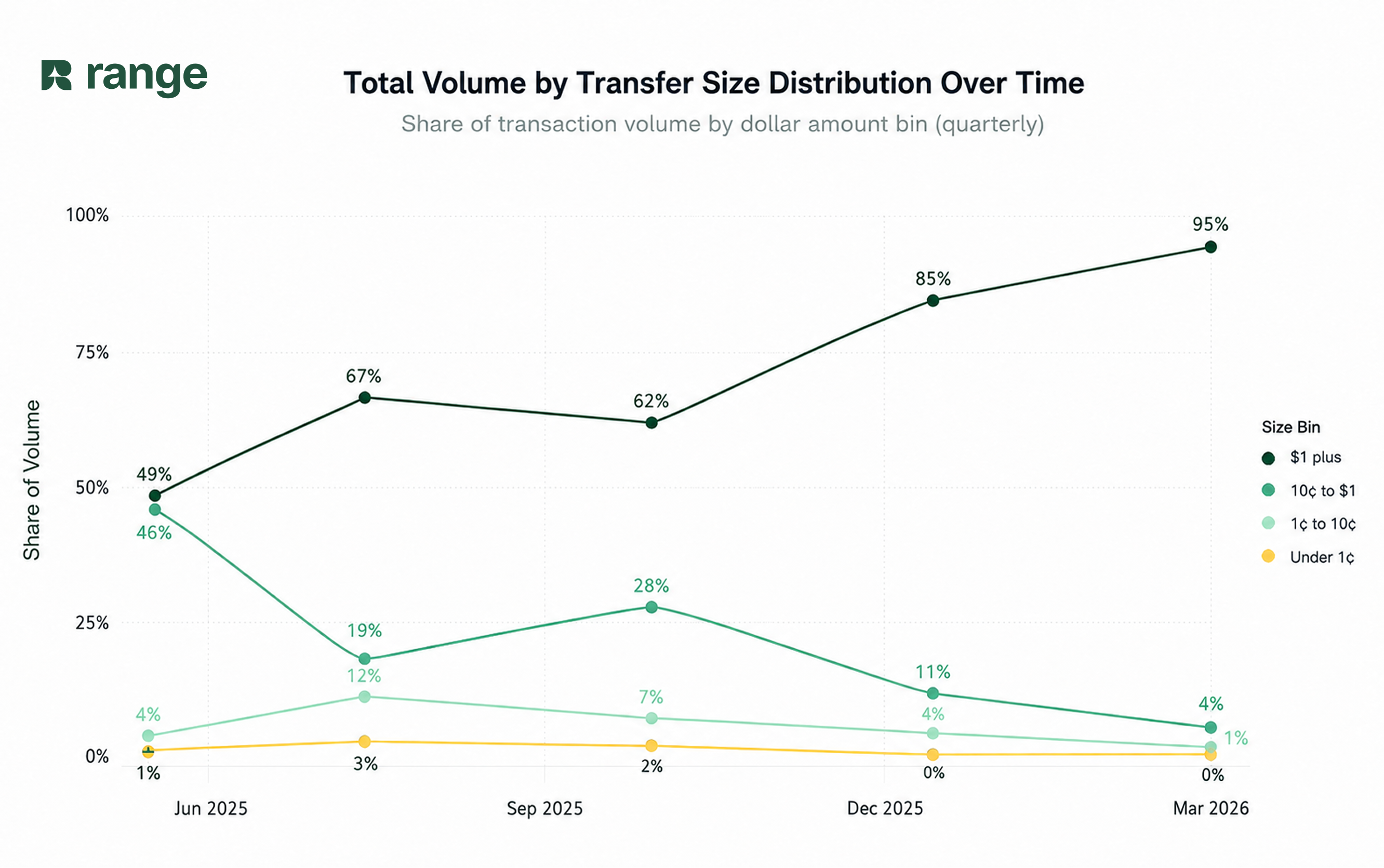
What's moving across it is changing too. The rail started out as sub-dollar micropayments, but public analyses of its onchain traffic show the balance has flipped over the past year: payments of a dollar or more now account for most of the value flowing through it. So the money is no longer trivial, and the parties receiving it have gone through none of the vetting a traditional vendor would.
"But we only pay big, legitimate infrastructure providers"
The strongest objection to all of this is that it is premature. Most x402 transaction volume today does not go to shady one-off services. It goes to a small set of large, legitimate infrastructure providers: search, scraping, data, and the edge networks that route most of the web's traffic. If your agents pay the same handful of household names every time, the argument goes, continuous screening is a solution waiting for a problem.
Two answers.
First, being big does not protect a counterparty from sanctions. Entity-level designation is how OFAC most often reaches large companies. The real exposure is not just the unknown shell service, it is any counterparty whose status changes between the day you onboarded it and the day an agent pays it again.
Second, today's concentration is a snapshot, not the destination. In April 2026 the protocol moved to vendor-neutral governance under an independent foundation backed by major payment networks and cloud providers. The largest content-delivery networks now let any publisher charge agents per request, settled onchain. And agents increasingly carry their own wallets and spending policies, so they can pay whoever offers the data or compute a task needs. The counterparty set that looks concentrated today is being built, deliberately and by the largest players in the space, to widen.
The right time to build screening is before your counterparty list surprises you, not after.
Three controls close the gap
The first is screening every payment, not just the first one. Sanctions exposure must be checked against the current list for every transaction, not the list that existed when the integration shipped. Range's Transaction Screening module checks every onchain transaction before it executes, covering sanctions, blacklists, fraud, and operational risk, with alerting on fiat and onchain activity. A counterparty is evaluated at the moment it is paid, not only when it was first introduced. Paired with Counterparty Risk & Travel Rule, the same counterparty is re-screened every time it reappears, however deep in an agent's chain of payments, with Travel Rule data routed against FATF and regional requirements.
The second is spending limits that enforce themselves. A cap written in a policy document only works if someone remembers to check it, and at thousands of agent payments a day, nobody will. Range's Treasury and Portfolio Risk module applies more than 500 configurable rules covering asset, FX, custody, protocol, and chain risk, so a finance team can cap exposure at the payment rail itself. The limit is enforced where the transaction happens, not left to the agent to police itself.
The third is the audit trail, the gap that surfaces last and costs the most. It looks complete until an examiner tries to reconstruct a specific chain of payments and finds holes. Range's Transaction Reconciliation module automatically normalizes and enriches transaction history across rails, and Reporting and Intelligence turns that history into real-time visibility, feeding labeled, classified records into the accounting and reporting tools a compliance team already uses. The record is built for examiner review from day one, not assembled after someone asks for it.
Compliance has to run at agent speed
If agents are initiating payments, the compliance layer checking those payments has to work the same way: reachable by machines, at machine speed, not just visible on a dashboard a human reviews the next morning. That principle is built into Range. Our API module supports MCP and AI-agent integrations directly, so agents can query our data surfaces natively rather than through a layer bolted on after the fact.
Range is the platform for companies operating across stablecoins and fiat. It does not replace the payment protocol or the agent framework you have already built. It sits underneath both, applying the same controls whether a payment was initiated by a person or by an agent acting on their behalf.
None of this waits on new regulation. The requirements already exist. What x402 changes is the speed at which a system has to meet them, and speed is an infrastructure question, not a policy question.
If your treasury or compliance team is evaluating or already running agentic payment workflows, see how Range applies pre-execution controls and real-time screening to every transaction an agent initiates. Book a demo.



Protect your time and money
Try every capability with your real data in a sandbox before you commit.