Kraken, Coinbase, Binance and five more exchanges are now live on Range
Exchange balances have always lived in statements you export and reconcile later on a spreadsheet, now they sit in the same unified view as everything else you hold.
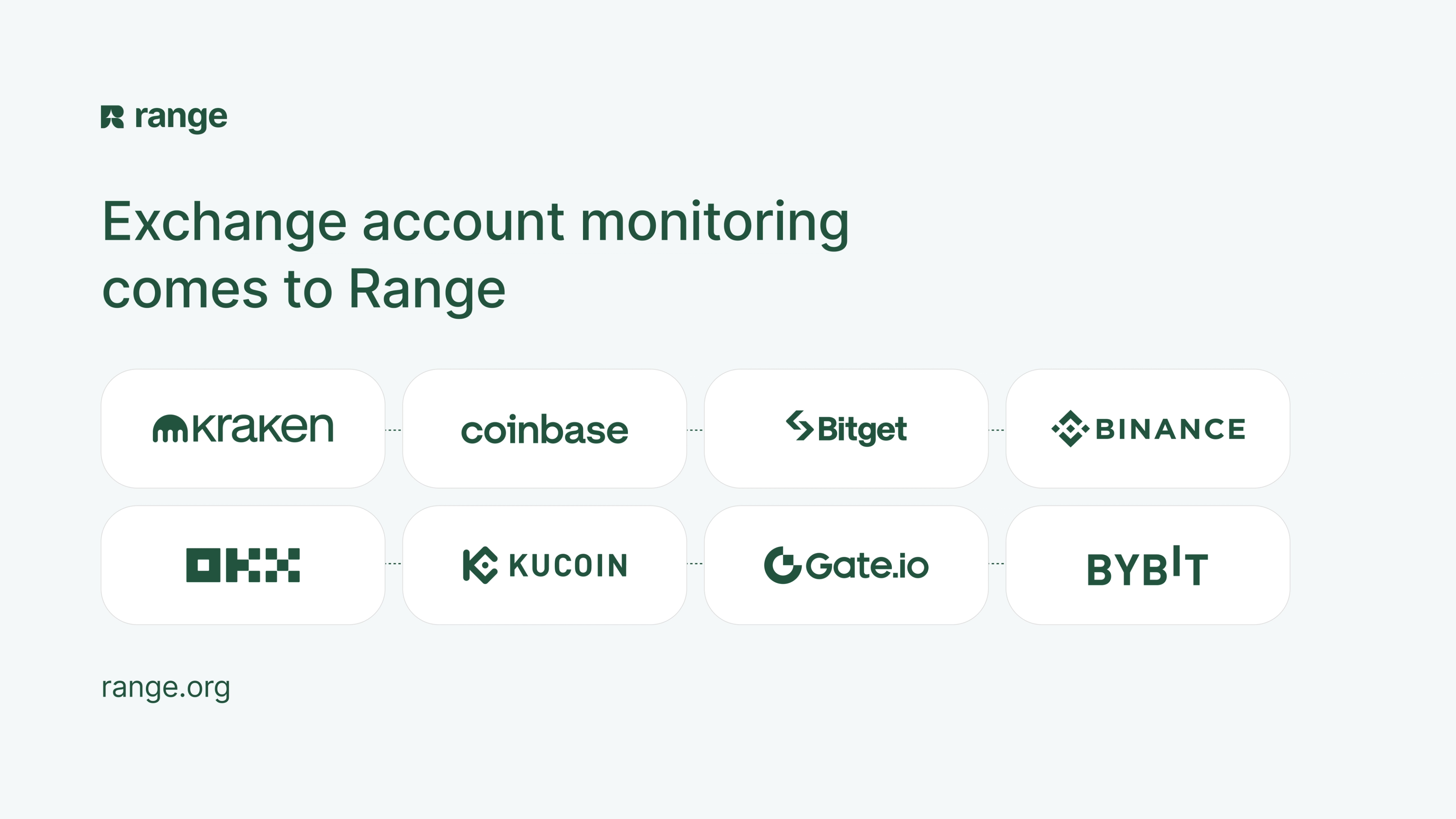
Range now supports account integrations with eight centralized exchanges. Balances and transactions from your exchange accounts flow into the same real-time ledger as every wallet, bank account and custodian you hold, with continuous monitoring across all of them.
Connect all your wallets across 200+ blockchain networks, plus your bank accounts, your exchange accounts on Kraken, Coinbase, Binance, OKX, Bybit, Bitget, Gate and KuCoin, and your custody wallets, to see every balance and transaction in one unified view.
Connecting your accounts is completely free, with unlimited integrations, unlimited team members and no per-seat pricing. Connect your accounts at range.org.
What CEX account monitoring in Range does
Connect your exchange account and easily pull its balances and transaction history. Deposits, withdrawals and trades are automatically categorized next to every wallet transfer and bank payment you want to track in Range.
That labeled history is what your month-end close runs on. Range feeds enriched transaction data into the formats Xero, QuickBooks, NetSuite and SAP can ingest, and builds an income statement and balance sheet from your labeled transactions, so finance is reading the same numbers as compliance instead of rebuilding them.
The same continuous sanctions, fraud and exposure monitoring that Range runs on your wallets and bank accounts now covers your exchange accounts. A counterparty that appears as a wallet, a bank account and an exchange deposit address is one record in Range, so exposure is measured across your entire treasury rather than per venue. Anything that trips a rule lands in an activity log your team can act on and hand to an auditor.
There is no export step and no month-end reconciliation queue. The ledger is already current when your finance team opens it.
Why crypto treasury management across exchanges needs one ledger
Companies operating across stablecoins and fiat rarely keep funds on a single venue. Balances sit on two or three exchanges for liquidity and off-ramps, in custody for reserves and in bank accounts for fiat operations. Each exchange reports in its own format and on its own schedule, and the gaps get closed by hand: someone exports statements, matches transactions in a spreadsheet and sends compliance a snapshot that is stale before anyone reads it.
That process does not scale with transaction volume, and it means exposure checks happen weeks after the money moved. If a counterparty on one exchange is later flagged, a batch review surfaces it long after the transaction cleared, when the options for doing anything about it have narrowed. And when an auditor or a regulator asks what you held and moved on a given day, the answer is only as fast as the person who can rebuild the spreadsheet.
Exchange account monitoring in Range removes the manual step: every account on every venue is screened continuously, the moment each transaction lands, against the same sanctions lists and risk signals as the rest of your treasury. The same record answers the finance, compliance and audit questions because there is only one.
For finance, compliance and risk teams
If your finance, compliance or risk team is still reconciling exchange statements by hand, get in touch and we will show you every balance and transaction across your wallets, your banks, your custodians and Kraken, Coinbase, Binance, OKX, Bybit, Bitget, Gate, KuCoin, with more exchanges coming soon, in a single live view and completely free.

Protect your time and money
Try every capability with your real data in a sandbox before you commit.