Mastercard Stablecoin Security: what finance teams still need to control
Mastercard's new stablecoin risk-scoring service helps institutions assess payments before they settle, but they remain responsible for the decisions and records behind those payments.

Mastercard is bringing its fraud and compliance intelligence to stablecoin payments.
Announced on October 19 at Money20/20 USA, its new Stablecoin Security service assesses fraud, scam, sanctions and other financial-crime risks before a payment completes. The service combines Mastercard's payment intelligence with blockchain analytics and returns a risk score through an API that connects to existing fraud and compliance systems.
Consider a bank processing a stablecoin payment for a business customer. The service can help the bank assess whether to proceed with the payment or require further review. It provides additional information at a point when the bank can still act.
The service will launch in North America first, with worldwide commercial availability expected in 2027. Borderless.xyz and Keyrails are the initial partners. Mastercard says it will expand the service's reach in 2027, including through BVNK, the stablecoin infrastructure firm it acquired in August.
Banks that adopt the service can assess a payment's risk indicators before funds move, while they still have time to apply their own controls.
But receiving a risk score is only one part of managing a payment. Finance and compliance teams still need to know who they're paying, whether the transaction meets company policy and how to account for it once it settles.
Range is built around that gap. It starts with what regulators and auditors expect a company to show, turns those requirements into controls on every payment, works with the risk and compliance providers a company already uses and handles monitoring, reconciliation and reporting from the same record.
What can a risk score tell you?
According to Mastercard, Stablecoin Security examines transaction context, the origin of funds, exposure to restricted parties and potential scam activity.
Stablecoin payments need these checks because funds can pass through multiple wallets and transactions before reaching their destination.
A Bank for International Settlements working paper examined 593 million transfer events across 141 million Ethereum transactions involving USDT, USDC and PYUSD in 2025. Nearly 60% of those transfer events occurred within complex, multi-step transactions.
The research doesn't evaluate Mastercard's service, but it shows why looking at a single transfer may give an incomplete picture of onchain activity.
A risk score can help institutions assess that activity. What happens next depends on their internal controls.
What finance and compliance teams still need to manage
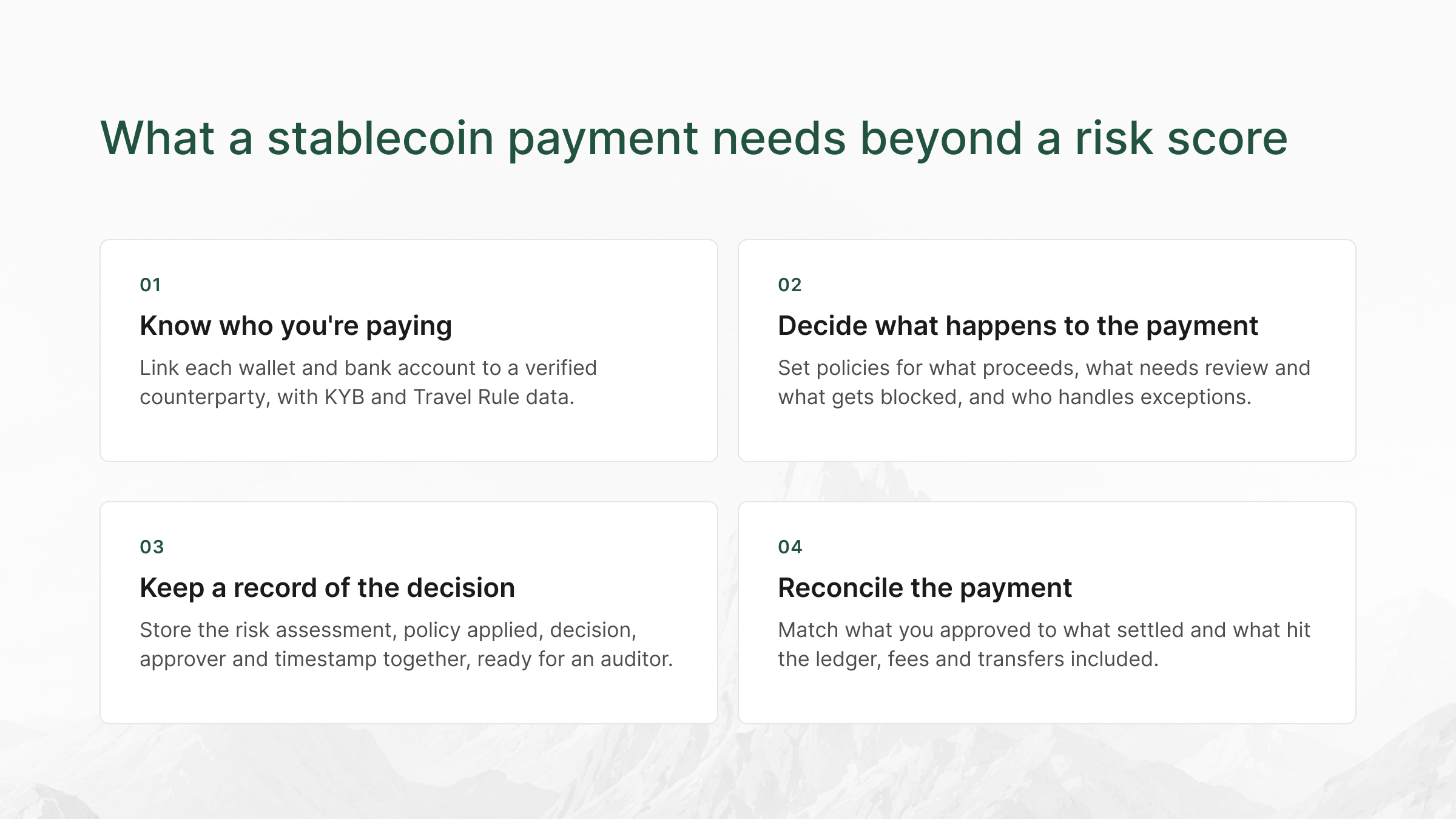
Even with automated risk scoring, finance and compliance teams still need to manage four parts of the payment process.
1. Know who you're paying
A wallet may have a low risk score and still belong to a vendor your company hasn't approved.
Finance teams need to connect wallet addresses and bank accounts to verified customers, vendors and partners. That includes keeping the relevant KYB documents, approval status, transaction history and applicable Travel Rule information together.
Teams need to know who they're transacting with, whether they're using a bank account or a stablecoin wallet.
2. Decide what happens to the payment
A risk score is useful when it's connected to a clear action.
Companies need policies that determine which payments can proceed, which require additional review and which should be blocked. They also need defined responsibilities for handling exceptions.
For example, a payment flagged for sanctions exposure should follow an established review process before releasing funds.
3. Keep a record of the decision
Months after a payment settles, an auditor or regulator may ask why it was approved.
The company should be able to retrieve the risk assessment, the policy applied, the resulting decision, who approved it and when.
Keeping that information together makes it easier to review individual payments and demonstrate that the company followed its controls.
4. Reconcile the payment
Once the funds move, finance teams need to verify that the transaction they approved matches what actually settled and what was recorded in their accounting system.
That includes accounting for fees, internal transfers and any differences between the expected and settled amounts.
Without reconciliation, a company may have evidence that a payment passed its compliance checks but struggle to connect that approval to the final ledger entry.
Connecting risk scores to payment controls
Most companies already use several systems to manage payment risk.
A compliance tool might flag a wallet, an internal system might hold the vendor's approval status, and a separate accounting platform might record the payment.
Each system contains useful information, but reviewing the full transaction means bringing those records together.
The risk assessment needs to link the counterparty, the payment decision and the final ledger entry.
Teams can then use different risk providers without rebuilding their approval and reporting processes around each one.
How Range brings these controls together
Range helps companies manage this process across fiat and stablecoin payments.
Before funds move, Range screens transactions for risk and applies the company's configured policies to allow, block, flag or escalate them. The same workflow can record screening results, alerts and approvals.
Range also connects wallets, bank accounts, exchanges and custodians to verified counterparty profiles, giving finance and compliance teams a consistent record of who they're transacting with.
Companies can continue using their existing risk and compliance providers through their own API keys. Range brings those results into the payment workflow, where teams can evaluate them alongside counterparty information and internal policies.
After settlement, Range's Transaction Reconciliation matches payments across fiat and stablecoin accounts, including fees and internal movements, and feeds enriched records into existing accounting tools.
Finance teams can see which counterparty was paid, which controls were applied, who approved the transaction and how it was recorded in the ledger.
Want to see how this works with your existing payment infrastructure? Book a demo to connect your accounts, apply your policies and see how screening decisions are recorded against your counterparties and transactions.



Protect your time and money
Try every capability with your real data in a sandbox before you commit.