Where do stablecoins sit at rest? We mapped $180B to find out
5 stablecoins share a $1 peg. Their distribution and usage tell 5 different stories.
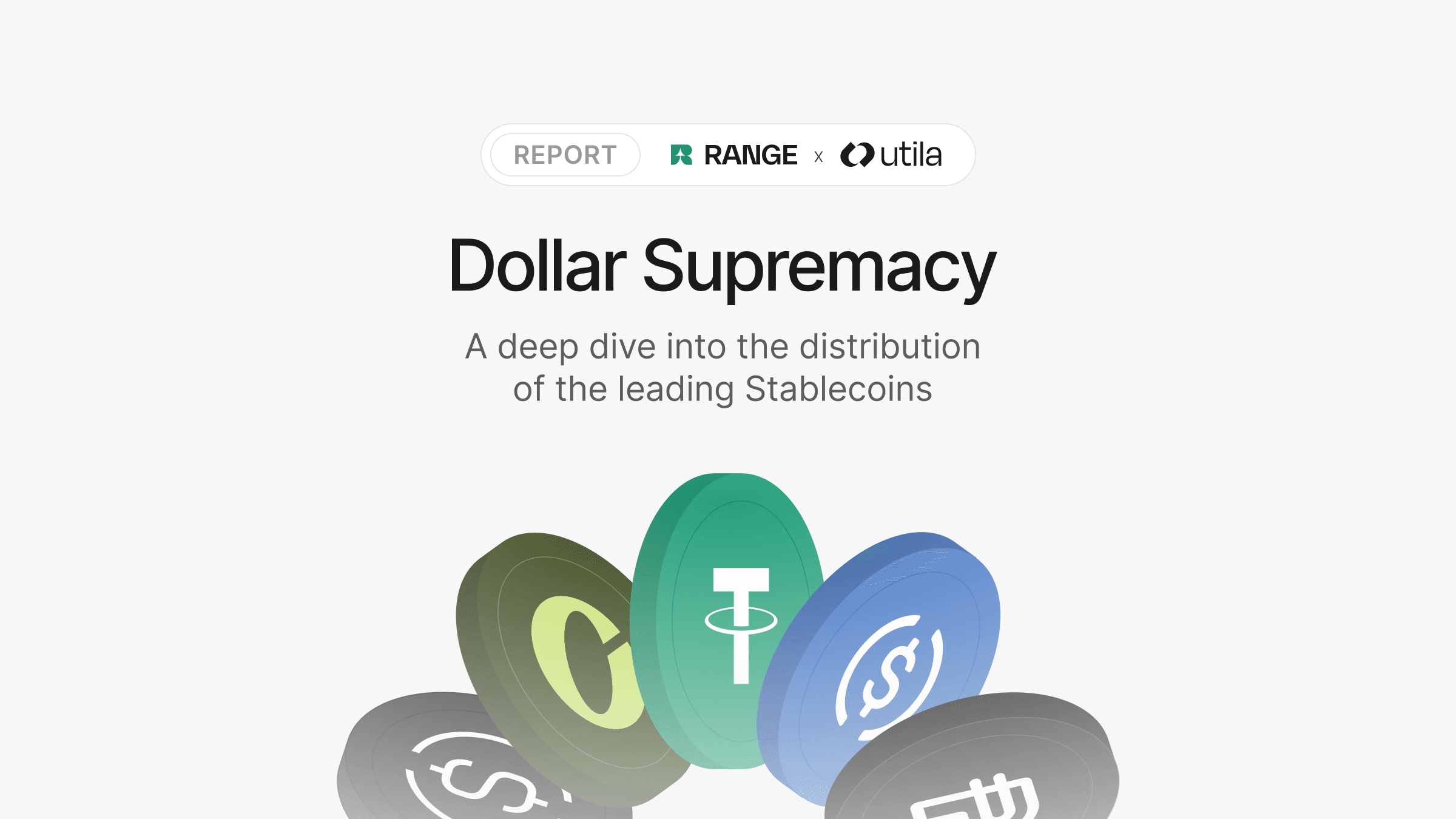
$180 billion in USD stablecoins sits across Ethereum and Solana. We mapped the full distribution of five major tokens, USDT, USDC, USDe, PYUSD and USDG, to answer a straightforward question: where does the money actually sit, and who controls it?
The result is Dollar Supremacy: A deep dive into the distribution of the leading stablecoins, Range's second stablecoin report, written by Max Grabner, our Head of Product.
"The $1 peg is the only thing these tokens share. When you look at where the supply actually sits, you find five fundamentally different financial products, each with its own concentration risks, counterparty dependencies and liquidity structure."
Max Grabner, Head of Product, Range
The findings show an ecosystem that is more concentrated, more structurally varied and more opaque than headline numbers suggest.
Same peg, different products
Stablecoin distribution data reveals that a dollar peg does not make these tokens interchangeable. Each stablecoin has developed a distinct usage pattern that defines its role in the broader ecosystem.
USDT effectively functions as an exchange settlement token. 57% of the analyzed supply sits on centralized exchanges, with Binance alone holding 40% of USDT's $107.1B market cap. USDC, at $62.1B across 7.6M holders, has the flattest concentration curve of any token in the study and the broadest distribution across DeFi, exchanges and wallets. USDe operates almost entirely as a yield instrument, with 63% deployed in DeFi and 59.8% locked in a single staking contract. PYUSD's $3.76B supply concentrates in lending protocols at 34%, functioning primarily as a lending subsidy. USDG is a directional bet on Solana, with 71.5% of its $1.29B supply on that chain.
Contrary to popular belief, these stablecoins are not competing products. They are structurally different financial instruments that happen to trade at the same price.
The ecosystem is shallower than it looks
Concentration risk runs deeper than most participants realize. Three centralized exchanges hold 36% of the combined supply across the five tokens analyzed. Binance's approximately $46B in holdings exceeds the combined circulating supply of USDe, PYUSD and USDG.
Every token's top three holders control between 23% and 81% of total supply. That range is wide, but even the lower bound represents significant concentration for assets positioned as foundational to onchain finance.
Additional data points reinforce the pattern of consolidation.
- $1.59B in USDT is currently blacklisted, up from $700M in January 2026
- USDe has just 13,200 holders, with the majority of supply in a single contract
- USDG's 6,336 holders make it the smallest distribution set in the study
- Squads multisig vaults hold approximately $980M across four tokens on Solana
These numbers point to an ecosystem in which a small number of entities exert outsized influence over stablecoin liquidity and movement.
Most of the opacity is a data problem
USDC has 38% of its Ethereum supply sitting in unattributed wallets. The report shows why this is a data coverage gap, not a fundamental anonymity issue.
Exchanges use highly structured wallet architectures that make identification possible at scale. OKX maintains 11 USDT wallets, each holding exactly $500M. Coinbase distributes USDC across 12 addresses, each receiving exactly $ 348M. These round-number patterns, combined with code hash matching and behavioral inference, mean that identifying one exchange wallet often unlocks dozens of related addresses.
The report improved attribution coverage meaningfully during its analysis. PYUSD on Ethereum went from 75% to 97.1% attributed after identifying a single $598M whale address. USDT on Solana improved from 42.5% to 76.6%. The tools exist. The gap is closing.
What this report covers
Dollar Supremacy draws on data as of March 2026, when total stablecoin circulation reached $300B, with over 70% concentrated on Ethereum and Solana. The report includes holder-level breakdowns, concentration metrics and distribution analysis for each of the five tokens.
Industry perspectives from Utila, Agora, Altitude, M0, Mento and Bitso Business provide additional context on how stablecoin distribution patterns affect infrastructure design, compliance strategy and risk management.
Read the full report
The stablecoin market's $300B headline obscures the underlying structural reality. Distribution data tells a more precise story about where risk concentrates, where liquidity actually flows and what it takes to monitor these assets effectively.
Download the report and explore the full stablecoin analysis here - Dollar Supremacy: A deep dive into the distribution of the leading stablecoins

Protect your time and money
Try every capability with your real data in a sandbox before you commit.