Bison Bank: Issuing stablecoins from inside a regulated bank
André Rendeiro, Executive Board Member at Bison Bank, on bringing crypto-asset services into the bank, using stablecoins for cross-border transfers and making compliance support the business.
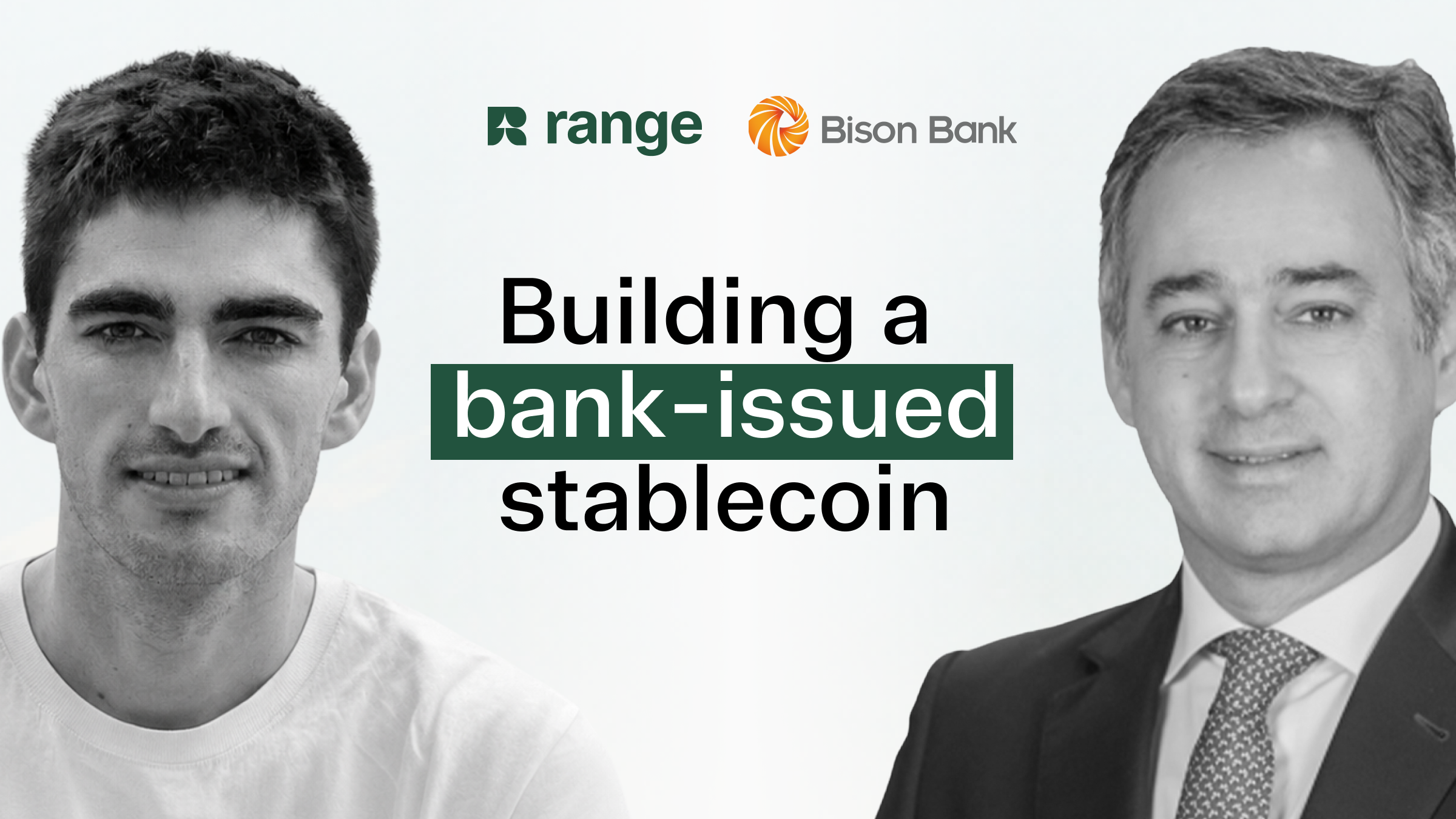
Bison Bank spent three years supporting a separate crypto-asset subsidiary before bringing the business inside the bank. It now provides crypto-asset services directly under MiCA, which it describes as a first for a bank in Portugal, and issues EUB and USB, euro and US dollar e-money tokens on Solana. André Rendeiro, Executive Board Member responsible for risk, compliance, governance and legal, joined Andres Monteoliva, Co-founder and CEO of Range, on Range Stablecoin Fireside to explain those decisions. The Lisbon-based bank serves mostly high-net-worth individuals and institutions worldwide across private banking, corporate advisory, custody and digital assets. André put its current size at around 10 billion in assets under management and 8,000 clients.
At Range, the end-to-end financial control platform for regulated companies using stablecoins, digital assets and fiat, we start with the requirements a bank's supervisors and auditors set. We translate those requirements into transaction controls and orchestrate the screening, custody and compliance providers the bank already uses. Monitoring, reconciliation and reporting run from the same record across stablecoins and fiat.
Why Bison Bank built its crypto business outside the bank first
Formerly Banif Banco de Investimento, Bison Bank was acquired by a Hong Kong-based group in 2018. Its digital asset business began in 2022, after Portugal's banking regulator introduced a registration regime for virtual asset services focused largely on anti-money laundering. Bison established a wholly owned subsidiary, Bison Digital Assets, outside the bank's supervisory perimeter.
The separate entity gave Bison room to learn while keeping any reputational event in the new business away from the bank. "So it was safer for us to do aside the bank, also to grow and learn," André said. The subsidiary started with Bitcoin and Ethereum exchange and custody, then added crypto assets, liquidity providers and its own custody and tokenization infrastructure. For three years, the bank supported it through a service-level agreement covering risk, compliance, accounting and business development.
Under MiCA, Bison merged the subsidiary into the bank, formalizing the relationship already established through that agreement. André said the move gave clients greater comfort and allowed Bison to offer crypto services to its traditional banking clients directly. He added that MiCA enabled the bank to add advisory services. Digital assets now account for about 10% of the bank's net operating income, André said, though Bison is in no rush to expand the business. "We need to learn and to go smoothly," he said.
For banks weighing digital assets, the starting point is deciding which services their control functions can supervise today and which require more experience. Documenting each function's support for the new business makes it easier to bring that arrangement inside the bank later.
Banks and regulators are learning together, so adoption will be slow
Bison aligns each step with Banco de Portugal and Portugal's securities market regulator, the CMVM. André said the bank makes sure both understand and are comfortable with its decisions. In his account, supervisors are learning too, and Bison's operations give them a working example of the activity.
Asked what holds other banks back, André pointed to knowledge. "I think there's a significant knowledge gap within the traditional banking system," he said. Large banks have established business models, he explained, making each move toward innovation a bigger challenge. He described Bison as a bank of about 130 people, with fewer resources but the ability to decide and implement faster. He read MiCA's decision to let banks provide crypto-asset services from their own resources as "a very strong sign from the regulators that this activity is here to stay".
André expects adoption to be slow over the next year, with tokenization among the first areas to advance. Bison has already discussed with the securities regulator some client funds that want to move in that direction, he said, because they see cheaper, easier settlement and lower tickets that open access to more people. He sees few European banks moving on stablecoins yet, though he pointed to a consortium exploring a joint stablecoin for its clients. The concept resembles Bison's own, he said, except that those banks would issue jointly from the start. In two to three years, André expects much broader bank adoption. He welcomes the prospect of a larger market with more participants and greater safety.
Preparing for either stablecoins or tokenization means allowing time for supervisors and internal teams to learn. Bring regulators into the discussion early and show them each proposed step before taking it.
How EUB and USB replace the correspondent banking chain
Bison launched EUB and USB to address its clients' cross-border payment difficulties. André described a US dollar transfer passing from a European client's bank through its correspondent, an American bank and the destination bank's correspondent before reaching the recipient's bank. Each compliance team can stop the payment to request information, and the transfer can take days. "Many times, we as a client, we don't even know where the money is," he said.
Bison's alternative is a closed network of banks, crypto-asset service providers, e-money institutions and payment institutions. Each opens an account with Bison to become a direct member, able to request minting and redemption. Members' institutional clients access the tokens through them. EUB and USB move only between whitelisted wallets. André said onboarding follows Bison's usual account-opening process for financial institutions. The bank then screens each wallet with its onchain tools and may request more information depending on the risk score. André said the harder task is persuading institutions that joining the network will help them serve their own clients.
The client may never know a token was involved. In André's account, the client requests an ordinary fiat transfer, and Bison checks its purpose and the destination bank as usual. At the point where the fiat would normally move over SWIFT or another rail, Bison instead sends tokens to the receiving direct member's wallet. That member usually retains the tokens and pays the recipient in fiat from its own funds. It can also return tokens to Bison for a credit to its bank account. As a bank issuer, André said, the fiat backing the token "is managed within our liquidity and risk framework as a whole", whereas an e-money institution needs a bank account to hold it. Volumes remain low, he said, and the network is focused on the Europe-Asia corridor for now.
Designing this kind of network requires distinct checks for institutional onboarding, wallet whitelisting and individual transfers. Keeping the fiat payment record and onchain transfer in one view lets operations teams show where a payment is at each stage.
Why Bison prioritizes dollars, institutional members and Solana
Bison issued a euro token because it is a European bank. André said the additional work was limited: the same white paper in a different currency. He sees the stronger use case in dollars, particularly for trade finance and cross-border transfers. Within the euro area the normal rails make sense, he said, while the token may make sense once payments go abroad. Other issuers see cross-border payments as the main market for a regulated euro stablecoin. Bison is starting with dollars. It is also testing other use cases, including one with a Portuguese university and a large Portuguese company, and another for payroll.
Bison will not offer the tokens directly to retail customers. "We are not a retail bank," André said, and serving retail would require a different structure and a large investment. Instead, Bison plans to reach retail customers through its members. Its goal is to onboard four to six direct member institutions next year, each with financial institution clients that serve retail customers.
Both tokens run on Solana. André said track record came first in the bank's assessment. Ethereum has a longer history, but Solana has been running for six or seven years. Although it struggled with stability early on, he said, it has since reached the stability and operability Bison needs, with competitive and stable transaction costs. The bank may add other chains if needed.
Before issuing a token, establish which currency clients need to move across borders and who can hold it. Assess the chain's track record, stability and transaction costs, and keep controls separate from the network so they can support additional chains later.
Compliance should let good business into the bank
Andres asked how André balances innovation with his responsibility for risk, compliance, governance and legal. André said those functions are less mature than people assume. In his account, they were built seriously only after the US financial turmoil and sovereign debt crisis, when many large banks needed help. Early teams drew staff from legal and treasury departments.
Those teams initially saw everything in black and white, he said. Today the functions aim to understand the business and help generate it, which André described as the job to "allow the good business to enter in the bank" and keep the bad business out. He agreed that excessive compliance can kill innovation. His answer is to apply it well, allowing innovation to grow within the bank's compliance parameters.
Each bank has its own risk appetite, André said, but "these areas should be business supportive and innovation supportive", always within that appetite and the bank's compliance standards. He wants risk and compliance working alongside business development as part of the overall solution.
That work starts during product design. Agree on risk appetite, then define the evidence each transaction must carry so teams can routinely approve good business and stop bad business.
Controls for banks issuing and using stablecoins
A bank issuing or settling in stablecoins must answer to its supervisors and auditors and operate within its risk appetite across stablecoins and fiat. Range translates those requirements into controls applied before each transfer and orchestrates the screening, custody and compliance providers the bank already uses. Monitoring, reconciliation and reporting share one record, ready for risk, compliance and audit teams.
If you are building a whitelisted stablecoin network or adding stablecoin settlement to cross-border payments, talk to us: Request a sandbox
About Bison Bank
Bison Bank is a Lisbon-based Portuguese bank providing private banking, depositary and custody banking, corporate advisory and digital asset services to high-net-worth individuals and institutional clients. It provides crypto-asset services directly under MiCA and is listed on ESMA's interim register of crypto-asset service providers with Banco de Portugal as its competent authority, which Bison describes as a first for a bank in Portugal. Bison Bank also issues EUB and USB, euro and US dollar e-money tokens on Solana, for transfers among its institutional partners. Learn more at bisonbank.com.
Want to appear on Range Stablecoin Fireside? If you are building with stablecoins and want a seat on the show, get in touch by email or on X.
Related reading
Stablecoin Fireside
Copper: How institutions settle stablecoins in markets that never close
Stablecoin Fireside
Squads: Business finance on stablecoins, with banks at the edges
Stablecoin Fireside
National Bank of Canada: What it takes to bring stablecoins into banking
Protect your time and money
In 30 minutes, we'll show you where Range fits.