Squads: Business finance on stablecoins, with banks at the edges
Stepan Simkin, Co-Founder and CEO of Squads, the team behind Altitude, on separating balances from payment rails, choosing Solana and giving agents control of company funds.
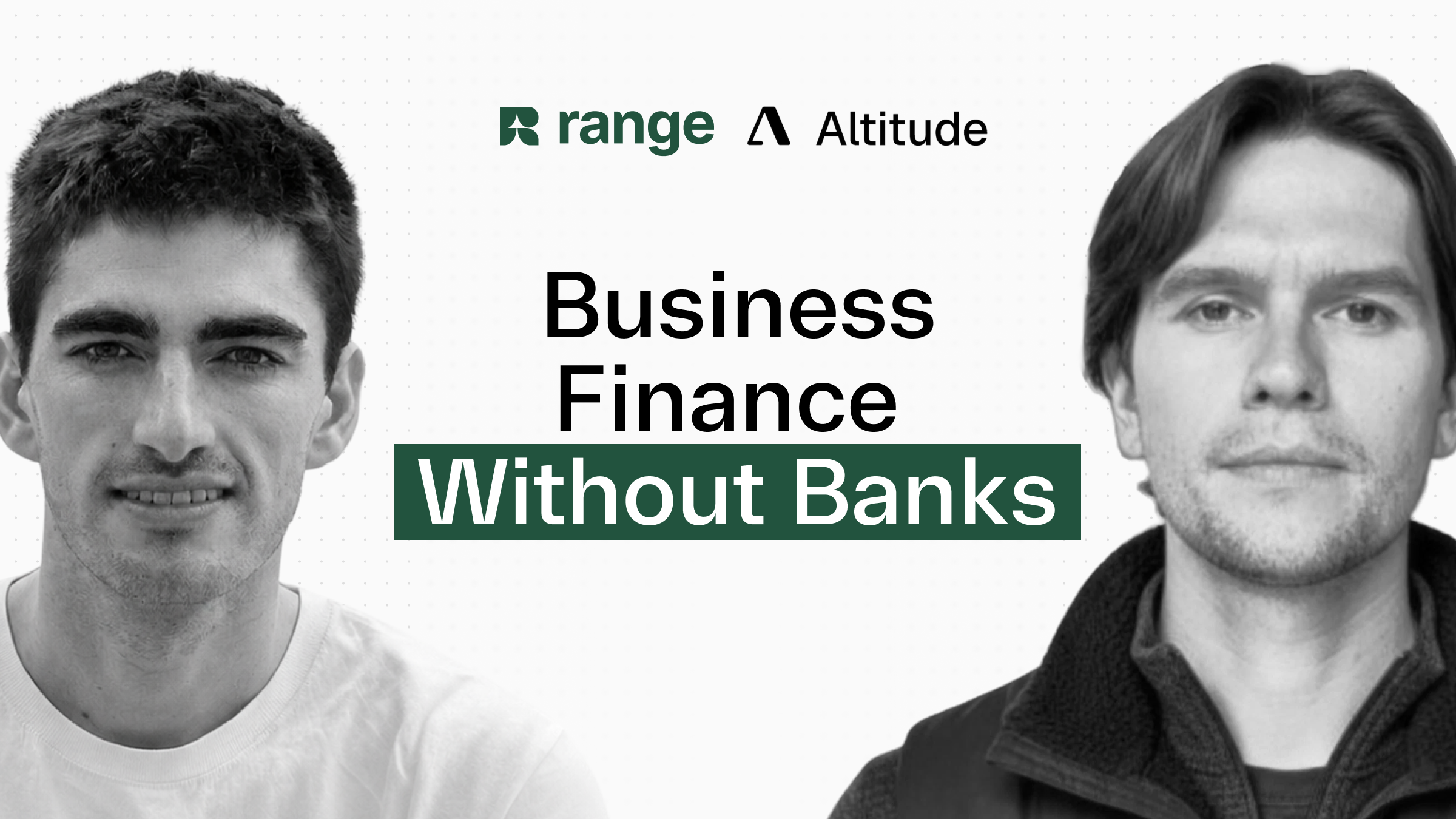
Squads has run its business on stablecoins since it started in 2021. That experience now shapes Altitude, its business account for managing payments and financial operations. Stepan Simkin, Co-Founder and CEO of Squads, joined Andres Monteoliva, Co-founder and CEO at Range, on Range Stablecoin Fireside to explain the choices behind it: self-custody, a balance held entirely on Solana and a gradual path toward letting agents move money.
For finance teams, separating balances from payment rails means tracking where money sits, how it moves and who can authorize each transaction. Range works on those requirements. We start with the regulatory and reporting requirements a company has to meet, translate them into transaction controls, orchestrate its existing risk and compliance providers, and run monitoring, reconciliation and reporting from one record across stablecoins and fiat.
Squads built Altitude around its own financial operations
Squads began in 2021 with governance tooling for the Solana ecosystem, then built widely adopted multisig infrastructure. The team came to see a multisig as one configuration of a programmable account, just as crypto was becoming the back end for financial services. Altitude grew out of that thinking.
The products share infrastructure but serve different needs. Squads Multisig secures large stablecoin or token treasuries and supports DeFi interactions. Altitude handles daily financial operations: payroll, accounts payable and receivable, and connections to a company's ERP. Altitude also onboards businesses that have nothing to do with crypto, because, as Stepan put it, "most businesses need to manage money."
Running Squads on stablecoins was not a statement of conviction. "It was purely operational", Stepan said. The founders held different passports and were unsure where to bank. Then "our investors at the time said, well, we can actually fund the stablecoins, and we just went with it."
The problems they encountered became Altitude's roadmap: spending from a stablecoin balance, reconciling onchain and offchain accounting records, and making bank transfers directly from the stablecoin treasury. The team solved them as infrastructure matured, including compliant banking connections and stablecoin-backed cards. For a business already holding stablecoins, those are concrete tests to put to a provider.
Banks move the money while businesses hold the balance
Andres put an old Bill Gates line to Stepan: "banking is necessary. Banks are not." Stepan sees that future approaching, though banks remain necessary while much of the world operates offchain. What has changed, in his account, is that programmable money makes it possible to "decouple the thing that makes the payments, which in some cases will be a bank, and the place that actually stores the money."
A business can hold programmable dollars in self-custody, using one bank for an international wire and another for a US domestic wire. Holding a usable balance no longer depends on first securing a banking relationship. Stepan was clear that "we still rely on banks when we actually need to make transfers, but I think the balance of power is shifting."
"So we wouldn't want to become a custodian", Stepan said, and Squads does not want to get its own charter and become a bank either. It is building a partner network of payment service providers, stablecoin orchestrators, newer banks and legacy banks. The goal is redundancy across US domestic rails, European rails and international wires. Those wires remain relevant in offshore jurisdictions without local digital payment systems.
Stepan described three stages of adoption. A wallet first holds stablecoins and connects to banks. The stablecoin sandwich then connects local payment systems, helping customers move money faster with lower FX fees. Eventually, businesses transact directly on stablecoin rails, with a euro transfer moving between Solana addresses. Much of that progress still centers on the dollar. For now, he said, most of those gains are wired to the dollar, and for a company building multicurrency accounts, "dollar alone will not get you there." A provider's coverage outside the dollar matters as much as its ability to connect to a bank.
Self-custody has to be verifiable
Self-custody carries emotional, philosophical and political weight in crypto, Stepan said. At Altitude, he treats it differently: "it's a supply chain advantage just like stablecoins themselves." For a business operating globally, the practical question is which problem the account solves. Stepan pointed to onboarding businesses from 150 countries as the real unlock.
When customers ask about the architecture, he makes two arguments. The first is that the money is in the customer's control: "there's no fractional reserves. The money is actually always there, and you can verify it." The second is that "it's all math and code", rather than paper promises or relationships. A customer can verify that the programmable system holding the asset exists and that the rules securing it are represented correctly. Open source once meant telling people to verify the code themselves, which most never did. With AI, he argued, a customer can now point a tool at the Squads code base and ask how it works.
Confidence also depends on the product, its compliance arrangements and the policies built into the infrastructure. Altitude's programmable system allows flexible controls for two-factor authentication and for transferring access when someone leaves the company. Securing your own keys used to be hard, and for many it still is. Programmability lets the team design those policies around what each customer needs, then build what the product or infrastructure requires to make them comfortable.
Evaluating a self-custodial account therefore means checking both the balance and the rules governing who can move it. That includes succession: a departing signer is a routine event for a finance team.
Owning the stack means keeping balances on Solana
Andres contrasted Squads with companies that build interfaces over another provider's infrastructure. Stepan gave three reasons for owning the stack. The first is security. Squads built the logic securing customer accounts, which lets it verify, including through formal verification, that the system works as intended. The second is product control: the closely connected product and protocol layers let Squads design policies around customer needs. "We don't need to wait for a provider to ship something", he said.
The third is agents. In traditional fintech, an API-first bank provides infrastructure to the companies above it. As agents take on more work, Stepan expects the layer providing accounts, payment processing and compliance directly to them to become more important. Squads Protocol would serve that role for stablecoins, holding accounts and moving money before it reaches other systems. Hence, in his words, "for us, it's very important to own the stack."
That choice comes with a constraint. The Solana virtual machine is not easily portable, so Squads cannot run across multiple chains: all balances will remain on Solana. Altitude can still receive payments from other blockchains and send payments to them. Stepan described the commitment as both a technical constraint and a bet on the people who kept building on Solana through its difficult years. Altitude does not need every asset, and Solana has plentiful stablecoins and RWAs for its needs.
Stepan expects newer chains to do well in time, but the team learned that "building blockchains that actually scale, that can actually serve a large part of the world economy is really hard", and he cannot bet the business on a chain still in active development. He was as skeptical of large incumbents: "the industry, particularly in crypto, is overestimating what the larger incumbents can meaningfully do with stablecoins." Banks and companies built on core banking APIs face considerable friction adopting infrastructure that upends a decade of their own work.
Agents earn control of company money in stages
Squads started narrow, with tasks it was comfortable deploying with real customers and real money. Altitude's agents already categorize transactions when an account syncs with accounting software and match receipts to card spending. They fully control those tasks, but they do not yet control funds.
Stepan expects a first automated accounts payable pilot by the end of 2026. It would operate under customer-defined policies: an expected invoice, a familiar recipient and an amount in the expected range. Customers would decide how much of the process to automate. Stepan described the sequencing as optionality first: an agent handles everything up to a point, the customer sets everything up and lets the agent automate it, or the agent runs the process completely end to end. The aim is enough flexibility that customers feel confident handing agents more of their financial operations. Squads is also experimenting with agents that buy software for a company, a use Stepan considers well suited to stablecoins and stablecoin-backed cards.
Insight comes first. Analysis that once took many people and engineering hours is now far more accessible, and in Stepan's words, "intelligence is your ramp to automation." Once customers trust those insights, the product can suggest automating recurring tasks. Longer term, Stepan said "our job is to remove all of that decision making" from whoever runs the account: the micro decisions about the right invoice, recipient, amount, timing and rail.
The same caution applies inside Squads. AI tools have raised the team's velocity, but in financial services, Stepan said, "you're dealing with people's money", so the faster process still carries reviews, tests and quality control. Before an agent moves funds, the business needs a policy covering known recipients, expected amounts and the point at which a person must approve. Recurring payables offer a starting point because the payment pattern is already known.
Controls for balances you hold and payments you route
Holding balances independently of banks gives finance teams more choices about how to route payments. Exercising those choices requires a record of every wallet, rail and counterparty, with policies that apply whether a person or an agent moves the money.
Range connects those controls to the records finance teams need: regulatory and audit requirements become transaction controls, existing risk and compliance providers work together, and monitoring, reconciliation and reporting draw on one record across stablecoins and fiat.
If you are moving financial operations onto stablecoin rails, talk to us: Request a sandbox
About Squads
Squads is a financial technology company building products and APIs for the stablecoin economy, including Squads Protocol, the smart account infrastructure on Solana that Squads Multisig is built on. Its business product, Altitude, is a global business account that brings payments, corporate cards and financial operations into one place, with stablecoin balances held in self-custodial wallets the customer controls. Learn more at squads.xyz.
Want to appear on Range Stablecoin Fireside? If you are building with stablecoins and want a seat on the show, get in touch by email or on X.
Related reading
Stablecoin Fireside
Copper: How institutions settle stablecoins in markets that never close
Stablecoin Fireside
National Bank of Canada: What it takes to bring stablecoins into banking
Stablecoin Fireside
Digital Sovereignty Alliance: Where stablecoin policy goes after GENIUS
Protect your time and money
Try every capability with your real data in a sandbox before you commit.