Copper: How institutions settle stablecoins in markets that never close
Adam VandenBoogaard, Head of Revenue, Americas at Copper, on keeping trading collateral in custody, governing stablecoin transfers and operating in markets that run 24/7.
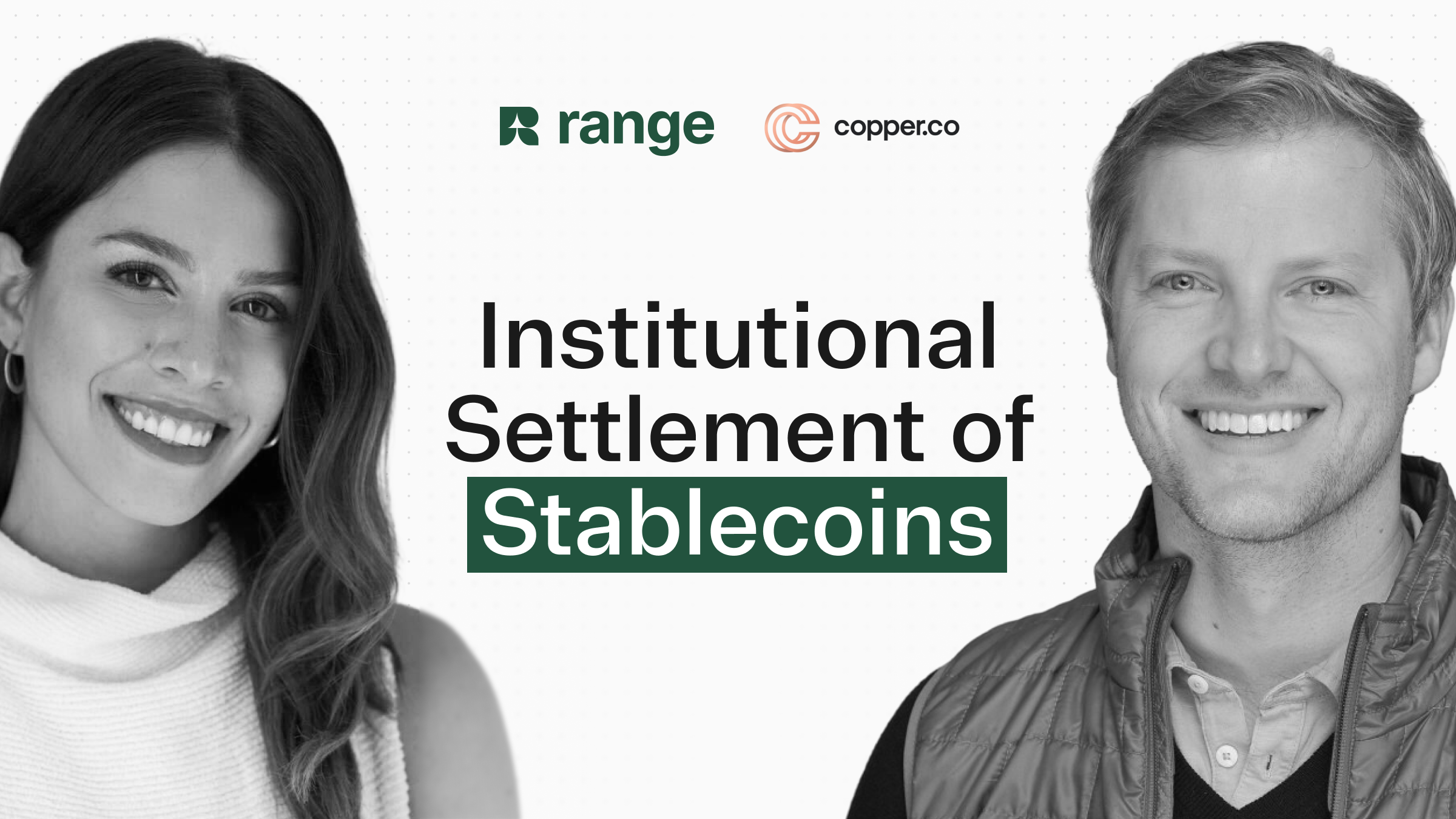
For an institution trading, settling or paying in stablecoins, round-the-clock availability raises an operational question: who controls the assets, and who responds when something needs attention outside banking hours? Adam VandenBoogaard, Head of Revenue, Americas at Copper, joined Paula Pettit, then VP of Strategy & Growth at Range, on Range Stablecoin Fireside to explain how institutions are answering it. Adam came to digital assets from the equity prime brokerage desk at Bank of America, after about twelve years as a naval flight officer. He described Copper as a global firm operating since 2018, with services spanning institutional custody, its ClearLoop off-exchange settlement network, staking and agency lending. In his words, "We're a provider of financial market infrastructure for blockchain based assets."
At Range, the platform for companies operating across stablecoins and fiat, we build the controls those operations need. We turn a company's regulatory and reporting requirements into transaction controls, orchestrate the custodians and risk and compliance providers it already uses, and run monitoring, reconciliation and reporting from one record.
Why institutions separated custody from trading
Copper serves many of the same types of clients Adam worked with at the bank: market makers, proprietary trading firms, hedge funds and asset managers. Most use several parts of the platform, from baseline custody to ClearLoop, depending on the use case. In traditional finance, Adam said, institutional clients had consistently sought digital asset exposure alongside familiar prime brokerage services such as financing and cross margin.
They were entering a market built around exchanges and individual investors. Adam said, "This started very much as a retail driven ecosystem." As asset managers, hedge funds and banks arrived, they brought demand for institutional-grade custody, liquidity, compliance and risk management.
Adam, who has been at Copper for about four and a half years, pointed to the algorithmic stablecoin depeg, the lending failures and the collapse of FTX as catalysts. In his account, they accelerated the separation of trading, custody and financing and pushed the industry toward traditional financial market standards. He identified the Bitcoin ETF in 2024 as another turning point, giving institutions a more familiar investment vehicle.
For institutions choosing providers, that separation is a practical decision: identify who holds your assets, who executes your trades and who provides financing. Where a trading venue also holds your assets, assess the concentration that creates.
Governance over how stablecoins move comes first
Adam used cash and stablecoins as synonyms, emphasizing the difference in availability. Stablecoins move around the clock, and he said people now ask, "why can't I move value just because it's nighttime, a weekend, or a holiday?" They already serve as the primary collateral and settlement asset across centralized exchanges and DeFi, with adoption spreading to cross-border payments, treasury management and settlement.
Asked what clients holding and moving stablecoins at scale need most, Adam called segregation imperative but rarely the top requirement on its own. Asset segregation and bankruptcy-remote structures remain foundational. Clients also need operational controls, liquidity access and oversight they can audit.
In Adam's words, "the highest priority for a lot of our clients is governance over the movement of funds." That means bank-grade controls, multi-level approvals, role-based permissions and dual authorization workflows, with a detailed record of each decision. As balances grow, he expects institutions to judge infrastructure on how well it delivers that combination.
Before moving volume, define who can initiate a transfer, who approves it, which thresholds require a second approver and where each decision is recorded. A custody model determines where assets sit; an approval policy determines who can move them.
How ClearLoop keeps trading collateral in custody
Trading venues and centralized exchanges usually require customers to prefund: assets move to a wallet controlled by the venue before trading begins. ClearLoop lets Copper's institutional clients trade on connected venues without first moving the underlying assets out of custody. Adam called it Copper's flagship offering and biggest differentiator, comparing it to third-party margin segregation in traditional finance.
The client maintains a direct bilateral relationship with the venue and trades on its order book. The assets remain in Copper's custody, while the client sees a virtual balance on each venue. Copper's infrastructure settles between client and exchange at fixed intervals determined by the exchange. Exchanges post collateral with Copper to cover clients' profit and loss exposure between settlement windows. ClearLoop was in market in 2020, and Adam said demand grew after FTX. As he put it, "It's counterparty risk mitigation." It also improves capital efficiency: clients no longer need separate pools of capital across venues and, as Adam said, "can deploy one capital pool" opportunistically.
Adam expects ClearLoop to expand into a broader network for institutional liquidity and collateral. He described support for more stablecoins and recognition of tokenized money market funds, tokenized treasuries and other real-world assets as collateral and settlement instruments. Deeper integration with prime brokers, market makers and liquidity providers is also part of that direction. Adam cited Copper's partnership with FalconX, which combines Copper's custody and ClearLoop infrastructure with FalconX's institutional credit and prime brokerage.
Before prefunding another venue, assess how much capital already sits on exchanges and what keeping it in custody would release.
One operating model for the Americas
Asked how the GENIUS Act and the OCC had changed the US picture, Adam described a shift in client conversations. Institutions previously asked how to access the ecosystem safely. With regulatory momentum and greater clarity around stablecoins, they increasingly take viability as a given and ask how to use them within an institutional framework. Stablecoins are becoming a form of digital cash in those discussions.
That brings governance, policy controls, reporting and Travel Rule compliance into the finance and risk management processes institutions already run. Adam said Copper expects capital markets to keep moving onchain, with adoption centered on custody, compliance and market infrastructure. He described Copper Markets (US) as Copper's US broker-dealer and qualified custodian, calling its launch a major step toward that goal.
Across Canada and Latin America, Adam said core client needs stay consistent, whether the client is a hedge fund in New York, a bank in Canada or a fintech in Brazil. They want secure custody, segregation, approval controls, regulatory compliance and management of counterparty and operational risk. Reporting obligations and licensing frameworks differ by jurisdiction. Copper treats those requirements as layers above a shared operating model. As Adam put it, "You don't want to have for clients a separate operating model or infrastructure for every country that they operate in."
Build shared controls once, then add each jurisdiction's requirements. Separate infrastructure for every country multiplies reconciliation and review work as the business enters new markets.
Markets that never close need controls first
Adam described a gradual progression from holding stablecoins to using them at scale. Institutions often begin with stablecoins as a cash equivalent or liquidity reserve for collateral management and treasury activity. As they become comfortable, they move into settlement between counterparties, drawn by round-the-clock availability, instant settlement and less reliance on banking hours. Supplier payments, cross-border disbursements and treasury management follow as usage expands.
The opportunity he considers underrated is in capital markets. Most people associate stablecoins with trading, payments or remittances, he said, but "maybe the larger opportunity is stablecoins as this universal collateral layer across financial markets." In that role, he expects stablecoins to become more and more of a capital efficiency tool.
For a head of treasury or digital assets establishing a stablecoin program, Adam's advice was to prepare the operating model. He said most institutions materially underestimate the shift from markets open eight to ten hours a day, five days a week, to markets that never close. Adam called it "really an operating model shift", because risk, treasury, collateral and operational events now occur around the clock. Processes built around market hours, settlement windows and bank cutoffs lose the buffers those constraints provided. Adam's recommendation was to "start with the controls and then focus on the use case."
Before launch, decide who responds to a margin call, failed settlement or flagged transfer at 3 a.m. on a Sunday, and what the systems enforce until that person acts.
Controls for institutions that operate around the clock
Institutional stablecoin programs answer to regulators, auditors and counterparties across every market they enter. Range turns those requirements into controls applied before money moves, orchestrates the custodians and risk and compliance providers you already use, and runs monitoring, reconciliation and reporting from one record across stablecoins and fiat, including when your people are offline.
If you are standing up a stablecoin program for markets that never close, talk to us: Request a sandbox
About Copper
Copper builds digital asset infrastructure for institutions, helping banks, asset managers, trading firms, exchanges and ETP providers custody, settle and move digital assets across markets. Its ClearLoop Network connects custodians, prime brokers and buy-side institutions with trading venues through one shared layer for settlement and collateral management, so firms can trade on connected venues while their assets stay in custody with Copper. In the US, Copper's services are offered by Copper Markets (US), Inc., an SEC-registered broker-dealer and FINRA member. Learn more at copper.co.
Want to appear on Range Stablecoin Fireside? If you are building with stablecoins and want a seat on the show, get in touch by email or on X.
Related reading
Stablecoin Fireside
Squads: Business finance on stablecoins, with banks at the edges
Stablecoin Fireside
National Bank of Canada: What it takes to bring stablecoins into banking
Stablecoin Fireside
Digital Sovereignty Alliance: Where stablecoin policy goes after GENIUS
Protect your time and money
Try every capability with your real data in a sandbox before you commit.