National Bank of Canada: What it takes to bring stablecoins into banking
Philippe Daoust, Managing Director of NAventures at National Bank of Canada, on getting fintechs through a bank's review, the risks behind Canada's stablecoin push and why customers may never see the rails they use.
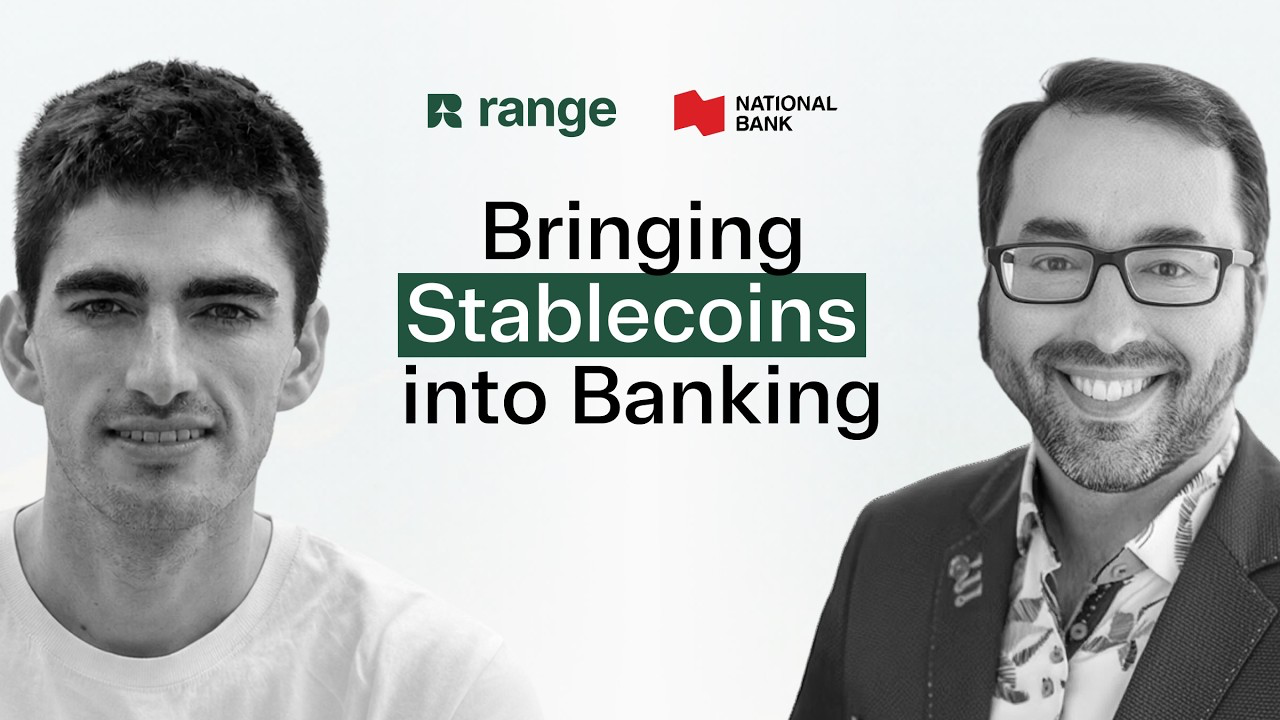
Before a bank buys from a fintech or moves money over stablecoins, its risk function needs visibility and its regulator needs to set the rules. Those requirements connected the conversation when Philippe Daoust, Managing Director of NAventures at National Bank of Canada, joined Andres Monteoliva, Co-founder and CEO at Range, on Range Stablecoin Fireside. Recorded live at Range Riserva in Lisbon, the discussion covered corporate venture investing, sponsor-bank failures and Canada's case for a domestic stablecoin. The views in this piece are Philippe's and are not presented as National Bank of Canada's official position.
The recurring question was what a regulated institution can see and prove. Range starts with a company's regulatory and reporting requirements, translates them into controls on each transaction, orchestrates the risk and compliance providers it already uses, and runs monitoring, reconciliation and reporting from one record across stablecoins and fiat.
A venture arm built to land inside the bank
When Philippe was asked to set up NAventures, he studied which corporate venture arms had succeeded and which had not. He distinguished pure investment arms, kept apart from the organization, from those aligned with the parent's strategy. In his words, "what I discovered is that those pure VCs tended to die very quickly." Strategically aligned arms lasted longer and had a larger effect on the organization.
"I want this corporate ventures to have maximum potential effect on the bank", Philippe said of his goal. He built NAventures to work closely with National Bank. By his count, it now has about 40 investments, and 80% have contracts or proofs of concept running with the bank.
Integration stops short of the purchase decision. Philippe described a deliberate separation between backing a company and buying from it: "if I propose your solution to the bank, it is going to come with who I believe is your two or three main competitor and then the business line is going to choose whoever they prefer." That habit, he said, has given NAventures a reputation inside the bank for finding the right companies instead of pushing its own investments.
If your organization both invests in vendors and buys from them, keep those two decisions with different people. Put each portfolio company next to its strongest alternatives, and let the business line that will run the product make the call.
What a fintech needs before a bank signs
Philippe said National Bank has been "bold enough to often be the first major clients of a Fintech", even when a company still needs work to be ready. "SOC two is obviously something that is extremely important for banks", he said. The bank has often signed a contract and run a proof of concept before a fintech completed SOC 2, then helped it get there. NAventures also helps its companies build what financial institutions need.
That first contract can help a fintech reach other institutions. Philippe described National Bank as Canada's sixth largest bank, at the upper end of the midrange by size. Other financial institutions know it takes risk requirements seriously, giving its vendors an entry into larger institutions. He added that when NAventures lists a company on its website, two or three competing investors call that company within the week.
Philippe also looks closely at the providers behind a fintech's compliance claims. Those companies usually rely on compliance providers built for fintechs, many of which he knows. "So this is the advantage of having a corporate venture is that I can go in and I know those companies", he said. When the provider is in his own portfolio, he knows the compliance behind it is serious. When he does not recognize it, he investigates.
For a fintech preparing for a bank's review, that means being ready to explain who provides its compliance checks and what each provider checks in the flow. SOC 2 preparation should start before the bank asks.
Embedded finance after the audit black box
Philippe framed the Synctera investment as a North American story, since Europe is developing differently. Embedded finance lets banks seeking deposits reach customers outside their home markets without massive marketing costs. National Bank, he said, is a super regional bank with a strong presence in Quebec but less reach across Canada. Several US banks face the same challenge.
Not long after the first investment in Synctera, embedded finance in the US went through a collapse. In 2022, regulators examined sponsor banks and found they were not meeting their obligations. Philippe described the model of that period from the fintech's side: "you the banking institution are going to come and audit me once a year, twice a year, but the rest of the year it was a black box."
Synctera, he said, was "built first for the risk department". National Bank's risk department could see information on any client on Synctera's platform at any time. When US auditors came in, all of Synctera's bank partners passed their audits. The wider market still suffered, and Philippe said recovery took about two or three years.
Asked whether failures such as Synapse made that model more important, Philippe said, "It is now very solid. It is now mainstream in The US." It is not yet mainstream in Canada. He sees two models thriving in the US: large banks offering banking as a service directly, and platforms connecting clients to several banks. For a program that depends on a sponsor bank, the operational requirement is continuous access for that bank's risk function. A scheduled audit should check information the bank can already see.
Why Canada needed its own stablecoin
Andres asked about Tetra Digital Group, which National Bank backed before Canada had a federal stablecoin framework. Philippe described Tetra as an example of smaller banks pushing the market forward, with Calgary-based ATB alongside National Bank. His group had advocated for digital assets inside the bank for years. It faced particular reluctance from a risk department that remembered criminals using Bitcoin to move money in its early years.
Two developments changed the conversation. Wealthsimple, which Philippe called the Robinhood of Canada, grew quickly in part by offering digital assets when banks did not. People seeking stablecoins or bitcoin had to go there. The US also had the GENIUS Act. As Philippe explained the reasoning behind the Tetra investment, Canada needed a Canadian stablecoin. "Otherwise, USDC is going to be the stablecoin by default for Canada because we're so close to the Americans."
His concern centered on deposits. Canadian businesses moving money in USDC would have little reason to convert it back, leaving balances outside Canadian dollars. Philippe said the Canadian government was concerned that 20 to 40% of Canadian deposits could move south of the border, seriously damaging the country's banking system. He attributed its push for a Canadian stablecoin to that risk.
Philippe had heard Southeast Asian central banks discuss a partnership on a panel in Asia, while Europe was already ahead with the euro. In his view, "there's one thing that Europe, Canada, Southeast Asia cannot miss, it's to be there at least at the same time as the American." He also sees a growing drive for national sovereignty that could bring companies back to Canadian dollar and euro stablecoins. For businesses settling in currencies other than the dollar, the question is where their flows default and where the resulting balances remain.
Regulation first, then rails customers never see
Philippe said everyday adoption starts with training executives who did not grow up with digital assets, then choosing use cases with clear value. International money movement comes first. Domestic payments face more resistance because the euro and Canadian dollar already work. Philippe's answer: "It's something you will do in the back end and your customer will never know about." As he put it, "Your customer doesn't care, he just wants to pay." Once executives understand stablecoins as underlying payment rails, he said, the discussion moves faster.
Asked about the main blocker for a bank like National Bank, Philippe answered: "Regulation. Regulation. Regulation. The regulator needs to move fast." Large financial institutions rarely move ahead of their regulator because they fear it will take a different route. He wants regulators in Europe and Canada to say what they will and will not allow, so everyone plays by the same rules, and expects that "as soon as you regulate, you will have financial institution following up."
On tokenized deposits, Philippe said Canada's six big banks will build a shared platform for tokenized deposits and digital assets, a route agreed with the government. That avoids each bank building a platform and then connecting it to the others. "That is going to make adoption way faster", he said. In the US, banks are pursuing their own platforms, with large banks trying to build groups around them. Philippe expects the winners to manage the most money and transactions, and to ensure stablecoins can be exchanged into fiat when they arrive in another country.
Asked where things could stand in eighteen months, Philippe gave a simple target: "we are all using digital assets, stablecoins without knowing it at all. And I think that would be a tremendous win for the market." If Europe and Canada reach that point, he believes they will be able to compete against USDC. "If we're not, we're going to be in major trouble." For a business moving a domestic flow onto stablecoin rails, that puts a practical question ahead of launch: where does each leg convert back into fiat, and who handles the exchange?
Controls a bank's risk function can see
Banks will move on stablecoins as fast as their regulators allow, and their risk functions will want a continuous view of every transaction once they do. Range builds for that requirement. We start with what regulators and auditors need to see, translate it into controls applied before money moves, orchestrate the risk and compliance providers a company already uses, and run monitoring, reconciliation and reporting from one record across wallets, accounts and counterparties.
If you are preparing a stablecoin program for a bank's review, talk to us: Request a sandbox
About National Bank of Canada
National Bank of Canada describes itself as one of the six largest banks in Canada and the leading one in Quebec. NAventures is its corporate venture capital arm, which aims to invest in, partner with and scale early to mid-stage companies that will shape the future of financial institutions. Learn more at nbc.ca.
Want to appear on Range Stablecoin Fireside? If you are building with stablecoins and want a seat on the show, get in touch by email or on X.
Related reading

Stablecoin Fireside
Copper: How institutions settle stablecoins in markets that never close
Stablecoin Fireside
Squads: Business finance on stablecoins, with banks at the edges

Stablecoin Fireside
Digital Sovereignty Alliance: Where stablecoin policy goes after GENIUS
Protect your time and money
Try every capability with your real data in a sandbox before you commit.