USDT0: Why the same dollar should move freely across chains
Lorenzo Romagnoli, Co-Founder of USDT0, on moving USDT across chains, choosing which networks to serve, and who benefits from stablecoins, agents and Tether Gold.
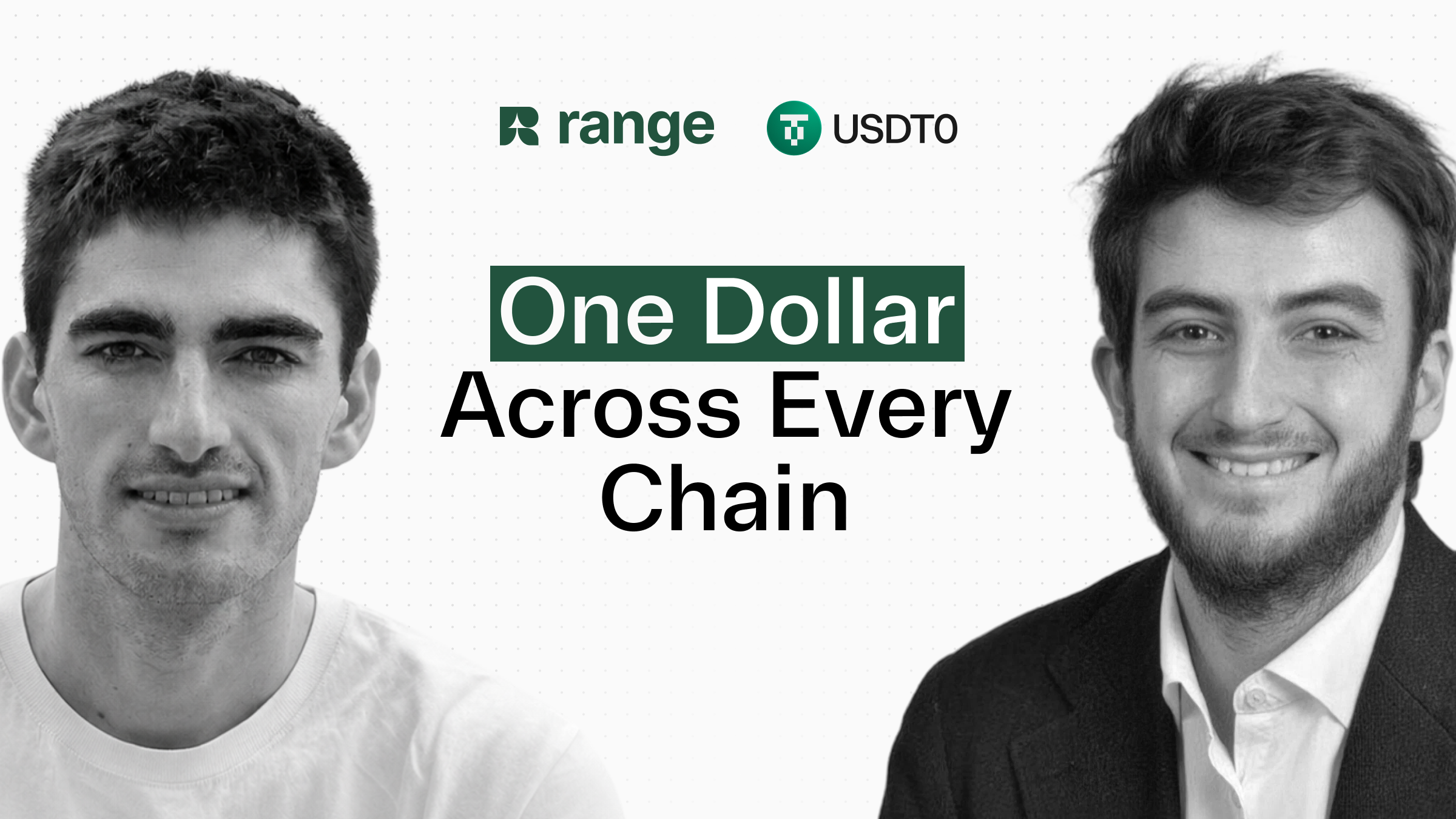
Merchants in Lugano have told Lorenzo Romagnoli, Co-Founder of USDT0, about customers who pay one invoice in USDT across several chains, after which the merchant loses the money and does not know what to do. That account, from the city where he lives, illustrates the problem USDT0 set out to solve: spending the same dollar still requires knowing which network holds it. Lorenzo joined Andres Monteoliva, Co-founder & CEO of Range, on Range Stablecoin Fireside to discuss USDT0, the omnichain form of Tether's USDT. His team had spent most of five years working in and out of Tether products. By the time the episode was recorded, he said, USDT0 had moved about $115 billion in less than two years.
At Range, the platform for companies operating across stablecoins and fiat, we build the controls that multichain operations depend on. We turn a company's regulatory and reporting requirements into transaction controls, orchestrate the risk and compliance providers it already uses, and run monitoring, reconciliation and reporting from one record across every network and bank account.
Why USDT needed one token across chains
Moving USDT between supported networks still meant relying on third-party bridges or centralized exchanges in 2025, Lorenzo said. His team pitched a fix to the rest of Tether and launched USDT0 that January. The goal was specific: apply newer interoperability technology to the most used stablecoin so users could move USDT between chains without fragmenting liquidity or trusting unfamiliar protocols.
Lorenzo said Tether has historically been conservative about new blockchains, with most USDT held on Tron and Ethereum. New chains seeking Tether's dollar now often approach USDT0, which he said can deploy faster and includes an interoperability layer.
Some of those chains have been live for only a month or a few months. The team weighs each deployment against the USDT that USDT0 already secures, and rejects chains even when demand and commercial terms are attractive. Lorenzo said: "We have a very high rejection rate." His assessment of the work was equally direct: "interoperability is the most dangerous thing anybody can touch and either you do it right or you shouldn't do it at all."
For a company accepting or holding stablecoins, the network belongs in the counterparty assessment. Check how long the chain has been live, how the token reached it and who answers if a bridge or contract fails. Set exposure limits accordingly.
The same dollar should not depend on its network
Andres described a problem he hears from institutional customers and finance teams: one asset represented in several forms across networks. Lorenzo's answer was direct: "It is the same asset and it shouldn't matter on which network you have your own money." Crypto-native users are accustomed to choosing a chain before sending money. For payment providers and point-of-sale systems, he said, that choice creates a serious problem.
The merchant accounts from Lugano show how that complexity reaches customers. By Lorenzo's count, around 300 shops in the city accept Bitcoin, USDT0 or USDT. He called the experience of losing a payment split across chains terrible, and said it is something the industry should fix to bring the next wave of people onchain.
Lorenzo described USDT0's approach in stages: "First, I'm trying to lay the railways down and then once we have the railways, we can start having trains going back and forth." Once that infrastructure exists, he said, others can build smart accounts and tools that automatically consolidate balances onto a single chain. USDT0 also works with centralized exchanges to help manage their large treasuries.
Until those tools are common, your team has to manage the complexity. Record balances by asset and network, agree on the receiving network with each counterparty, and assign a named owner to payments that arrive elsewhere. Resolve those exceptions before month-end.
Slow, permissionless transfers and shared liquidity
Lorenzo distinguished two approaches to interoperability. Intent-based solutions offer very fast transfers, sometimes with sub-second finality, for limited sizes. USDT0 serves a different need: he said USDT0's own transfers can take fifteen minutes or twelve hours, depending on the originating chain, and cost nothing beyond gas whether the amount is $10, $100 million or a billion dollars in a single permissionless transaction. For USDT on Tron, Ethereum and Solana, USDT0 operates the Legacy Mesh, a separate product Lorenzo described as more traditional bridging infrastructure. He said its monthly volume between Tron and Ethereum grew from less than $100 million to more than $1 billion.
Lorenzo expects the largest interoperability players to keep consolidating. He acknowledged his bias, since USDT0 is the largest application on LayerZero, but sees no sign of LayerZero's dominance in cross-chain messaging slipping. He pointed to large volume drivers such as Ethena and EtherFi, which use LayerZero's OFT standard, as USDT0 does.
Shared liquidity is another part of the model. Lorenzo said USDT0 "allows for new chains to not have to build their own liquidity pools of hundreds of millions of dollars". Even building a $50 million decentralized exchange pool is difficult in current conditions, he noted. Chains integrating USDT0 can draw on pools on Ethereum and other established networks, which he said lowers their costs, improves users' price execution and makes capital more efficient.
For finance teams, a twelve-hour transfer means a balance remains in transit for twelve hours. Record it as such, match the outgoing and incoming legs, and flag transfers that exceed their route's normal completion time. See how to track cross-chain transactions and bridge transfers for a walkthrough.
Who stablecoins are built for, and why the dollar leads
Lorenzo thinks the industry misunderstands who its product serves. USDT is so large, he said, because "stablecoins were not made for me and you." He can open a Swiss bank account in less than a day, he said. The people who use stablecoins most are in Latin America, Africa and Asia, where hundreds of millions remain outside the traditional financial system because banks cannot make enough money serving them.
For someone in Tanzania, Turkey or Nigeria, he said, a year of work can leave them with more money but less purchasing power. "You're just trying to get access to a lifeboat. And for many people, this lifeboat is the US dollar." Accessing dollars without stablecoins is difficult, and USDT's distribution has made it easier. That explains Lorenzo's skepticism about stablecoins denominated in anything other than the dollar, with one exception: Tether Gold.
He expects more stablecoins to emerge, pointing to PayPal and USDG. Acknowledging his bias, he expects Tether's dominance to grow. Tether spent, he thought, six or seven years without making money while it built its distribution network. Its users, he said, are difficult to move. Even persuading them to shift USDT from Tron to Ethereum is hard, let alone to adopt a stablecoin they do not know or trust.
If your company pays or collects from customers in those markets, expect USDT on the networks those customers already use. Build acceptance, screening and reconciliation around what your counterparties hold.
Agents, arbitrage and Tether Gold
Lorenzo remains undecided about how agents will pay. Sometimes he sees stablecoins as their only way to move money; at other times, he expects agents to use the existing financial system. Either way, he anticipates millions of agents paying each other and paying for what they use. As he put it, "funnily enough, an agent and a human are not that different". USDT0's products are fully permissionless, and he said bots arbitraging USDT prices between chains already account for a good share of its volume.
He recalled claims on X that USDT0's volume was botted. Hedge fund bots were moving large sums between Unichain, Arbitrum and Polygon to capture arbitrage worth a few hundred dollars. Lorenzo saw that as a financial market working as it should: removing barriers lets arbitrage close price gaps. Education is the constraint he sees. He cited a hedge fund that avoided putting USDT to work on Arbitrum because moving it required fees or an exchange deposit it did not trust. The fund had never found time to investigate USDT0.
Lorenzo calls himself a big Tether Gold bull. "I think Tether gold will do to gold what Tether did to the US dollar, which is democratizing access to it." He said Tether Gold on chains such as Solana, Avalanche and BNB Chain is powered by USDT0, and noted that Tron is a different technology. He estimated that buying gold through his bank would cost up to 75 basis points each way. With Tether Gold, he can hold a token representing one ounce of gold in a Swiss vault, divide it and use it as collateral onchain. His goal for USDT in 2027 is similarly practical: "I wanna be able to go around and give USDT to basically everyone on any chain".
Automated flows need the same controls as human ones. Define normal activity for each wallet, set limits on transaction size and frequency, and review exceptions against one record. What agentic payments change about stablecoin reconciliation explains the implications for month-end.
Control every chain your dollars move on
Multichain stablecoin operations answer to the same regulators, auditors and counterparties as the rest of the business. Range turns those requirements into controls applied before money moves, orchestrates the risk and compliance providers you already use, and runs monitoring, reconciliation and reporting from one record across stablecoins, networks and fiat. If your team holds or moves stablecoins on more than one chain, talk to us: Request a sandbox
About USDT0
USDT0 is the omnichain form of Tether's USDT, built by Everdawn Labs on LayerZero's Omnichain Fungible Token (OFT) standard. Every USDT0 is backed one-to-one by USDT locked in a smart contract on Ethereum. The network launched in January 2025 and, as of November 2026, connects more than 25 chains, with its Legacy Mesh linking existing USDT deployments on networks such as Tron, TON and Solana.
Want to appear on Range Stablecoin Fireside? If you are building with stablecoins and want a seat on the show, get in touch by email or on X.
Related reading
Stablecoin Fireside
Bison Bank: Issuing stablecoins from inside a regulated bank
Stablecoin Fireside
Copper: How institutions settle stablecoins in markets that never close
Stablecoin Fireside
Squads: Business finance on stablecoins, with banks at the edges
Protect your time and money
In 30 minutes, we'll show you where Range fits.